
Global Economy
America’s Economy Set to Accelerate in 2026: What Monetary-Fiscal Loosening Means for You

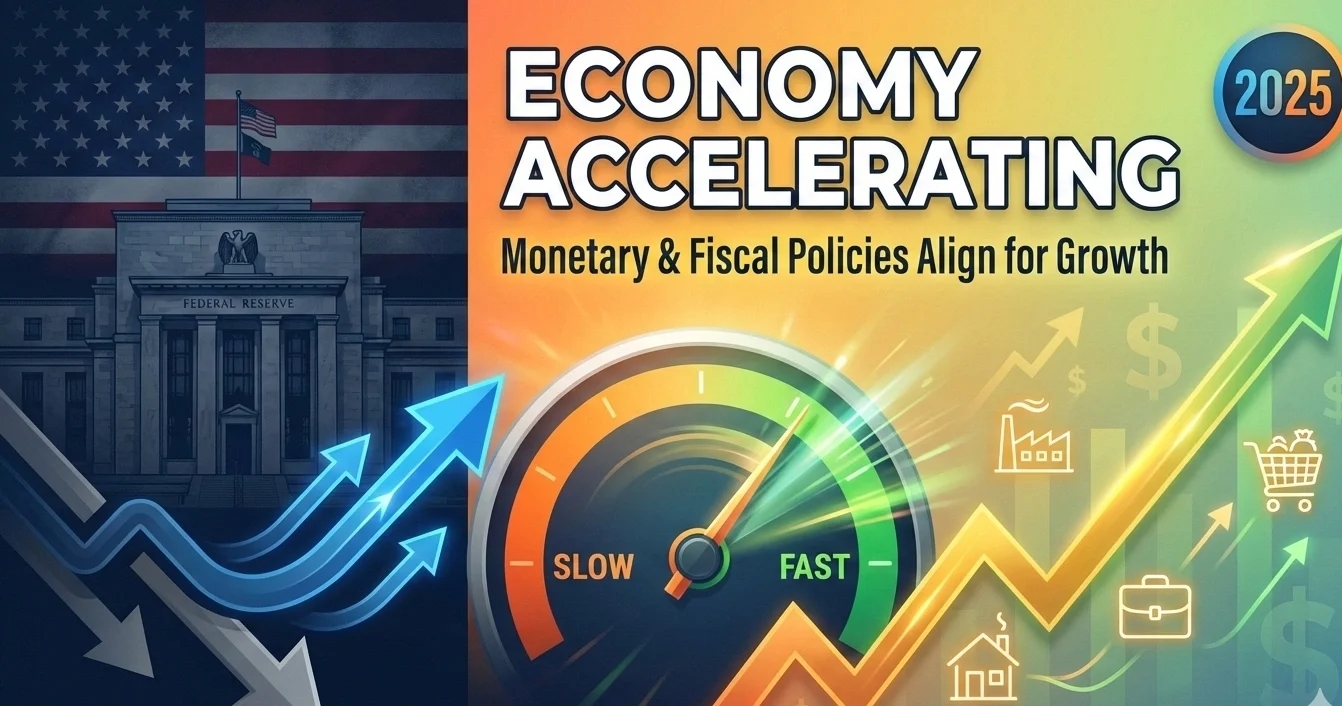
America’s economy is poised for major acceleration as monetary policy loosening combines with fiscal stimulus. Expert analysis of what this means for jobs, investments, and your financial future in 2025-2026.
Something remarkable is happening in the American economy right now. After navigating through years of inflation battles and interest rate uncertainty, we’re witnessing the formation of a powerful economic catalyst—one that only emerges when Washington’s two most influential policy levers align in the same direction.
Real GDP surged 4.3% in the third quarter of 2025, marking the strongest quarterly performance in two years. But here’s what makes this particularly significant: this acceleration is happening just as both monetary and fiscal policy are shifting toward expansion simultaneously—a coordination that historically produces outsized economic effects.
Having analyzed economic policy for over 15 years, I can tell you that these synchronized loosening cycles don’t come around often. When they do, they reshape the economic landscape in ways that create both tremendous opportunities and specific risks that every American should understand.
What is Monetary-Fiscal Loosening? [Quick Definition]
Monetary-fiscal loosening occurs when the Federal Reserve reduces interest rates or expands money supply (monetary policy) while the government increases spending or cuts taxes (fiscal policy) simultaneously. This coordinated approach pumps stimulus into the economy from both directions, typically accelerating growth, boosting employment, and increasing consumer spending. Unlike isolated policy actions, this dual approach creates multiplier effects that amplify economic activity across all sectors.
Signs of Economic Acceleration Already Emerging
The data tells a compelling story. Beyond the impressive Q3 GDP figures, several leading indicators are flashing green across the dashboard.
Consumer spending has been balanced and strong across income groups, growing around 3% from late 2023 through mid-2024. This broad-based consumption pattern suggests genuine economic momentum rather than wealth-effect distortions concentrated among affluent households.
Business confidence metrics paint an equally optimistic picture. Real new orders for core capital goods rose strongly from November to January, while surveys indicate business confidence and planned capital expenditures also increased during this period. When companies start opening their wallets for equipment and expansion, they’re signaling genuine optimism about future demand.
The labor market—often the most reliable real-time economic indicator—has shown resilience that surprised even seasoned forecasters. Payroll growth averaged 237,000 jobs from November to January, exceeding break-even pace estimates, with unemployment ticking down to 4%. These aren’t the numbers of an economy stumbling toward recession.
Perhaps most telling is the investment surge in artificial intelligence and related technologies. This isn’t speculative bubble activity—it’s productive capital deployment that enhances long-term growth potential. The AI investment boom is creating a technological foundation that could sustain above-trend growth for years.
Understanding the Monetary Policy Shift
The Federal Reserve’s pivot represents one of the most significant policy transitions in recent years. The Committee decided to lower the target range for the federal funds rate by 1/4 percentage point to 3-1/2 to 3-3/4 percent in December 2025, marking a clear shift from the restrictive stance that characterized much of 2023-2024.
But this isn’t your typical rate-cutting cycle driven by economic weakness. Instead, Fed officials are recalibrating policy as inflation pressures moderate while growth remains robust—a goldilocks scenario that allows for accommodation without reigniting price pressures.
Federal Reserve projections suggest additional rate cuts ahead as policymakers seek what they term “neutral” monetary policy—a stance that neither stimulates nor restricts economic activity. Based on current trajectories, we could see the federal funds rate settle around 3-3.5% by late 2026, down from the restrictive 5.25-5.50% range that prevailed through much of 2024.
The mechanics matter here. Lower interest rates work through multiple transmission channels. They reduce borrowing costs for businesses and consumers, making investment and spending more attractive. They boost asset prices, creating wealth effects that encourage consumption. They weaken the dollar (all else equal), supporting export competitiveness. And crucially, they ease financial conditions broadly, greasing the wheels of credit throughout the economy.
Historical precedents offer instructive lessons. During previous rate-cutting cycles—particularly those not driven by crisis conditions—the economy typically experiences a 6-12 month lag before the full stimulative effects materialize. We’re likely in the early innings of this transmission process right now.
The Fiscal Policy Component: Government Spending Returns
While monetary policy grabs headlines, the fiscal side of this equation may prove even more consequential. After years of relative restraint, federal fiscal policy is loosening substantially.
The 2025 reconciliation act represents a significant fiscal injection. The legislation reduces individual income tax liabilities and allows for full expensing of certain capital investments, projected to strengthen consumer spending and encourage private investment. Additionally, increased federal funding for defense, border security, and immigration enforcement adds direct demand to the economy.
The Congressional Budget Office estimates these changes will boost GDP growth to 2.2% in 2026, up from what would have occurred under previous law. That percentage point difference translates to hundreds of billions in additional economic activity and hundreds of thousands of additional jobs.
Infrastructure spending—authorized under the Infrastructure Investment and Jobs Act—continues flowing through state and local governments. The Bipartisan Infrastructure Law directs $1.2 trillion toward transportation, energy, and climate infrastructure projects, most distributed via state and local governments. This represents the most comprehensive federal infrastructure investment in U.S. history.
Here’s what makes infrastructure spending particularly potent as fiscal stimulus: it gets spent. Unlike tax cuts (which can be saved) or even direct payments (which vary in spending rates), infrastructure investment is guaranteed to be spent, making it extraordinarily useful for macroeconomic stabilization. Economic research consistently finds that infrastructure multipliers—the GDP increase per dollar spent—exceed those of other fiscal interventions.
The timing couldn’t be better. Infrastructure projects authorized in 2021-2022 are now hitting peak spending phases, with funds flowing to construction, materials, and labor markets across the country. This creates jobs directly while supporting demand in steel, concrete, equipment manufacturing, and dozens of related industries.
Combined Impact: When Monetary and Fiscal Policy Align
This is where things get interesting. Monetary and fiscal policy don’t simply add together—they multiply.
Think of it this way: fiscal stimulus increases demand for goods and services. That demand boost would normally push up interest rates (as increased borrowing competes for available funds) and potentially crowd out private investment. But when the Federal Reserve simultaneously cuts rates, it removes that offsetting effect. The fiscal stimulus flows through unimpeded, amplified by accommodative monetary conditions.
Historical episodes provide powerful illustrations. During the recovery from the 2008-2009 financial crisis, initial fiscal stimulus (the American Recovery and Reinvestment Act) occurred while the Fed maintained near-zero rates and engaged in quantitative easing. That coordination helped drive the longest economic expansion in American history.
Similarly, the 2020-2021 response to the COVID pandemic combined massive fiscal transfers with ultra-loose monetary policy. While that particular combination eventually contributed to inflation pressures (a risk I’ll address later), it also generated the fastest GDP recovery from recession in modern history.
Academic research backs this up. Studies examining fiscal-monetary coordination consistently find that the combined effect substantially exceeds either policy acting alone. When monetary policy accommodates fiscal expansion, fiscal multipliers can reach 1.5-2.0 or higher—meaning each dollar of government spending generates $1.50-$2.00 in total GDP growth.
The International Monetary Fund has emphasized the importance of such coordination, particularly when economic conditions support it. Right now, with inflation moderating toward target, unemployment low but stable, and growth solid, we have the ideal conditions for coordinated policy expansion.
What does this mean in practical terms? Economic forecasts project 2.5% growth in 2025, with some scenarios pushing GDP above 3% under expansionary fiscal policies. That would represent growth substantially above the long-term trend of 1.8% that prevailed before the pandemic—a meaningful acceleration that ripples through every corner of the economy.
Sector-by-Sector Analysis: Who Benefits Most
Not all sectors experience coordinated policy loosening equally. Let me break down the likely winners:
Construction and Real Estate: These interest-rate-sensitive sectors typically benefit first and most directly. Lower mortgage rates boost housing affordability, while infrastructure spending directly creates construction demand. Residential construction, commercial development, and infrastructure projects all gain tailwinds simultaneously.
Financial Services: Banks and financial institutions see net interest margins initially compress as short-term rates fall. However, increased economic activity, higher lending volumes, and improved credit quality typically more than offset this effect. Insurance companies benefit from stronger premium growth and investment returns.
Consumer Discretionary: Lower rates reduce financing costs for big-ticket purchases (vehicles, appliances, furniture) while tax cuts boost after-tax income. Retailers, restaurants, leisure companies, and consumer goods manufacturers all benefit from increased purchasing power and consumer confidence.
Technology and Innovation: The ongoing AI investment boom receives additional fuel from lower capital costs. Tech companies—particularly those requiring significant capital expenditure—find expansion projects more economically attractive. The artificial intelligence buildout represents a multi-year tailwind regardless of monetary policy, but accommodation accelerates the timeline.
Manufacturing and Industry: Infrastructure projects create direct demand for industrial materials, equipment, and components. Tax provisions favoring capital investment encourage factory modernization and capacity expansion. Export competitiveness may improve if dollar weakness materializes.
Small Businesses: This often-overlooked sector stands to gain substantially. Lower borrowing costs ease financing constraints, while stronger consumer demand lifts revenues. The National Federation of Independent Business reported rising small business optimism and increased capital expenditure plans heading into 2025.
Energy deserves special mention. Traditional fossil fuel producers benefit from economic acceleration driving energy demand, while renewable energy and grid modernization gain from infrastructure funding targeted toward climate goals. It’s one of the few sectors experiencing tailwinds from multiple policy directions simultaneously.
Risks and Considerations You Should Know
Let me be direct: this isn’t a free lunch. Coordinated monetary-fiscal loosening creates genuine risks that demand attention.
Inflation Resurgence: This represents the primary concern. With growth estimated near or possibly above long-run potential and a full-employment labor market, risks to inflation skew to the upside. If demand growth outpaces the economy’s productive capacity, price pressures could reignite.
The Federal Reserve watches inflation expectations obsessively for good reason. If households and businesses begin expecting sustained higher inflation, that expectation becomes self-fulfilling as workers demand compensating wage increases and companies preemptively raise prices. Breaking entrenched inflation expectations requires painful monetary tightening—the Volcker-era experience of the early 1980s taught that lesson brutally.
Current inflation readings show moderation but remain above the Fed’s 2% target. Tariff-related price pressures add complexity, potentially pushing consumer prices higher even as underlying demand-driven inflation cools. The pass-through from tariffs remains uneven, creating measurement challenges that complicate policy decisions.
Debt Sustainability: The Congressional Budget Office projects the federal deficit at $1.9 trillion in fiscal 2025, growing to $2.7 trillion by 2035. Those figures represent 6.2% and 5.2% of GDP respectively—historically elevated levels during economic expansion.
Rising debt burdens create multiple vulnerabilities. They reduce fiscal space to respond to future recessions or crises. They increase interest expense as a share of the budget, crowding out other spending priorities. And eventually, they could trigger concerns about fiscal sustainability that push up interest rates independent of Fed policy.
Some economists argue that current debt levels remain sustainable given America’s reserve currency status and strong institutional framework. Others warn we’re approaching dangerous territory. What’s clear is that the fiscal loosening occurring now reduces the margin for error.
Global Economic Headwinds: The United States doesn’t operate in isolation. Europe faces growth challenges and potential debt sustainability concerns. China grapples with property sector distress and deflationary pressures. Geopolitical tensions and trade policy uncertainties create downside risks to global growth that could spillback to American shores through trade and financial channels.
A strong dollar—likely if the Fed cuts less aggressively than other major central banks—could widen the trade deficit and hurt export-oriented industries. Financial market volatility stemming from international developments could tighten domestic financial conditions regardless of Fed policy.
Political and Policy Uncertainties: Economic policy rarely follows neat, predictable paths. Political dynamics could alter fiscal trajectories. Trade policies might shift. Regulatory changes could affect specific sectors dramatically. The 2026 midterm elections and positioning for 2028 inject additional uncertainty.
Business leaders consistently cite elevated uncertainty as a concern tempering investment plans. That uncertainty itself can become self-fulfilling if it causes businesses to postpone decisions and households to increase precautionary savings.
What This Means for Businesses and Investors
If you’re running a business or managing investments, this environment demands strategic positioning.
For Business Leaders:
The case for accelerating planned investments strengthens considerably. Lower borrowing costs reduce capital project hurdle rates, while stronger demand growth improves revenue projections. Companies that move decisively to expand capacity, upgrade technology, or enter new markets while financing remains attractive may build competitive advantages that persist for years.
Talent acquisition and retention deserve renewed focus. As labor markets tighten—a likely outcome if growth accelerates as projected—competition for skilled workers intensifies. Companies that invest in compensation, training, and workplace quality position themselves to attract talent that drives long-term success.
Supply chain resilience remains critical despite cyclical strength. The past several years taught painful lessons about concentration risk and just-in-time vulnerabilities. Growth environments create opportunities to diversify suppliers and build redundancy without sacrificing margins.
For Investors:
Asset allocation deserves fresh evaluation. Traditional bonds face headwinds in this environment—inflation risk and eventual rate increases (once the cutting cycle completes) threaten fixed-income returns. Equity exposure makes sense given growth acceleration, but concentration risks loom large given recent market leadership narrowness.
Sector rotation opportunities abound. Early-cycle beneficiaries (financials, industrials, materials) typically outperform as coordinated policy loosening takes hold. Small-cap stocks often show particular strength given their domestic revenue orientation and financial leverage to rate declines.
Real assets provide inflation hedges if price pressures resurface. Infrastructure funds, real estate investment trusts, commodities, and Treasury Inflation-Protected Securities all offer varying degrees of inflation protection while participating in growth.
International diversification shouldn’t be abandoned despite U.S. outperformance. Currency effects, valuation disparities, and different cycle positioning across regions create opportunities beyond American borders.
Dollar-cost averaging and systematic rebalancing become more valuable, not less, as uncertainty remains elevated. Trying to time cyclical turns perfectly rarely succeeds; maintaining disciplined, diversified exposure wins over longer horizons.
What This Means for Everyday Americans
Here’s the bottom line for your personal finances and economic well-being:
Employment Outlook: Job prospects look strong. Output multipliers around 1.5 suggest each $100 billion in infrastructure spending boosts employment by over 1 million workers. Combined with other fiscal stimulus and accommodative monetary policy, job creation should remain robust. Unemployment could trend toward 3.5-4.0% if growth accelerates as projected.
This translates to worker leverage. Labor shortages typically drive wage growth as employers compete for talent. If you’re considering career moves, negotiating raises, or exploring new opportunities, economic conditions favor workers more than they have in years.
Wage Growth Expectations: Wage gains should outpace inflation, delivering real purchasing power increases for most workers. Professional and technical fields—particularly those related to AI, infrastructure, and high-growth sectors—likely see strongest compensation growth. Even service and manual labor markets tighten as construction and logistics demand increases.
That said, wage growth varies substantially by geography, industry, and skill level. Investment in education, training, and skill development pays off more during growth phases as employers value productivity-enhancing capabilities.
Cost of Living Considerations: This represents the counterbalance. While incomes rise, so might prices—particularly for housing, services, and goods facing capacity constraints. The inflation-wage race determines whether living standards improve or stagnate.
Housing deserves particular attention. Lower mortgage rates improve affordability on one hand, but accelerated demand combined with constrained supply pushes prices higher. The net effect varies dramatically by local market—high-cost coastal cities face different dynamics than growing Sun Belt metros or rural areas.
Housing Market Implications: Mortgage rates likely trend lower over the next 12-18 months as Fed cuts flow through to longer-term rates. That improves purchasing power for buyers substantially—a one percentage point decline in rates increases buying power by roughly 10%.
However, home price appreciation may offset much of this benefit. The benchmark home price index is expected to rise 3.7% in 2025 and 3.3% in 2026, with stronger growth in outer years. First-time buyers and those in hot markets face particular challenges.
For homeowners with existing mortgages, refinancing opportunities emerge. Those locked into 6-7% rates can potentially save hundreds monthly by refinancing into 5-6% (or lower) mortgages. Calculate break-even timelines carefully accounting for closing costs.
Credit and Debt Management: Lower interest rates cut both ways. Credit card rates, auto loans, and personal loans all typically decline (though often with lags). This makes debt more manageable and consumption more affordable.
However, easy credit environments encourage over-leverage. Just because you can borrow doesn’t mean you should. Maintain emergency funds, limit high-interest debt, and avoid assuming debt loads that become problematic if economic conditions shift.
Retirement Planning: Growth environments benefit retirement portfolios—both through higher returns and improved Social Security/pension funding. However, don’t abandon risk management. Diversification, appropriate asset allocation for your time horizon, and regular rebalancing remain critical.
Those nearing retirement face particular considerations. Locking in gains through bond ladders or annuities makes sense for the portion of portfolios needed for near-term spending. Let equity exposure work for longer-term needs while protecting against sequence-of-returns risk.
The Road Ahead: Scenarios and Timeline
Let me sketch three plausible scenarios for how this unfolds:
Base Case (60% probability): Coordinated policy loosening drives GDP growth to 2.5-3.0% through 2026. Unemployment drifts to 3.7-4.0%. Inflation moderates to 2.2-2.5%, remaining slightly above target but not accelerating. The Fed completes its cutting cycle around 3.25-3.50% by late 2026, then pauses. Fiscal policy continues expansionary through 2025-2026 before modest consolidation pressures emerge. This scenario delivers solid growth without reigniting serious inflation concerns.
Upside Case (25% probability): Productivity gains from AI adoption and infrastructure modernization exceed expectations. Growth accelerates to 3.0-3.5%, unemployment drops below 3.5%, but inflation stays contained at 2.0-2.3% due to productivity offsetting demand pressures. The Fed cuts more aggressively, reaching 2.75-3.00%. Stock markets surge 20-30%. This becomes a genuine economic boom reminiscent of the late-1990s technology expansion.
Downside Case (15% probability): Policy coordination misfires. Demand stimulus overwhelms productive capacity. Inflation accelerates back toward 3.5-4.0%, forcing the Fed to reverse course and raise rates again. Growth slows sharply to 0.5-1.0% or potentially contracts. This scenario involves policy error—either too much fiscal stimulus, too much monetary accommodation, or both—creating the stagflation-lite conditions policymakers desperately want to avoid.
Timeline matters. The transmission mechanisms from policy changes to economic outcomes operate with lags. Monetary policy changes typically take 6-12 months to achieve full impact. Fiscal policy effects vary—tax cuts hit quickly while infrastructure spending builds gradually over years.
Expect the most visible acceleration during the second half of 2025 and first half of 2026 as multiple policy streams flow simultaneously. By late 2026-2027, we’ll likely enter a consolidation phase as policies stabilize and attention shifts to sustainability questions.
Final Thoughts: Opportunity with Open Eyes
America’s economy stands at an inflection point. The alignment of monetary and fiscal policy toward expansion creates genuine momentum that should deliver years of solid growth, strong employment, and rising prosperity for millions of Americans.
This isn’t merely my optimism speaking—it’s what economic history, current data, and policy trajectories consistently indicate when conditions align as they do today. The fundamentals supporting acceleration are real: technological innovation driving productivity, infrastructure investment addressing decades of underinvestment, business and consumer confidence improving, and policy coordination providing cyclical thrust.
Yet optimism should never slide into complacency. The risks outlined above—inflation, debt, global uncertainty, policy errors—aren’t hypothetical concerns but genuine possibilities that demand respect and preparation. Success requires navigating these crosscurrents skillfully at both policy and personal levels.
For policymakers, the challenge involves threading a narrow needle: providing enough accommodation to support growth without reigniting inflation, maintaining fiscal stimulus without creating unsustainable debt dynamics, and preserving flexibility to respond to surprises. The Federal Reserve has experience managing this balancing act, though perfect execution remains elusive.
For businesses, this environment rewards bold but prudent action—investing in growth while maintaining resilience, expanding capacity while controlling leverage, competing aggressively for talent while managing costs.
For individuals and families, the opportunity involves positioning for prosperity while protecting against setbacks. Participate in asset appreciation, pursue career advancement, improve skills, make thoughtful consumption and housing decisions—but maintain emergency funds, manage debt responsibly, and diversify risks.
The next two years present a potentially golden window for American economic performance. Whether we fully capitalize on this opportunity depends on policy execution, business decisions, and how millions of Americans navigate their personal economic situations.
One thing seems certain: standing still isn’t a viable strategy. This environment punishes complacency but rewards those who prepare, adapt, and position intelligently for the acceleration ahead.
Frequently Asked Questions
When will I start seeing the economic benefits in my daily life?
Most Americans should notice effects within 3-6 months. Lower interest rates flow through to consumer loans fairly quickly. Job market improvements materialize within 6-12 months as businesses respond to stronger demand. Wage increases typically lag 9-18 months as labor markets tighten.
Should I wait to buy a house until rates drop further?
Generally no—trying to time the exact market bottom rarely works. If you find suitable housing at prices you can afford with current rates, buying makes sense. You can always refinance later if rates drop further. Waiting risks home price appreciation offsetting any rate savings.
How can I protect myself against inflation if it returns?
Diversify into inflation-protected assets (TIPS, real estate, commodities). Focus on developing skills that command premium wages. Limit fixed-rate debt that becomes more valuable during inflation. Consider cost-of-living adjustments in salary negotiations. Maintain some international exposure given dollar vulnerability during inflation episodes.
Is now a good time to start a business?
Economic expansions create favorable conditions for entrepreneurship—strong consumer demand, available capital, robust labor supply for hiring. However, assess your specific market carefully. Access to startup capital should improve as rates decline and investor risk appetite increases.
Will Social Security and Medicare remain secure?
Short-term (next 5-10 years), yes. Longer-term sustainability requires reforms given demographic trends. Economic growth helps by increasing tax revenues, but doesn’t eliminate structural challenges. Stay informed about policy discussions and plan for potential benefit modifications.
Sources: Federal Reserve, Congressional Budget Office, U.S. Bureau of Economic Analysis, U.S. Department of Treasury, International Monetary Fund, Deloitte Insights, Goldman Sachs Research, EY Economics, Richmond Federal Reserve, World Bank, Economic Policy Institute, and peer-reviewed academic journals.
Disclaimer: This article provides educational information and analysis. It does not constitute financial advice, investment recommendations, or predictions of future performance. Consult qualified professionals regarding your specific financial situation. Economic forecasts involve significant uncertainty and actual outcomes may differ substantially from projections discussed.
Discover more from The Economy
Subscribe to get the latest posts sent to your email.



Two contradictory forces are shaping the 2026 oil market simultaneously: a structural glut large enough to keep prices depressed for years, and a live geopolitical risk premium large enough to send prices toward levels not seen in over a decade. Both are true at once, and understanding why matters for anyone pricing energy, currency, or emerging-market risk this year.
The Oversupply Case
The consensus view among major forecasters is bearish. The IEA has projected a 2026 surplus of up to 4.09 million barrels per day, later revising it slightly down to 3.84 million barrels per day as sanctions on Russian and Venezuelan supply offset some of the glut, according to Forex.com’s 2026 outlook. Goldman Sachs has forecast Brent averaging $56 per barrel and WTI $52 in 2026, driven by long-delayed pandemic-era projects coming online in clusters alongside OPEC+’s gradual unwinding of production cuts, per coverage from iTiger. The bank has flagged Brent could fall into the $40 range if non-OPEC supply proves more resilient than expected or a recession hits in 2026-2027.
EBC Financial Group’s analysis similarly expects Brent to average $58-60, with the IMF projecting global growth of 3.3% for 2026 — a supportive but not booming demand backdrop. Crucially, forecasters diverge sharply on demand growth itself: the IEA projects roughly 930,000 barrels per day of additional 2026 demand, while OPEC is far more bullish at 1.4 million barrels per day — a gap that alone could determine whether the market tightens faster than consensus expects.
The Geopolitical Premium
Layered on top of that oversupply is acute conflict risk. The 2026 U.S.-Israeli military conflict with Iran and the effective closure of the Strait of Hormuz triggered what one analysis calls a “historic geopolitical supply shock” against the oversupply backdrop, according to Just2Trade’s market review. The IMF has characterized an “adverse scenario” of 2.5% global growth and 5.4% inflation as a live operating risk, warning that prolonged conflict with oil near $125 a barrel could de-anchor global inflation expectations entirely. Notably, oil and equity markets have diverged during the crisis — Brent fell sharply during a late-May ceasefire period even as equities rallied, illustrating how regime-dependent the correlation between crude and financial markets has become.
Setting Up the Next Shortage
Perhaps the most underreported angle is the setup for what comes after 2026. Lower prices are already deferring investment, particularly in U.S. shale — the EIA forecasts flat 2026 output with potential declines if prices stay below $60, according to Fort Worth Inc.’s analysis of Saxo Bank data. Goldman Sachs projects prices could rebound toward $80/$76 (Brent/WTI) by end-2028 specifically because low 2025-2026 prices will curb non-OPEC supply growth while minimal new long-cycle projects come online post-2026, following roughly 15 years of underinvestment.
Who This Hits Hardest
The oversupply-plus-risk-premium combination lands unevenly. Producers with high fiscal breakeven prices and limited buffers — Russia chief among them, whose Q1 2026 oil and gas revenue collapsed 45% year-on-year — are exposed on the downside even as they occasionally benefit from conflict-driven price spikes. Gulf producers, by contrast, are using current elevated-but-volatile pricing to accelerate diversification of their sovereign wealth into non-oil assets, a hedge against exactly this kind of structural oversupply persisting into the 2030s.
Discover more from The Economy
Subscribe to get the latest posts sent to your email.

Indonesia has taken its first concrete legislative step toward building a financial centre intended to compete with Singapore, Hong Kong, and Dubai, as President Prabowo Subianto pushes an ambitious plan to draw foreign capital into Southeast Asia’s largest economy and lift growth toward 8% by the end of his term in 2029.
Parliament Passes Enabling Legislation
Indonesia’s parliament passed the enabling legislation for the new financial hub, laying its legal foundation, according to reporting by the South China Morning Post. The milestone marks the most tangible progress yet on a project analysts say is projected to attract billions of dollars in investment — though they caution that crucial details on tax incentives, investor eligibility requirements, and regulatory safeguards still need to be finalised before the centre can credibly compete with established regional players.
The ambition is unmistakable: a financial centre capable of pulling capital away from Singapore’s deep, established markets, Hong Kong’s China-gateway status, and Dubai’s fast-growing wealth-management ecosystem is a tall order, and observers note that persuading global institutional investors to relocate meaningful operations to a new jurisdiction is a multi-year undertaking that has only just begun in earnest.
Indonesia’s parliament passed enabling legislation in July 2026 for a new financial hub designed to rival Singapore, Hong Kong, and Dubai, as President Prabowo Subianto targets 8% GDP growth by 2029. Singapore remains Indonesia’s top foreign investor at $8.8 billion in H1 2026, ahead of Hong Kong and China.
A Broader Investment Story Already Taking Shape
The financial-hub push arrives alongside signs that Indonesia is already deepening its role as a regional investment destination. Singapore remained Indonesia’s largest foreign investor in the first half of 2026, contributing $8.8 billion, followed by Hong Kong at $7.8 billion, China at $3.9 billion, Japan at $1.9 billion, and the United States at $1.7 billion, according to investment data reported by the New Straits Times. Malaysia ranked fifth, contributing $700 million in the second quarter alone, as Indonesia’s total realised investment reached Rp511.8 trillion.
Indonesian Investment Minister Rosan Roeslani has pointed to regulatory reform — including Government Regulation No. 28, introduced last October, which he said has provided greater licensing certainty — as a key driver of investor interest, while explicitly acknowledging that neighbouring economies are reforming in parallel, requiring Indonesia to keep pace.
Growth Outlook Holds Steady Amid Regional Headwinds
The financial-hub push comes as Indonesia’s broader macroeconomic backdrop remains comparatively resilient. The Asian Development Bank’s July 2026 outlook kept Indonesia’s growth forecast unchanged at 5.2% for both 2026 and 2027, even as the bank lowered its overall developing Asia and Pacific growth projection to 4.9% amid Middle East-driven energy cost pressures. That stability stands in contrast to Malaysia, whose 2026 growth forecast was revised only marginally higher to 2%, according to the same ADB report — even as Maybank Investment Banking Group separately upgraded its own Malaysia forecast more aggressively, to 4.9%, citing strong regional investor interest at July’s Invest ASEAN conference in Singapore, which drew 200 institutional investors managing a combined $23 trillion in assets.
Rice Diplomacy as a Parallel Economic Thread
Indonesia’s regional economic engagement extends beyond high finance. State logistics agency Bulog is continuing negotiations with Malaysia and Singapore over proposed rice export deals, with pricing and commercial terms still under discussion as of mid-July, according to The Star. The talks illustrate the breadth of Indonesia’s economic diplomacy push across ASEAN even as its flagship financial-hub ambitions dominate headlines.
What It Means for Global Investors
For asset managers and multinationals weighing where to locate Southeast Asian operations, Indonesia’s financial-hub legislation is a signal of intent rather than an immediate call to relocate. The real test will come as tax-incentive structures, licensing rules, and investor-protection frameworks are finalised over the coming months — details that will determine whether Jakarta can credibly compete with Singapore’s decades-long regulatory head start, or whether the hub instead becomes a complementary gateway focused on domestic Indonesian capital markets and Belt-and-Road-adjacent regional flows.
Discover more from The Economy
Subscribe to get the latest posts sent to your email.

China’s leadership used its closely watched late-July Politburo meeting to strike a more supportive tone on the economy without committing to the kind of sweeping stimulus package investors had hoped might follow a sharp second-quarter slowdown, reinforcing Beijing’s preference for targeted, precision-guided policy support over broad-based easing.
Growth Slows Below Beijing’s Own Target Range
China’s economy expanded 4.3% year-on-year in the second quarter of 2026, a marked deceleration from the 5.0% pace recorded in the first quarter and a figure that sits below the lower bound of Beijing’s own 4.5–5% full-year growth target — the lowest such target range Beijing has set since the early 1990s, according to CryptoBriefing’s analysis of the data. Consumer demand has remained persistently weak, and deflationary pressure has now been a recurring theme in the Chinese economy for several consecutive quarters.
A Reuters poll of economists ahead of the meeting found growth for 2026 as a whole is expected to cool to around 4.6%, before easing further to roughly 4.4% in 2027, as weak domestic demand offsets the boost from resilient exports recorded during a global oil-price shock earlier this year.
Fiscal Firepower Exists — But Beijing Is Choosing Restraint
Perhaps the most consequential signal from analysts previewing the meeting was not about new money, but about unused capacity. China retains roughly RMB 6.8 trillion of this year’s approved government bond issuance quota still undeployed as of the end of June, alongside an RMB 800 billion quasi-policy financing instrument and an estimated RMB 1.8 trillion in unused bond quota carried over from prior years, according to analysis published on Substack’s macro research platform. The implication: Beijing does not lack tools, it is choosing to prioritise faster execution of existing plans over announcing a new headline package.
Standard Chartered economists have argued the meeting was likely to emphasise accelerating fiscal execution in the second half rather than expanding the overall scope of policy support, with monetary policy relegated to a supplementary role. That reading is consistent with the People’s Bank of China’s approach since May 2025, when it last adjusted policy rates or reserve requirements, opting instead for short-term liquidity operations.
China’s July 2026 Politburo meeting signalled stronger support language without a large new stimulus package, after Q2 GDP growth slowed to 4.3% — below Beijing’s 4.5–5% target. With RMB 6.8 trillion in unused bond quota available, policymakers are prioritising faster fiscal execution over broad-based monetary or fiscal easing.
Property Downturn and Overcapacity Remain the Structural Drag
Beneath the headline growth numbers lies a widening bifurcation. New growth drivers — high-end manufacturing, the digital economy, and modern services — accounted for more than 40% of growth in the first half, with high-tech manufacturing value-added up 13.3%. Yet retail sales grew just 1.3% year-on-year in the same period, and fixed-asset investment fell 5.7%, according to detailed policy analysis from independent China economy newsletter Fred Gao. That divergence — a resilient “new economy” propping up an ailing “old economy” — is precisely the dynamic policymakers appear determined not to paper over with indiscriminate stimulus that could derail the structural transition central to the 15th Five-Year Plan’s opening year.
Markets Should Watch Implementation, Not Rhetoric
The consistent message from economists across Citi, Standard Chartered, and independent research houses ahead of the meeting was that markets should discount policy language and instead track fiscal execution data in the coming months — the pace of local government bond issuance, infrastructure project approvals, and any loosening of housing-related restrictions in major cities. Beijing’s playbook, as one analyst close to policymaking circles put it, increasingly resembles precision-guided support rather than the credit-fuelled stimulus waves of 2008–09 or 2015–16.
What It Means for Investors
For global investors positioned in Chinese equities, the yuan, or commodities exposed to Chinese infrastructure demand, the takeaway is one of managed disappointment: meaningful policy support is coming, but gradually, and calibrated to avoid reigniting the property-sector excesses Beijing spent years trying to unwind. A weaker yuan remains the most likely near-term consequence of any incremental stimulus, while a sharper-than-expected growth slowdown in the third quarter remains the primary catalyst that could force Beijing’s hand toward broader action.
Discover more from The Economy
Subscribe to get the latest posts sent to your email.

Pakistan IMF Program 2026: Inside the Push Toward an Interest-Free Economy

Russia Oil Revenue 2026: How Sanctions on Rosneft and Lukoil Are Draining the War Chest

Canada US Trade War 2026: Inside Carney’s Push to Cut Ties With Trump’s Tariffs

Rachel Reeves’s £25 Billion Problem: What the Autumn Budget Gap Means for Britain

Inside the Fed’s Most Divided Vote in Years: Why Warsh Held the Line on Rates

Pakistan Passed Its Third IMF Review

The Fed Is Fractured — And a New Chair Just Made It Louder, Not Quieter

The UK Economy in 2026 Is Neither Recession Nor Recovery :Stagflaton

Indonesia’s $121 Billion Nickel Bet Is Facing a Battery Chemistry

Why Ultra-Wealthy Families Are Splitting Between Singapore and Dubai inmarkets 2026

China Chose Political Control Over Fixing Its Deflation Trap in 2026

Oil Markets Are Oversupplied and Geopolitically Explosive at the Same Time

Russia’s Budget Deficit Blew Past Its Full-Year Target in Three Months

Malaysia’s Rare Earth Bet: Six Powers Are Negotiating for Kuantan at Once

Russia Bans Diesel Exports 2026: Global Fuel Market Impact Explained

Gold Price Forecast 2026: Fed’s July 29 Decision and Record Central Bank Buying Explained

Strait of Hormuz Blockade 2026: Oil Prices Surge 9% as US-Iran Conflict Reignites

Strait of Hormuz 2026: Why Markets Still Don’t Trust It’s Open

Down But Not Out: Inside the Slow Sinking of Russia’s War Economy

China Politburo July 2026: Stimulus Signals Explained

Gulf Capital Retreat From Pakistan 2026: UAE Loan Freeze & What It Means

Pakistan Economy 2026: GDP Grows 3.7% as IMF Completes EFF Review Amid Middle East Risk

Apple vs OpenAI Lawsuit: The Economic Story Behind the Headline

Global Stock Market Selloff 2026: Stagflation Fears Return as Iran Conflict Reignites

Indonesia Russian Oil Imports 2026: Why Jakarta Is Diversifying Crude Supply

The Yuan Now Settles 67% of Russian Oil Payments — Quiet De-Dollarization in Action

AI Capex Bubble 2026: The Hidden $662B Debt Nobody Reports

Pakistan’s Economic Survey FY26: Inflation Spike Insights
-

 Markets & Finance7 months ago
Top 15 Stocks for Investment in 2026 in PSX: Your Complete Guide to Pakistan’s Best Investment Opportunities
-

 Analysis5 months ago
Johor’s Investment Boom: The Hidden Costs Behind Malaysia’s Most Ambitious Economic Surge
-

 Analysis6 months ago
Top 10 Stocks for Investment in PSX for Quick Returns in 2026
-

 Analysis6 months ago
Brazil’s Rare Earth Race: US, EU, and China Compete for Critical Minerals as Tensions Rise
-

 Banks7 months ago
Best Investments in Pakistan 2026: Top 10 Low-Price Shares and Long-Term Picks for the PSX
-

 Investment7 months ago
Top 10 Mutual Fund Managers in Pakistan for Investment in 2026: A Comprehensive Guide for Optimal Returns
-

 Global Economy7 months ago
15 Most Lucrative Sectors for Investment in Pakistan: A 2025 Data-Driven Analysis
-

 Global Economy7 months ago
Pakistan’s Export Goldmine: 10 Game-Changing Markets Where Pakistani Businesses Are Winning Big in 2025