
Opinion
Pakistan’s Solar Push: Can Renewables Power Growth?

Introduction
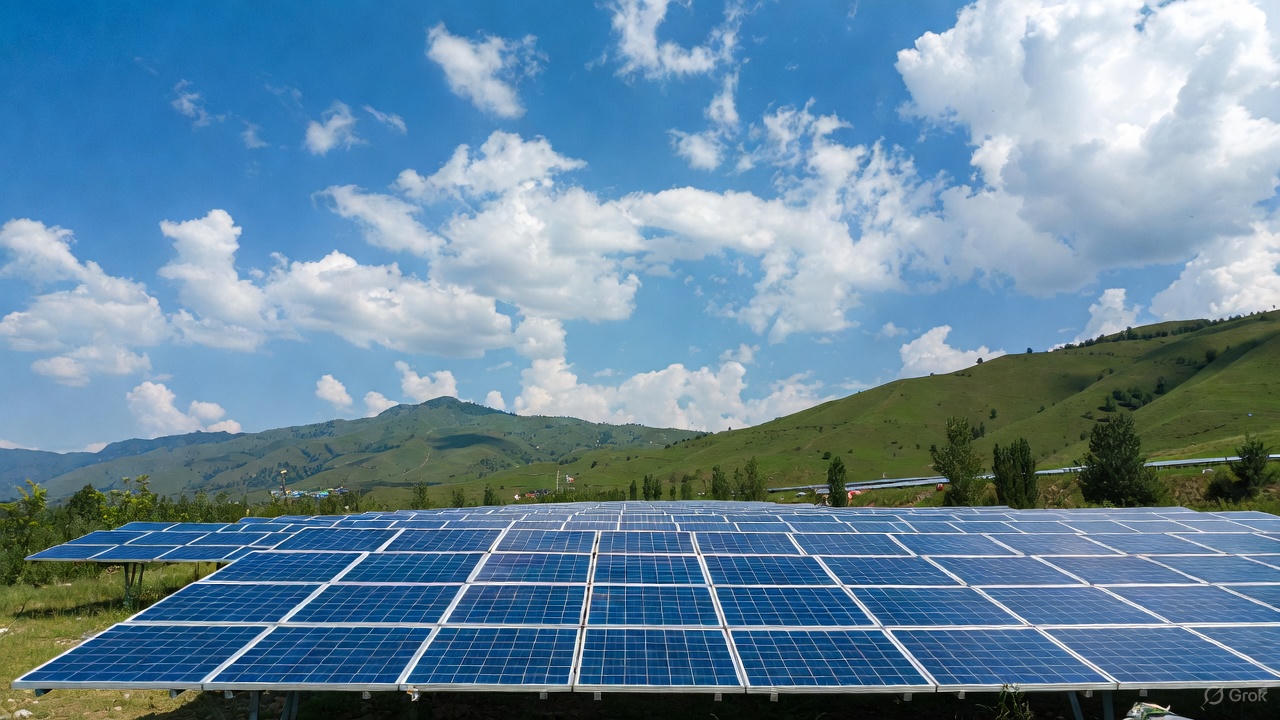
Pakistan’s energy story has long been dominated by imported fossil fuels, chronic shortages, and rising costs. Yet, in 2025, a new narrative is unfolding: solar energy is emerging as a cornerstone of Pakistan’s economic future. With net-metered solar capacity reaching 5.3 GW by April 2025 out of a total installed generation capacity of 46,605 MW, the country is making strides toward a greener grid. But can renewables — particularly solar — truly power growth, or are structural challenges too steep?
🌞 Historical Context: Pakistan’s Energy Mix
- For decades, Pakistan relied heavily on thermal power (oil, gas, coal), which accounted for nearly 60% of generation in 2020.
- Hydropower contributed around 30%, while renewables were negligible.
- This dependence on imports strained foreign reserves, with energy imports costing over $20 billion annually by 2022.
📊 Current Solar Capacity & Targets
- Net-metered solar capacity: 5.3 GW (April 2025).
- Government targets: 40% renewable share by 2025 and 60% by 2030, already surpassing interim goals.
- World Bank projection: Solar and wind should reach 30% of total electricity capacity by 2030, equivalent to 24,000 MW.
- ADB forecast: Pakistan’s GDP growth at 2.7% in 2025, with inflation at 4.5%, highlighting the need for cheaper, stable energy.
💡 Economic Benefits of Solar
- Energy Security: Reduces reliance on imported oil and gas, easing pressure on foreign reserves.
- Job Creation: Solar installation and maintenance could generate hundreds of thousands of jobs by 2030.
- Cost Savings: World Bank estimates renewables could save Pakistan $5 billion over 20 years.
- Industrial Competitiveness: Affordable electricity boosts manufacturing, especially textiles and IT.
🚧 Challenges Ahead
- Grid Integration: Transmission capacity lags at 22,000 MW vs demand of 31,000 MW, causing outages.
- Financing: IMF notes Pakistan’s debt burden limits fiscal space for large-scale renewable projects.
- Policy Gaps: Recent 18% GST on imported solar panels risks slowing adoption.
- Equity Concerns: Solar adoption is faster among urban elites; rural and low-income households remain underserved.
🌍 Comparative Insights
- India: Installed over 80 GW of solar by 2025, leveraging subsidies and large-scale parks.
- Bangladesh: Pioneered solar home systems, reaching millions of rural households.
- Pakistan: Strong potential, but policy inconsistency and financing hurdles slow progress.
🔮 Future Outlook
- IMF’s Resilience and Sustainability Facility: $1.3 billion allocated to Pakistan for climate-resilient infrastructure.
- Private Sector Role: Rooftop solar and battery storage are booming, with adoption quadrupling from 2024–2025.
- Global Context: Falling solar panel costs (down 80% since 2010) make renewables increasingly competitive.
✍️ Conclusion
Pakistan’s solar push is real and transformative, but fragile. The numbers show progress: capacity is rising, targets are ambitious, and economic benefits are clear. Yet, without grid upgrades, equitable financing, and consistent policy, solar alone cannot power sustainable growth.
In my view, Pakistan is not just entering a renewable era — it is at a crossroads. If policymakers align fiscal discipline with energy reforms, solar could become the backbone of Pakistan’s economic revival. If not, the promise of renewables risks being another missed opportunity.
Discover more from The Economy
Subscribe to get the latest posts sent to your email.



The US-Israel-Iran conflict has exposed a structural fault line beneath the Gulf’s gilded markets. What investors called safe havens are now ground zero for the most violent emerging market sell-off of the decade.
For two decades, Dubai and Abu Dhabi have sold the world a compelling narrative: that Gulf capital markets could transcend regional geopolitics, that gleaming towers and diversified economies had immunised them from the volatility that haunts their neighbours. That story is now in ruins — buried beneath $120 billion in erased market capitalisation, 18,400 cancelled flights, and the low drone of Iranian missiles over the Arabian Gulf.
Since the United States and Israel launched coordinated military strikes against Iranian missile sites and nuclear facilities on February 28, 2026, the Dubai Financial Market General Index (DFMGI) has plunged approximately 17 percent — its steepest sustained decline in a generation. The Abu Dhabi Securities Exchange (ADX) has shed 9 percent over the same period, shedding roughly $75 billion in market value. Together, the two exchanges have vaporised an estimated $120–$124 billion in market capitalisation, according to data from Gulf Business News. For comparison, the S&P 500 fell approximately 7 percent over the same interval — a painful correction, but nowhere near the structural shock coursing through the Emirates.
This is not a rout driven by sentiment alone. It is a geopolitical repricing — the markets finally doing what analysts long warned they might: acknowledging that no amount of architectural ambition or sovereign wealth can fully insulate an open economy from a war being fought within missile range of its airports.
The Anatomy of a $120 Billion Loss
When the Dubai Financial Market reopened on March 4 after a two-session regulatory closure ordered by the UAE Securities and Commodities Authority, the index immediately plunged 4.65 percent — shedding 302 points in a single session. The ADX fell a further 2.78 percent, or 309 index points, to 10,156. Banking and real estate counters, long the twin pillars of the UAE’s equity story, bore the sharpest selling pressure. Emaar Properties, the developer behind the Burj Khalifa and a bellwether for Dubai’s property ambitions, has fallen by more than 25 percent since the conflict began, according to Middle East Eye. Aldar Properties, Abu Dhabi National Hotels, and ADNOC Distribution each declined nearly 5 percent in a single session.
The losses represent more than a correction. They represent a fundamental reassessment of the risk premium attached to Gulf equity markets — what traders call the geopolitical risk premium — that had, for years, been dramatically underpriced. As Ashish Marwah, Chief Investment Officer at Abu Dhabi’s Neovision Wealth Management, told AGBI: “Our markets have a structural concentration in asset-heavy sectors like banking and real estate. These sectors are naturally sensitive to global macro cycles and interest rate environments.” When geopolitical shock is layered on top of macro uncertainty, the effect is compounding and brutal.
The Strait of Hormuz: Where Economics Meets Naval Blockade
The proximate cause of the UAE’s distress is not simply the war itself, but what Iran did with it. On March 4, 2026, Iran effectively closed the Strait of Hormuz — the 21-mile chokepoint through which approximately 20–21 million barrels of oil per day, or nearly 30 percent of global seaborne crude trade, normally flows. The closure was, as the International Energy Agency characterised it, the “largest supply disruption in the history of the global oil market” — eclipsing even the 1973 Arab oil embargo in its potential economic reach.
The consequences cascaded rapidly. Brent Crude surged past $120 per barrel almost immediately. QatarEnergy declared force majeure on all LNG exports. Iraq was forced to shut operations at the Rumaila oil field — one of the world’s largest — for lack of storage space as tankers remained stranded in the Gulf. War-risk insurance premiums for vessels attempting Hormuz transit spiked to levels that made commercial shipping economically nonviable.
According to analysis by SolAbility, the daily economic cost of the Hormuz closure approaches $20 billion in global GDP losses, with scenarios ranging from a $2.41 trillion hit under an optimistic reopening to $6.95 trillion under full escalation. The UN’s trade agency, UNCTAD, has warned that global merchandise trade growth is expected to decelerate sharply, from 4.7 percent in 2025 to between 1.5 and 2.5 percent in 2026, with the financial stress rippling outward to developing economies already stretched thin by post-pandemic debt burdens.
Here lies the central paradox: the UAE, unlike Qatar or Kuwait, has alternative pipeline routes — the Abu Dhabi Crude Oil Pipeline can carry up to 1.5 million barrels per day to the Port of Fujairah, bypassing Hormuz. And yet Dubai and Abu Dhabi have been more damaged by the conflict than almost any other Gulf market. The reason illuminates the UAE’s fundamental vulnerability: this economy was never primarily about oil.
Brand Dubai, Grounded
Tourism generated approximately $70 billion for the UAE economy in 2025 — fully 13 percent of gross domestic product — according to UAE state media. That industry is now in freefall. More than 18,400 flights have been cancelled since the conflict began. Dubai International Airport — the world’s busiest by international passenger volume, handling approximately 95 million passengers annually — was struck during Iranian drone offensives and shut down entirely on March 1. Emirates and Etihad suspended operations simultaneously. In a single day, more than 3,400 flights were cancelled across Dubai, Al Maktoum, Abu Dhabi, and Sharjah.
The scenes that followed were dissonant with every marketing image Dubai has ever projected. Wealthy expatriates, many of whom moved to the Emirates partly for its sense of security, reportedly paid up to $250,000 for private evacuation flights. Hotel bookings collapsed. Real estate brokers began offloading property at discounts of 10 to 15 percent to secure rapid exits, according to Reuters. Goldman Sachs analysts estimate that real estate transactions have dropped 37 percent year-on-year, with sales plunging more than 50 percent compared to February 2026. Dubai’s real estate index, which only weeks earlier had been praised by Savills as “one of the most dynamic property markets in the world” following record transaction volumes of $147 billion in 2025, has fallen by at least 16 percent.
By March 28, Iran had launched 398 ballistic missiles, 1,872 drones, and 15 cruise missiles at UAE targets — making the UAE the most heavily targeted country after Israel itself. While the majority were intercepted, debris caused material damage in both Abu Dhabi and Dubai, including strikes on or near the Burj Al Arab, Palm Jumeirah, Dubai International Airport, and the Fujairah oil industrial zone.
The Structural Fault Lines Now Exposed
For years, the UAE’s economic model was celebrated as a masterclass in post-oil diversification. Under the 10-year plan unveiled in 2023, UAE leaders set an ambition to position Dubai among the world’s top four global financial centres by 2033. That goal now looks distant — not because it was unachievable in peacetime, but because the model assumed something that geopolitics has violently undone: perpetual regional stability as a passive backdrop.
The UAE built its wealth on four pillars — finance, aviation, real estate, and tourism — all of which are acutely sensitive to conflict. Each of those pillars is now under simultaneous pressure. That is not the profile of a safe haven. It is the profile of a highly leveraged bet on stability. As Haytham Aoun, assistant professor of finance at the American University in Dubai, acknowledged to Al Jazeera, the sell-off should be seen as a “temporary shock” rather than evidence of structural economic damage — a framing that may be correct in the long run, but offers cold comfort to investors watching their portfolios contract by double digits in real time.
There are also governance concerns surfacing. Reports suggest Dubai authorities have arrested at least 70 British nationals for filming the aftermath of Iranian strikes, with fines of up to $260,000 and prison sentences of up to 10 years threatened for sharing footage. Whatever the security rationale, that posture sends precisely the wrong signal to the international investor and expatriate community the UAE has spent decades cultivating.
Forward Look: Capital Flight, Investor Confidence, and the Road to Recovery
The immediate prognosis for emerging market volatility in the Gulf is sobering. Unlike the 2008 financial crisis — which struck the UAE via liquidity channels and was eventually resolved by sovereign intervention — the current shock is kinetic and ongoing. Resolution depends not on central bank policy, but on the conclusion of an active military conflict whose timeline even US President Donald Trump has suggested could extend “four to five weeks” or beyond.
That said, there are structural reasons to resist full pessimism. The UAE’s sovereign wealth funds — including Abu Dhabi Investment Authority, one of the world’s largest at an estimated $1 trillion in assets under management — provide an extraordinary buffer that few emerging markets can match. Burdin Hickok, a professor at New York University School of Professional Studies and former US State Department official, noted that markets in Dubai and Abu Dhabi are likely to rebound strongly once the conflict is resolved, pointing to the fundamental quality of the underlying economic architecture.
The medium-term question is more pointed: will capital that has fled the Gulf during this crisis return? Or will the episode permanently recalibrate global investors’ risk models for the region, institutionalising a higher geopolitical risk premium that raises the cost of capital for Gulf markets for years to come?
The answer will hinge on several variables: the speed and terms of conflict resolution, the condition of Hormuz shipping lanes, the resilience of the UAE’s aviation and hospitality sectors, and — perhaps most importantly — whether the UAE government can restore the narrative of institutional transparency and rule of law that underpins long-term foreign direct investment.
What is already clear is that the comfortable myth of the Gulf safe haven — the idea that Dubai and Abu Dhabi somehow existed outside the arc of regional conflict — has been definitively and expensively dismantled. The $120 billion cost of that illusion will be measured not only in lost market capitalisation, but in the harder-to-quantify erosion of confidence that takes years to rebuild.
The Gulf, it turns out, is not beyond geography. And markets, however gilded, are not beyond war.
Discover more from The Economy
Subscribe to get the latest posts sent to your email.
Analysis
Has the World Bank Performed a U-turn on Industrial Policy? Interventionists Who Think So Should Read Its New Report More Closely
The Bank’s landmark 2026 report is a significant intellectual evolution—but it is no blank cheque for state intervention. A careful reading reveals something more interesting, and more demanding, than either its cheerleaders or critics will admit.
When the Priest Revises the Catechism
When The Economist declared in April 2026 that the World Bank had abandoned three decades of stigma against industrial policy, the think-tank circuit lit up like a Christmas tree. Industrial policy advocates who had spent years being lectured about market distortions and government failure finally had what they thought was institutional absolution—from the very institution that had long served as the high church of the Washington Consensus. The Wall Street Journal, not typically given to rooting for state intervention, ran its own headline pronouncing that the World Bank had “embraced industrial policy.” The triumphalism from certain quarters of the development community was immediate, effusive, and—on closer inspection—substantially overblown.
The report in question, Industrial Policy for Development: Approaches in the 21st Century (March 2026), authored by economists Ana Margarida Fernandes and Tristan Reed, is a serious, carefully qualified, empirically grounded document that runs to several hundred pages of analysis drawn from 183 national development plans and evidence across more than 60 economies. It represents a genuine intellectual shift at the Bank—one worth examining in detail. But it is emphatically not the unconditional surrender to interventionism that its more excitable admirers have proclaimed. Those who are reading it that way are, to borrow a phrase, looking at a compass and claiming they’ve found a treasure map.
The Long Shadow of the Washington Consensus
To appreciate what has actually changed, it is necessary to recall what the old orthodoxy looked like—and how it came to feel so shopworn.
The Washington Consensus, the policy framework associated with John Williamson’s 1989 synthesis and subsequently operationalised by the World Bank and IMF across the developing world, was not a monolith of stupidity. It correctly identified the fiscal chaos, runaway inflation, and state capture that had ravaged Latin America and sub-Saharan Africa through the 1970s and 1980s. Privatisation, trade liberalisation, and macroeconomic stabilisation delivered genuine benefits in countries where the prior alternative had been kleptocratic mismanagement. To dismiss it entirely is intellectually dishonest.
But its treatment of industrial policy—the deliberate use of government instruments to shape the structure of an economy toward particular sectors, technologies, or firms—was always its weakest limb. The 1993 World Bank report, The East Asian Miracle, was compelled by the sheer empirical weight of South Korea, Taiwan, and Japan to concede that some forms of selective intervention had, in fact, accompanied extraordinary growth. Yet the report then executed what remains one of the more remarkable intellectual contortions in development economics: it simultaneously acknowledged that directed credit, export discipline, and sectoral targeting had been central to East Asia’s ascent, and concluded that this held “little promise” for most other countries. The reasoning—that East Asia’s state capacity was exceptional and unreplicable—was not without merit. But it served, conveniently, to leave the core doctrine of market supremacy largely intact.
That convenient wall has been crumbling for years. China’s state-led industrial rise, the CHIPS and Science Act in the United States, the European Union’s Green Deal Industrial Plan, the Inflation Reduction Act’s industrial subsidies—all represent major market economies abandoning the posture that selective state support for industries is inherently distortionary and therefore illegitimate. Against that backdrop, the World Bank clinging to the 1993 catechism would have rendered it not principled but simply irrelevant.
What the 2026 Report Actually Says—And What It Doesn’t
Indermit Gill, the Bank’s Chief Economist, frames the intellectual moment with admirable candour in his foreword. The 1993 report’s dismissal of selective industrial policy, he writes, has “the practical value of a floppy disk today.” It is a striking admission—frank to the point of self-deprecation—and it is why the headlines were understandable, if ultimately misleading.
Because when you move beyond Gill’s foreword and into the analytical body of the Fernandes-Reed report itself, what you find is not a celebration of state intervention but a sophisticated, heavily conditional framework for thinking about when and how industrial policy can work—and when it reliably fails.
Several findings deserve particular attention:
The tools are more diverse than the debate admits. The report catalogues 15 distinct policy instruments that governments deploy under the banner of industrial policy—ranging from performance-based subsidies and special economic zones to export promotion agencies, public procurement, and investment incentives. This taxonomy matters because much of the political debate treats industrial policy as synonymous with tariff walls and targeted subsidies. The Bank’s analysis suggests that the more successful contemporary interventions tend to operate through less blunt instruments: co-investment vehicles, matching grants conditional on export performance, and sector-specific infrastructure.
Upper-middle-income countries are already intervening heavily—and badly. One of the more arresting data points in the report is that upper-middle-income countries spend approximately 4.2% of GDP on business subsidies—a figure that rivals or exceeds what advanced economies deployed during the peak of post-war industrial planning. Developing economies, the report finds, are among the heaviest users of industrial policy instruments. The problem is not too little intervention; in many cases, it is poorly designed, poorly targeted, and poorly monitored intervention. This finding subtly reframes the policy debate: the question is not whether governments should engage in industrial policy but whether they should do it more intelligently.
Performance conditionality is non-negotiable. The Bank’s framework is insistent on what might be called the discipline condition. Effective industrial policy, the report argues, requires that support be time-bound, subject to measurable performance benchmarks, and genuinely withdrawable when those benchmarks are not met. The cautionary tale of subsidies that metastasise into permanent entitlements—zombifying industries rather than catalysing them—runs through the analysis as a recurring theme. This is not a departure from the Bank’s long-standing emphasis on institutional quality and accountability; it is a restatement of it in a new context.
Goals have multiplied beyond productivity. The 21st-century industrial policy toolkit, the report acknowledges, is being deployed in pursuit of objectives that would have seemed peripheral to the 1993 debate: job creation in specific regions, foreign exchange generation, green industrial transition, and national security resilience. The fusion of climate policy and industrial policy—manifest in the extraordinary state investments being made in clean energy supply chains across the US, Europe, China, and increasingly India—represents a structural shift in what governments are asking industrial policy to accomplish. The Bank’s framework attempts to provide analytical guidance across all these goals, though the tension between them is not always fully resolved.
Institutions still precede everything. For all the evolution in tone, the report is emphatic that the preconditions for successful industrial policy remain demanding. Strong bureaucratic capacity, credible commitment mechanisms, insulation from political capture, and a competitive domestic market environment are all listed as prerequisites rather than outcomes. This is where the interventionist reading tends to break down. The report is not telling governments with weak institutions, endemic corruption, and captured regulatory bodies that they should now feel liberated to pick winners. It is telling them, more carefully, that success under those conditions remains extremely unlikely—and that the sequencing question (fundamentals first) has not changed.
The Risks That Have Not Disappeared
None of the 20th century’s cautionary lessons about industrial policy have been repealed by the 2026 report. The risks of regulatory capture—where the industries being promoted come to shape the policies promoting them—remain as real as ever. The political economy of withdrawing support from failing industries has not become easier simply because the Bank has published a nuanced framework; it has, if anything, become harder in an era of economic nationalism where the political costs of being seen to abandon domestic producers are higher than ever.
The challenge of enforcement in low-capacity states deserves more attention than the report gives it. It is one thing to design performance conditionalities in theory; it is quite another to enforce them when the industry being supported employs 40,000 workers in a swing constituency, and when the monitoring agency lacks both the data systems and the political independence to apply sanctions. South Korea’s famous export discipline worked in part because the Park government was genuinely willing to withdraw credit from underperforming chaebol—a willingness that is historically unusual and politically contingent in ways that resist replication.
The report also underplays, perhaps intentionally, the geopolitical drivers of the current industrial policy revival. The CHIPS Act was not primarily a development economics exercise; it was a strategic response to China’s dominance of semiconductor supply chains and the perceived vulnerabilities that dependence exposed during the COVID-19 pandemic. The EU’s Critical Raw Materials Act is similarly animated by concerns about strategic autonomy that sit uncomfortably within a conventional welfare economics framework. When major powers justify industrial policy on national security grounds, they are not primarily inviting replication by developing countries—they are, in some respects, restructuring global supply chains in ways that create new dependencies for exactly those countries.
This is a significant gap. The World Bank’s mandate centres on development in the Global South, yet the industrial policy revolution currently reshaping global trade is being driven by the Global North for strategic reasons that may be actively harmful to developing country interests. A Bangladeshi garment manufacturer or a Kenyan software firm is not the primary beneficiary of the Inflation Reduction Act’s domestic content requirements; they may, in fact, be among its victims.
What the Report Gets Right
Sceptics who dismiss the 2026 report as ideological window-dressing—or as an institution capitulating to political fashion—are missing its genuine contributions.
The most important is evidentiary. The systematic review of 183 national development plans and the cross-country econometric evidence on policy effectiveness is the most comprehensive analytical exercise the Bank has conducted on this topic. It moves the debate beyond the anecdotal—beyond the duelling citations of Singapore’s success and Brazil’s Embraer against the failures of Tanzania’s groundnut scheme and India’s licence raj—and toward something more methodologically rigorous. The finding that well-designed export promotion agencies have positive effects on trade performance across diverse country contexts, for instance, is a useful practical contribution that deserves more attention than the headline debate about whether the Bank has “changed its mind.”
The 15-tool taxonomy is similarly valuable. It forces a more granular conversation. Blanket arguments for or against “industrial policy” obscure enormous variation in instrument design, targeting precision, conditionality structure, and institutional context. A matching grant for small manufacturing exporters in Vietnam is a fundamentally different policy animal from a permanent tariff wall protecting a state-owned steel company in Argentina, even if both travel under the same banner.
The report is also right to note that the conditions under which industrial policy operates have changed since 1993 in ways that are not purely political. Education levels and institutional baselines in many developing countries are substantially higher than they were 30 years ago. The technological infrastructure for monitoring and evaluation—the data systems, the satellite imagery for industrial zone oversight, the digital payment rails for conditional transfer programmes—has improved dramatically. The argument that East Asian-style industrial policy was uniquely unreplicable rested partly on state capacity arguments that are less universally true than they once were.
Implications for Developing Countries
For policymakers in developing economies, the 2026 report offers something more useful than either the old orthodoxy or the new triumphalism: a structured decision framework. The key questions it poses deserve wide circulation.
Which sectors or activities exhibit genuine market failures—information externalities, coordination problems, learning-by-doing spillovers—that justify intervention? Is the institutional capacity to design, monitor, and enforce conditionalities actually present? Are competition disciplines—from domestic rivalry or export markets—in place to prevent the support from degenerating into rent extraction? And is there a credible sunset mechanism, or is this a policy that will be permanent from the moment of its announcement?
These are demanding questions. They will not produce comfortable answers in many contexts. But they are the right questions—and the fact that the World Bank is now asking them openly, rather than simply proscribing the entire enterprise, is a genuine advance.
A Toolkit, Not a Theology
The appropriate metaphor for what the World Bank has done in March 2026 is not a U-turn. It is more like a careful renovation of a building that had become structurally unsound in certain sections while remaining sound in others. The macroeconomic fundamentals—fiscal discipline, monetary credibility, competitive exchange rates, strong property rights—remain in place as the ground floor. What the Bank has done is admit that the upper floors, specifically its prescriptions about the role of the state in shaping economic structure, need significant reconstruction.
Industrial policy, the 2026 report concludes, belongs in the development toolkit. But a toolkit is not an ideology. A skilled carpenter does not use a hammer for every job simply because a hammer is now considered acceptable; they use the tool that fits the problem, with the precision the job demands.
The interventionists celebrating a full reversal at the World Bank are indulging in the same binary thinking they correctly criticise in their opponents—they have simply flipped the polarity. The Bank’s new report is asking harder questions, not providing easier answers. For developing countries navigating a world of rising protectionism, accelerating automation, and green transition imperatives, that analytical discipline is precisely what is needed.
Whether governments will apply it with the rigour the Bank prescribes is, of course, an altogether different question. And it is the one that will determine whether the 21st century’s industrial policy renaissance looks more like South Korea in 1970 or Brazil in 1980. History suggests the answer will vary by country, by decade, and by the quality of the institutions doing the intervening. The World Bank has, to its credit, stopped pretending otherwise.
The market did not build the internet. It did not sequence the human genome. And it will not, on its own, decarbonise industrial civilisation on any timeline that matters. But governments that have failed to build functioning tax systems, independent judiciaries, and competitive markets are unlikely to succeed where markets have not. The World Bank’s new report understands this. The question is whether its readers do.
Further Reading and Sources:
- Industrial Policy for Development: Approaches in the 21st Century, World Bank, March 2026
- The East Asian Miracle, World Bank, 1993 — Open Knowledge Repository
- Brookings Institution: The CHIPS and Science Act — What It Includes, Why It Matters
- Peterson Institute for International Economics: Washington Consensus Origins and Legacy
- European Commission: Critical Raw Materials Act
- World Bank Chief Economist Indermit Gill’s commentary on development economics paradigm shifts
- Foreign Affairs: The Return of Industrial Policy
- PIIE Event Coverage: Industrial Policy in the 21st Century
Discover more from The Economy
Subscribe to get the latest posts sent to your email.

The call came, as these things often do, without warning. A seasoned equity partner at one of the Big Four — two decades of late nights, cross-border engagements, client dinners, and carefully cultivated relationships distilled into a six-figure “units” allocation — was summoned for what was framed as a career conversation. The language was collegial, the room was quiet. And then, politely but unmistakably, the message landed: you will no longer share in the firm’s profits. We are moving you to a salaried partner role.
No performance improvement plan. No transparent benchmark they had failed to meet. Just the quiet arithmetic of a partnership that needed fewer people at the table.
This is not an isolated anecdote. According to reporting by the Financial Times, both KPMG and EY have in recent years removed members of their UK equity partnerships and instead offered them “salaried partner” roles — a demotion wrapped in the same title, drained of its financial substance. And on April 23, 2026, the story took on transatlantic dimensions: KPMG announced it was cutting roughly 10% of its US audit partners — approximately 100 individuals — after years of failed voluntary retirement programmes. The message to the profession has never been louder: the partnership is no longer a destination. It is, increasingly, a temporary assignment.
The Golden Ticket, Tarnished
For generations, making partner at a Big Four firm was the legal and financial world’s closest equivalent to a tenured professorship. You had, in the popular imagination and in contractual reality, arrived. The equity partnership conferred ownership, profit-sharing, prestige, and an implicit understanding that barring catastrophic misconduct, your position was secure until mandatory retirement. It was, in the language of another era, a job for life.
That compact is dissolving — not with a dramatic rupture, but through a series of quiet institutional manoeuvres that, taken together, signal a structural reorientation of how these firms are governed, whom they reward, and what professional excellence is now expected to deliver.
The statistics are unambiguous. Big Four partner promotions across the UK fell to just 179 in 2025, a five-year low and a sharp retreat from the 276 promoted at the peak of the post-pandemic boom in 2022, according to analysis by the Financial Times of Companies House filings, press releases, and LinkedIn data. EY elevated only 34 equity partners, down from 74 in 2022. Deloitte made just 60 promotions, against 124 in 2022. Overall, the total number of equity partners across the four firms fell for the first time in five years, dropping by roughly 80 to approximately 3,050.
The belt-tightening is deliberate, and its beneficiaries are the incumbents. KPMG’s average UK partner pay reached £880,000 in 2025 — an 11% year-on-year increase — putting it ahead of both PwC (£865,000) and EY (£787,000) for the first time since 2014. Deloitte partners crossed the £1 million threshold. Revenue, meanwhile, has barely moved: EY reported 2% growth in what it called a “challenging market”, while KPMG posted just 1% growth after 9% in 2023, and Deloitte suffered its first annual revenue decline in 15 years.
The mechanism is elementary. When you constrain the denominator — fewer equity partners sharing the profit pool — the numerator rises for those who remain. Profit-per-equity-partner (PEP) is the prestige metric in professional services, the figure that determines lateral hire competitiveness, graduate recruitment marketing, and the partner’s own sense of institutional worth. And right now, the Big Four are protecting it with considerable ruthlessness.
Demotion Without Firing: A New Instrument of Control
What distinguishes the current moment from previous cycles of partner attrition is not the reduction in numbers per se — firms have always managed their equity pools — but the instrument being used. The introduction of a salaried or “non-equity” partner tier creates a new, lower rung on the ladder that can be used not merely as a holding pen for promising directors, but as a landing zone for underperforming incumbents.
Deloitte, EY, and KPMG have all introduced this salaried partner tier, widely regarded in the industry as a mechanism for retaining senior staff without sharing profits. PwC, the only firm still operating an equity-only partnership, has created a “managing director” grade as its structural equivalent. The title is preserved; the economics are fundamentally altered.
In the case of KPMG’s UK operation, multiple people with knowledge of the matter told the Financial Times that partners were called into rooms for what were “positioned as career conversations” but were in reality mechanisms to reduce equity partner headcount. Some received the news with little warning, having been given positive performance feedback until the conversation itself. Several chose to leave rather than accept what they experienced as a demotion, describing the process as blindsiding.
EY, meanwhile, has demoted a small number of equity partners to salaried roles since introducing the tier in 2022, according to three people familiar with the matter. The firm declined to comment.
To be clear, “departnering” is not unique to accountancy. Goldman Sachs has long managed partner membership with clinical precision; law firms regularly de-equitise underperforming partners, particularly in mid-tier practices. But the cultural signal from the Big Four is significant precisely because of the scale, the prestige mythology, and the professional pipeline implications. These are the firms that recruit tens of thousands of graduates annually on the implicit promise of a meritocratic climb toward a life-altering outcome.
Why Now? Three Interlocking Forces
1. The Consulting Hangover
The pandemic generated an extraordinary and, in retrospect, unsustainable surge in demand for advisory services. Governments needed economic modelling, corporations needed digital transformation, boards needed risk assessment. The Big Four expanded headcount aggressively. By 2022, PwC was promising to add 100,000 staff globally; KPMG was promoting equity partners at a rate it could not sustain.
The hangover has been severe. PwC’s revenue growth slowed to 2.9% in fiscal 2025, down from 9.9% in 2023. Consulting revenues have contracted across the sector as clients, now operating in a tighter macro environment, question the value of expensive advisory mandates. James O’Dowd, managing partner at Patrick Morgan, told City AM that the firms are “cutting jobs to protect partner profits and rebalance bloated teams” after years of aggressive post-pandemic hiring.
2. AI Restructuring the Audit Architecture
Perhaps more structurally significant than the revenue cycle is the accelerating role of artificial intelligence in reshaping what partners actually do. KPMG launched its Workbench multi-agent AI platform in June 2025, developed with Microsoft, connecting 50 AI agents with nearly 1,000 more in development. EY granted 80,000 tax staff access to 150 AI agents through its EY.ai platform, investing more than $1 billion annually in AI platforms and products. Deloitte struck a deal with Anthropic to deploy Claude AI to its 470,000 employees worldwide.
The point is not that AI will replace partners tomorrow. It is, rather, that the work historically required to justify a partner’s existence — managing audit workflows, overseeing large teams of junior staff performing repetitive compliance tasks, supervising structured data review — is increasingly automated. KPMG acknowledged as much in its US announcement, noting that artificial intelligence is “increasingly handling key steps of audits, spurring firms to rethink staffing and delivery”. At PwC, leadership has indicated that new hires will be doing the work of managers within three years, supervising AI rather than performing the audit tasks themselves.
This compression of the value chain has a direct implication for partner economics. If AI can execute the audit procedures that previously required six team members, you need fewer partners to supervise them. The case for a large partnership structure becomes harder to make.
3. The Future-Revenue Problem
Laura Empson, professor of management at Bayes Business School, has articulated the third driver with particular precision. The question being asked of potential partners has shifted from “can you generate enough business this year?” to something more existential: “Will this person generate a substantial stream of income for the foreseeable future — and right now the future is particularly hard to foresee?” A director with a strong practice in regulatory compliance was, five years ago, a safe bet. Today, as AI takes on compliance automation and regulatory technology firms encroach on traditional advisory turf, the projection is far murkier. The firms are not just managing the present — they are hedging against futures they cannot yet model.
Winners, Losers, and the Long Game
The winners in this restructuring are, in the near term, the incumbent equity partners who remain. By shrinking the pool and reweighting units toward rainmakers — under KPMG’s current leadership, the firm has reallocated profit units to place less weight on tenure and more on business generation — the firms are concentrating extraordinary wealth among a smaller group. KPMG’s UK partners, who were earning £816,000 on average in 2025’s reporting cycle and £880,000 in the most recent period, now out-earn their counterparts at EY for the first time in a decade.
The losers are harder to count but easier to identify. The most acute damage falls on the cohort of ambitious directors and senior managers who have spent a decade or more building toward equity partnership as their defining professional objective. James O’Dowd of Patrick Morgan noted that whereas 20 years ago, Big Four employees could make equity partner by around 35, they are now looking at their early 40s — if they get there at all. The salaried partner tier is, for many, not a staging post but a terminus.
There is also a diversity dimension that deserves sharper scrutiny than it typically receives. Research consistently shows that informal sponsorship, visibility networks, and the “cultural fit” judgements that govern partnership decisions tend to replicate existing demographic profiles. When promotion cycles compress and the bar rises, historically underrepresented groups — women, minorities, first-generation professionals — disproportionately absorb the attrition. The firms publish annual diversity data with admirable transparency; whether that transparency translates into accountability when the pressure is on remains a live and uncomfortable question.
More troubling still is the impact on institutional knowledge. Partnership models, whatever their flaws, created an incentive for long-term relationship stewardship. A partner who owned the firm had reasons to invest in client relationships, mentorship, and institutional culture that extended well beyond the quarterly cycle. When you strip equity from people who have spent twenty years building domain expertise, you create a class of high-skilled employees with diminished loyalty and a market incentive to take their networks elsewhere — to boutiques, to in-house roles, to competitors offering better economics. The knowledge transfer implications are real.
The Contrarian View: Are They Trading Resilience for Returns?
Here is the question the managing partners are not asking loudly enough: does concentrating profits in fewer hands make these firms better, or merely more profitable in the short term?
There is a credible argument that what looks like strategic discipline is actually a structural fragility in the making. The Big Four derive much of their value not from capital but from trust — the trust that a client places in an auditor’s independence, the trust that a regulator places in a firm’s quality controls, the trust that markets place in a signed opinion. That trust is accumulated slowly, through relationships, through institutional memory, through the kind of deep sectoral expertise that takes years to develop.
When you compress the partner class aggressively, you signal to the broader professional pipeline that the implicit social contract has changed. Junior auditors at KPMG UK, earning around £32,500 as new graduates while partners take home nearly £880,000, are already observing a ratio that strains credulity as a meritocratic proposition. Removing overtime pay for busy season, shrinking the equity pool, and quietly demoting long-tenured partners does not create the conditions for the recruitment and retention of the next generation of exceptional audit professionals.
There is also the audit independence question. The Financial Reporting Council and its international equivalents have long expressed concern that commercial pressures on audit firms compromise the independence of judgment that audits require. A partnership model explicitly oriented toward protecting PEP — where the primary signal of success is partner compensation rather than audit quality — does not obviously serve the public interest that audit is meant to protect.
What Comes Next: Three Scenarios for the Profession
The optimistic scenario holds that these are rational adjustments to a structural oversupply of partners accumulated during an anomalous boom period, and that AI will simultaneously create new value — in AI assurance, ESG verification, regulatory technology — that supports a leaner but higher-margin partnership in the medium term. EY’s vision of a “service-as-a-software” commercial model, where clients pay by outcome rather than hour, might indeed generate the next platform for partnership growth.
The bearish scenario holds that compression of the talent pipeline, combined with AI-driven commoditisation of core services, will accelerate the fragmentation of the Big Four’s market position. Boutique advisory firms, technology-native audit platforms, and specialist consultancies are already capturing the mid-market segments where the Big Four’s scale is a disadvantage rather than an asset. If the firms price themselves out of the talent market by narrowing the partnership pathway, the talent goes elsewhere — and so, eventually, do the clients.
The structural scenario — and the one with the most historical precedent — is that this marks not a temporary adjustment but a permanent restructuring of what professional partnership means. The partnership model of the 20th century was predicated on human capital scarcity: expertise was concentrated in senior people, and those people needed to be economically incentivised to stay. AI erodes that logic. The next model may look less like a traditional partnership and more like a technology firm with a professional services overlay — equity concentrated at the top, a salaried technical workforce in the middle, and an AI infrastructure doing much of the work below.
For Aspiring Partners, Directors, and Regulators
If you are a director or senior manager at a Big Four firm reading this, the strategic implication is uncomfortable but clear: the pathway to equity partnership is narrower, later, and more uncertain than at any point in the past two decades. The hedge is diversification — cultivating expertise in areas where AI augments rather than replaces human judgment (regulatory navigation, complex cross-border transactions, AI assurance itself), and building client relationships that are genuinely portable. The salaried partner tier may, for some, represent a viable and well-remunerated alternative. For others, the boutique and in-house markets have never been more attractive.
For regulators, the questions are structural. Does the concentration of equity in fewer, higher-paid partners improve or compromise audit quality? Do the oversight frameworks that govern partnership conduct need updating to reflect the new realities of AI-assisted audit and performance-managed equity pools? The FRC and PCAOB have the tools to ask these questions. The political will to pursue them publicly is another matter.
For the firms themselves, the most important question may be one they are reluctant to examine: is the protection of partner compensation a strategy, or a symptom? A strategy would involve investing in the next generation of talent and expertise with the same vigour applied to protecting the equity pool. A symptom would be the short-term extraction of value from a franchise whose long-term competitive position is quietly eroding.
The Covenant, Rewritten
There is a moment, in the mythology of professional services, when a young accountant or consultant first allows themselves to imagine making partner. It is a moment of ambition and delayed gratification — the belief that if you are good enough, disciplined enough, client-focused enough, the institution will eventually reward your investment with a share in its future.
What KPMG and EY are doing — quietly, through human resource conversations in unremarkable meeting rooms — is rewriting that covenant. The reward is no longer guaranteed by longevity or even by excellence across a career. It is contingent, performance-managed, and revocable. In that sense, they are asking their most senior professionals to accept an employment relationship that the most junior associates have always known.
That may be a more honest model. It is certainly a more anxious one. And whether the profession that emerges from this restructuring will be better equipped to serve the public interest — or merely better equipped to serve the interests of those already at the top — is the defining question for the decade ahead.
Discover more from The Economy
Subscribe to get the latest posts sent to your email.
-

 Markets & Finance4 months ago
Top 15 Stocks for Investment in 2026 in PSX: Your Complete Guide to Pakistan’s Best Investment Opportunities
-

 Analysis3 months ago
Brazil’s Rare Earth Race: US, EU, and China Compete for Critical Minerals as Tensions Rise
-

 Analysis2 months ago
Top 10 Stocks for Investment in PSX for Quick Returns in 2026
-

 Investment3 months ago
Top 10 Mutual Fund Managers in Pakistan for Investment in 2026: A Comprehensive Guide for Optimal Returns
-

 Banks3 months ago
Best Investments in Pakistan 2026: Top 10 Low-Price Shares and Long-Term Picks for the PSX
-

 Global Economy4 months ago
Pakistan’s Export Goldmine: 10 Game-Changing Markets Where Pakistani Businesses Are Winning Big in 2025
-

 Global Economy4 months ago
15 Most Lucrative Sectors for Investment in Pakistan: A 2025 Data-Driven Analysis
-

 Asia4 months ago
China’s 50% Domestic Equipment Rule: The Semiconductor Mandate Reshaping Global Tech