
Analysis
Why Investment Trusts Are Going Big on Private Equity


Investment trusts offer the smartest, most democratic route into private equity in 2026—with wide discounts, rate-cut tailwinds, and a $8.6trn asset class finally opening its doors.
In my two decades covering global capital markets, I have watched retail investors be told, repeatedly and emphatically, that private equity is not for them. It is the preserve of Yale’s endowment, of Kuwaiti sovereign wealth funds, of family offices with nine-figure balance sheets and the patience of a Benedictine monk. Everyone else, so the story went, would have to make do with the public markets and whatever crumbs of innovation happened to trickle through the IPO window.
That story was always partially false. And in 2026, it is becoming demonstrably, structurally, and commercially obsolete.
The vehicle quietly dismantling this exclusivity is one of Britain’s oldest and most elegant financial inventions: the investment trust. Specifically, a cohort of listed, closed-end funds that invest in private equity—companies and strategies that never appear on a public exchange, cannot be bought on Robinhood, and have historically outperformed their listed counterparts over long investment horizons. These are investment trusts that have gone big on private equity, and the case for following them has rarely been more compelling than it is right now.
The Opportunity Set: Why Private Equity Matters More Than Ever
Let us begin with the most underappreciated fact in modern investing. The universe of publicly listed companies has been shrinking for decades. In the United States, the number of exchange-listed firms has halved since its peak in the 1990s. In Europe, the pattern is similar. Meanwhile, the private markets have exploded. According to Preqin data, global private equity assets under management stood at $8.6 trillion as of December 2024—almost ten times the figure from two decades earlier.
Think about what that means for a conventional investor. The most dynamic companies—the software champions, the healthcare innovators, the infrastructure builders of tomorrow—are increasingly choosing to remain private for longer, or forever. When HgCapital, the private equity giant behind HgCapital Trust (HGT), acquired OneStream Software in a $6.4 billion deal in January 2026, it was taking a profitable, high-growth cloud software business out of public investors’ reach, not into it. If you are not in private equity, you are simply being cut out of whole chapters of the economy.
Preqin and BlackRock’s “Private Markets in 2030” report forecasts global alternative assets reaching $32 trillion in AUM by end of the decade—a structural shift, not a cyclical blip, driven by AI infrastructure build-out, energy transition spending, and the relentless migration of ambitious companies away from the scrutiny and quarterly-earnings tyranny of public markets. Investors who are not finding ways to participate in this migration will, over the coming decade, find their portfolios increasingly anaemic.
The Investment Trust Advantage: Closed-End Structure as a Feature, Not a Bug
The mechanism by which ordinary investors can access this vast private universe—without locking up capital for a decade, without writing a million-dollar cheque to a Mayfair GP, without navigating a J-curve of zero-returns for the first five years—is the listed investment trust.
Here is why the structure matters. Open-ended funds holding illiquid private assets are inherently fragile. When markets panic and retail investors rush for the exits, fund managers of open-ended vehicles are forced to sell assets at fire-sale prices to meet redemptions. We have seen this movie before; it never ends well. The investment trust structure, because it is a closed-end vehicle whose shares trade on a stock exchange, eliminates this mismatch entirely. The manager never has to sell a portfolio company prematurely because a panicking investor in Peterborough wants their money back on a Tuesday afternoon. The underlying assets can breathe, compound, and mature on their own timescales—which is precisely how private equity is meant to work.
This structural elegance is especially powerful for the asset class. The AIC notes that over the past ten years, the average investment company has returned approximately 10% annually, but that aggregate disguises the extraordinary performance of the Private Equity sector, where the top names have generated returns that belong in a different universe.
The Numbers: A Decade of Exceptional Performance
See our guide to investment trust performance across AIC sectors.
Private equity investment trusts, as a category, have been among the best-performing assets available to retail investors over the past decade. 3i Group, the UK’s largest investment trust at £26.2 billion in net assets, has delivered a 10-year share price total return of 1,100%—an annualised gain of 26.39%. Over 20 years, 3i has returned 15.85% annualised, beating its FTSE 350 benchmark by nearly 9 percentage points. HgCapital Trust, the software-focused private equity trust managing approximately £2.5 billion in assets, has delivered 526% over 10 years at an annualised 17.75%—comfortably beating FTSE All-Share’s 7.62% annual gain by a margin of 10 percentage points.
These are not cherry-picked outliers. Morningstar’s analysis of private equity investment trusts finds the category has returned an average of 9% per year over the past decade, a figure that, while below the headline acts, still substantially outpaces most passive global equity indices on a risk-adjusted basis over comparable periods.
Performance Comparison Table: Private Equity Investment Trusts vs Benchmarks (to end-2025)
| Trust / Benchmark | 10-Year Annualised Return | Current Discount/Premium |
|---|---|---|
| 3i Group (III) | ~26% | Wide discount (post-correction) |
| HgCapital Trust (HGT) | ~17.75% | ~14–27% discount (volatile 2026) |
| HarbourVest Global PE (HVPE) | ~10%+ | ~26–28% discount |
| Pantheon International (PIN) | Competitive | ~27% discount |
| AIC PE Sector Average | ~9% p.a. | Double-digit discounts prevalent |
| FTSE All-Share Index | ~7.62% | — |
| Morningstar Global Markets Index | ~13% | — |
Sources: AIC/Morningstar; Trustnet; QuotedData. Data to early 2026. Past performance is not a guide to future returns.
2026: Why This Is the Inflection Point
I have seen plenty of “inflection points” declared prematurely in my career. I am using the phrase here with deliberate care, because the evidence from multiple credible sources is unusually convergent.
Bain & Company’s 17th annual Global Private Equity Report, published February 2026, confirmed that global buyout deal value climbed 44% to $904 billion in 2025, while exit value rose 47% to $717 billion—both figures representing the second-highest values on record, behind only 2021’s peak. The engine driving this recovery is a combination of aging dry powder ($1.3 trillion in global buyout dry powder, much of it under deployment pressure), falling interest rates across both Europe and North America, and a reopened corporate M&A market hungry for acquisitions.
Critically, Hugh MacArthur, Bain’s chairman of global PE practice, stated that “2026 is shaping up as promising—interest rates are moving south, deal pipelines are well stocked. The conditions for deal and exit activity are rosier than for some time.” Why does this matter for listed PE trusts? Because lower interest rates directly unlock exit opportunities. Higher borrowing costs made it nearly impossible for GPs to sell portfolio companies at the prices they expected, since trade buyers rely heavily on debt. As rates normalise, the logjam of unrealised assets—Bain estimates 32,000 unsold companies worth $3.8 trillion globally—begins to flow. And as exits materialise, NAVs grow, distributions increase, and discounts narrow.
The IPO pipeline is equally significant. Global IPOs rose 36% in 2025, though from a very low base. HgCapital Trust’s largest single holding, Visma—the Norwegian enterprise software giant—has been considering an IPO in 2026. The Revolut and Stripe IPOs, both imminent according to QuotedData’s analysis, could deliver significant NAV uplifts to trusts holding stakes in these companies. Each exit, realised above carrying value, is a signal that these trusts’ underlying assets are worth more than their share prices suggest—which is precisely the argument for buying them now.
The Discount Opportunity: Buying a Pound for 70 Pence
For value-conscious investors, the case for private equity investment trusts is sharpened by one of the most persistent market inefficiencies of the current cycle: wide share price discounts to net asset value.
AIC data shows that when the average investment trust discount exceeds 10%, the average trust has gone on to generate a return of 89.3% over the following five years. That compares to a 56.1% return when discounts are below 5%. We are currently in the former territory—and then some.
Trusts in the private equity sector have dominated the list of best-performing funds trading on double-digit discounts, accounting for eight of 20 featured companies in AIC analysis. Six of those were trading at discounts exceeding 30%, including NB Private Equity Partners, HarbourVest Global Private Equity, CT Private Equity Trust, and Abrdn Private Equity Opportunities. These are not distressed funds. They are well-run vehicles holding portfolios of companies that have, in the words of the AIC’s Annabel Brodie-Smith, “performed well over the long term”—and whose shares can now be acquired at a discount to the value of the underlying assets.
HarbourVest Global Private Equity’s discount narrowed from 46% in April 2025 to approximately 28% by early 2026—still wide, but directionally telling. The fund has responded to shareholder pressure (including a 5% stake acquired by activist Saba Capital) with an enhanced buyback programme, structural simplification through a separately managed account, and a continuation vote scheduled for July 2026 AGM. In 2025, HarbourVest received $424 million in distributions and repurchased $90 million of its own shares, generating a 12.5% uplift in share price from buyback activity alone. This is exactly the kind of proactive capital allocation that should attract patient investors.
Meanwhile, boards across the sector have taken heed. Record share buybacks, strategic reviews, mergers and acquisitions are all in motion as trust boards seek to close the gap between share price and asset value. As Brodie-Smith put it: “Investment trust boards are keenly focused on enhancing returns for shareholders. There have been lots of mergers and acquisitions and this is likely to continue, which will create exciting opportunities for investors.”
The Democratisation Argument: Private Equity for the Many
Here is the paradox that has long frustrated me: the asset class that most needs patient, long-term capital from individual investors is the one that has historically been most inaccessible to them.
Retail investors currently own approximately 10% of the shares in private equity investment trusts—compared with around 50% of investment trust shares in most other sectors. That gap is not a reflection of performance or suitability. It is a legacy of complexity, opacity, and the received wisdom that private equity is not for ordinary people. But those barriers are structural, not fundamental.
A pension saver in Manchester, a retail investor in Singapore, a family office in Dubai: all of them can buy shares in HgCapital Trust or Pantheon International on the London Stock Exchange for the same price per share as a Mayfair hedge fund. They can sell those shares the same day if they need to. They can invest £500 or £500 million. The minimum ticket is whatever a single share costs. That is genuinely democratic access to an asset class that is being excluded from the conventional 60/40 portfolio to everyone’s detriment.
Preqin’s 2030 outlook notes that Hamilton Lane forecasts 20% of all private market capital will be held in evergreen structures within a decade—up from around 5% today. The introduction of private market assets into US 401(k) pension plans, alongside ELTIF and LTAF structures in Europe, signals that regulators and policy-makers have finally recognised what has been obvious to close observers for years: ordinary investors are being systematically denied access to returns that institutions take for granted.
Listed investment trusts investing in private equity are, in this context, not a niche product. They are the most fully developed, most liquid, most transparent, and most regulated vehicle through which anyone can gain this exposure today.
The Structural Tailwinds: Rate Cuts, AI, and the New Deal Cycle
Three forces are converging in 2026 to make private equity investment trusts particularly timely.
First, interest rate normalisation. Central banks in the UK, eurozone, and United States have been cutting rates through 2025 and into 2026. Lower rates reduce the cost of leveraged buyout financing, increase the attractiveness of deal multiples, and make it easier for GPs to execute the exits that return capital to investors. Preqin’s 2026 outlook explicitly identifies lower interest rates as “usually beneficial to deal-making,” noting that the annualised growth rates for alternatives AUM are expected to accelerate through the cycle.
Second, the AI revolution is creating a private equity opportunity, not a threat. HgCapital has spent over two decades quietly accumulating one of the world’s largest portfolios of private business software companies—back-office automation, compliance technology, payroll, ERP. These are exactly the businesses that AI is now making dramatically more valuable, because they provide the infrastructure layer on which enterprise AI will be deployed. Hg has built $185 billion of investments across 60 privately owned software providers, and access to that portfolio, available via HgCapital Trust on the London exchange, is extraordinary.
Third, exit activity is broadening. After three years in which PE exits were concentrated at the mega-deal level, Pantheon’s managers forecast in early 2026 that the recovery would start to “trickle down” into smaller and mid-market companies—which is where the bulk of listed PE trusts’ portfolios reside. GP-led continuation vehicles grew 62% year-on-year in 2025, while secondary deal volumes rose 41%, providing alternative routes to liquidity that had been largely frozen in 2022–2024.
Risks Worth Taking Seriously
I would not be doing my job if I presented this as a one-way bet. Private equity investment trusts carry specific risks that must be understood before investing, and each deserves honest treatment.
Valuation opacity. Private companies are not marked to market daily. NAVs are typically updated quarterly and use methodologies that can lag reality in both directions. Some investors have expressed concern that portfolio valuations remain too optimistic in a world of higher discount rates. Counterargument: where exits have been executed, prices have often come in ahead of carrying values—suggesting the conservatism runs in the investor’s favour.
Discount risk. Buying at a discount is only advantageous if the discount eventually narrows. If sentiment towards the sector deteriorates further, discounts can widen before they tighten—as the painful 2022–2024 period demonstrated. The 3i Group story of 2025–2026 is instructive here: a trust that reached a 70% premium to NAV at its peak fell dramatically as concerns about its concentrated bet on European retailer Action materialised. Even the best manager cannot fully insulate a listed vehicle from sentiment cycles.
Fees. Many PE trusts operate a two-tier structure—fees at the trust level, and underlying fees charged by the GPs in which they invest. The total expense ratio can meaningfully exceed that of a passive global equity ETF. Investors need to satisfy themselves that the incremental return potential justifies the incremental cost.
Liquidity mismatch (in extremis). While the closed-end structure eliminates forced selling, it does mean that in severe market stress, bid-ask spreads can widen sharply. In a full-blown financial crisis, the shares of even well-managed PE trusts can fall dramatically, regardless of underlying portfolio performance. This is a long-term asset class for long-term investors.
See our guide to investment trust discounts for a fuller treatment of discount dynamics.
Where to Look: A Framework, Not a Stock Tip
I do not dispense individual investment recommendations. But I can offer a framework for investors considering private equity investment trusts in 2026.
For diversification and breadth: Funds-of-funds structures such as Pantheon International (PIN) or HarbourVest Global Private Equity (HVPE) offer exposure to hundreds of underlying private companies across geographies, vintages, and strategies. They are trading at significant discounts to NAV and have been actively engaging with shareholders on capital return and governance.
For concentrated sector focus: HgCapital Trust (HGT) offers a unique window into the European and North American software ecosystem, with a manager that has over 30 years of experience and a portfolio built around recurring revenue businesses with strong pricing power. Its largest investment, Visma, is considering an IPO in 2026—a potential NAV catalyst.
For thematic diversification: Oakley Capital Investments (OCI) and ICG Enterprise Trust offer concentrated but well-researched access to pan-European private businesses across a range of sectors.
In all cases, the investment should be considered as part of a diversified portfolio, given the higher-risk nature of concentrated sector exposure.
The Forward View: Patient Capital, Patient Investor
The private equity cycle is beginning to turn. The exits are starting to flow. The discounts are historically wide. The structural case for the asset class has never been stronger. And the listed investment trust—Britain’s 155-year-old financial innovation—remains the most elegant, most accessible, most liquid, and most transparent vehicle through which any investor, from any starting point, can participate in the private equity premium.
Preqin’s data points to 2025 as the probable low point of the fundraising cycle, with across-the-board increases in fund inflow activity forecast through to at least 2030. History is consistent on this point: the AIC’s 30-year data shows that discounts have always eventually narrowed, and the investment trust sector has always rebounded. The question is not whether this cycle ends. The question is whether you will have positioned yourself before it does.
The family offices already know the answer. The pension allocators are slowly learning it. It is time for sophisticated retail investors to recognise that private equity, accessed via listed investment trusts, is not the elite asset class of the few. It is the opportunity of this decade—and 2026 may be the year the door is most open.
Discover more from The Economy
Subscribe to get the latest posts sent to your email.



For decades, the global dominance of the U.S. dollar has rested on two primary pillars: deep, unencumbered liquid capital markets and an indispensable global financial messaging protocol known as SWIFT. When Beijing launched its e-CNY initiative, Western observers initially framed it as a central bank digital currency (CBDC) designed primarily for domestic surveillance, retail convenience, and financial inclusion.
However, recent strategic moves highlight a far more ambitious objective. As documented by the South China Morning Post, Beijing is actively leveraging Hong Kong as its central offshore laboratory to establish the infrastructure required for international cross-border digital yuan adoption.
The crucial strategic question is no longer whether China can engineer robust distributed ledger architecture, but whether an offshore financial hub operating under “One Country, Two Systems” can bridge the gap between rigid domestic capital controls and global institutional acceptance. To succeed, China must resolve the fundamental tension between absolute monetary sovereignty and the open networks required for international currency adoption.
1. The Paradox of the Offshore Laboratory
China’s monetary expansion faces a well-documented structural paradox. According to macroeconomic research from the Carnegie Endowment for International Peace, no currency can achieve true international reserve status without offering open capital accounts and deep, freely convertible liquidity. Yet, completely relaxing capital controls would expose China’s domestic banking system to volatile international capital flows and speculative pressures.
Hong Kong serves as the pressure valve and testing ground for this paradox:
- Legal & Regulatory Buffer: Hong Kong maintains a trusted common law judicial system and an independent monetary authority (Hong Kong Monetary Authority).
- Convertibility Bridge: It allows mainland authorities to test e-CNY settlement, cross-border retail links, and digital asset integration without opening mainland financial markets directly to global speculative shocks.
- Institutional Liquidity: As the world’s premier offshore renminbi hub, Hong Kong provides the institutional counterparties necessary to build real-world transaction volume.
“The digital yuan’s true test lies not in domestic retail adoption, but in whether foreign counterparties can settle cross-border trade without taking on unacceptable regulatory or capital risks.”
2. Wholesale Settlement and Project mBridge
While retail consumer wallets attract considerable media attention, the real geopolitical shift is occurring at the wholesale institutional level. Strategic initiatives like Project mBridge—developed in partnership with the Bank for International Settlements (BIS), the People’s Bank of China, and regional central banks—demonstrate how multi-CBDC platforms can streamline international trade.
As reported in market analyses by Bloomberg and trade finance studies covered by Reuters, multi-lateral CBDC platforms offer significant operational advantages:
- Elimination of Intermediaries: Direct ledger-to-ledger transactions bypass traditional correspondent banking networks.
- Speed and Efficiency: Cross-border settlement times are reduced from days to seconds.
- Cost Reduction: Transaction costs and foreign exchange spreads across regional trade corridors in Asia and the Middle East are dramatically lowered.
If commercial enterprises operating in Hong Kong can settle trade directly in e-CNY with instant finality, Beijing creates a compelling economic incentive for trade partners that operates independently of Western clearing networks.
3. Geopolitical Implications & The Road Ahead
Western policymakers and central bankers are monitoring these developments closely. Recent congressional testimony and Treasury reviews highlighted by Reuters reflect growing concern in Washington that alternative settlement rails could gradually erode the reach and enforcement of Western financial sanctions.
However, technological capability alone does not guarantee global currency dominance. Until foreign corporate treasuries and central banks have full confidence in converted currency liquidity, property rights, and transparent legal protections, the digital yuan will serve primarily as an efficient alternative mechanism for bilateral trade rather than an immediate replacement for the U.S. dollar.
Institutional Summary & Comparison
| Dimension | Conventional Retail Focus | Wholesale / Strategic Reality |
| Primary Mechanism | Retail e-CNY wallets for tourists & merchants | Multi-CBDC corridors (Project mBridge) & Project Ensemble |
| Core Objective | Domestic payments & payment app competition | Disintermediation of correspondent banking and SWIFT rails |
| Primary Barrier | Consumer habituation & merchant readiness | Capital controls, currency convertibility, and institutional trust |
Sources & Citations
- South China Morning Post: Beijing wants Hong Kong to sow the seeds for the digital yuan
- Bank for International Settlements (BIS): Central Bank Digital Currency (CBDC) & Cross-Border Payments Research
- Carnegie Endowment for International Peace: China’s Financial System and Capital Account Dynamics
- Bloomberg Financial Analysis: Global Macro & Digital Currency Integration
- Reuters News & Analysis: Cross-Border Settlement and Global Trade Finance
Discover more from The Economy
Subscribe to get the latest posts sent to your email.
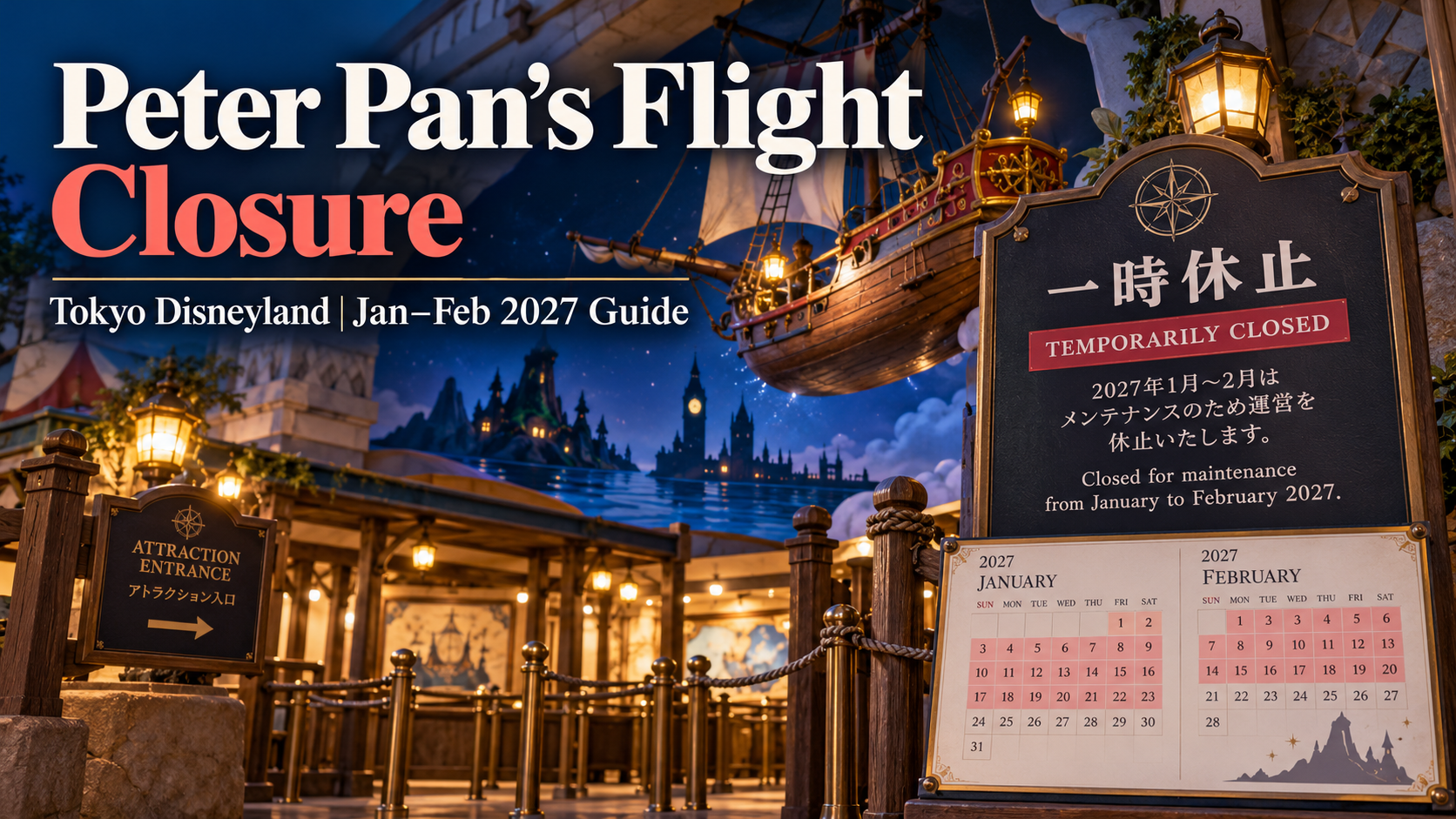
Guests planning a visit to Tokyo Disneyland in early 2027 should put one easily missed detail on their itinerary: Peter Pan’s Flight is scheduled to be temporarily closed from January 6 through February 2, 2027. The operator lists the dates both on its official attraction page and in the Tokyo Disneyland closure schedule. This is a scheduled interruption, not an announcement that the classic ride is being removed permanently. Travelers visiting on dates inside that window should assume the attraction will not be available unless Tokyo Disney Resort publishes a change.
The distinction matters because online references to “Peter Pan closing at Tokyo Disney” can confuse two different parks and two different experiences. Tokyo Disneyland’s Peter Pan’s Flight is a compact Fantasyland ride. Tokyo DisneySea has a separate, newer attraction called Peter Pan’s Never Land Adventure, with its own planned March 2027 maintenance period. The first planning step is making sure the information applies to the ticket you actually bought.
At a glance: what the operator currently says
| Planning question | Verified answer |
|---|---|
| Which attraction? | Peter Pan’s Flight |
| Which park? | Tokyo Disneyland, Fantasyland |
| Scheduled closure starts | January 6, 2027 |
| Scheduled closure ends | February 2, 2027 |
| Reopening expectation | After the listed closure window, subject to operator changes |
| Type of notice | Temporary closure; not announced as permanent |
| Where to recheck | Official attraction listing |
The dates are explicitly labeled as a temporary closure by Tokyo Disney Resort. Do not treat February 3 as an unconditional reopening guarantee: an operator may update maintenance information or temporarily suspend operations for other reasons. Check again shortly before travel and on the day you enter the park.
What is Peter Pan’s Flight?
Peter Pan’s Flight is a dark ride based on the familiar journey from London to Never Land. Guests sit in a flying pirate-ship vehicle that travels through a storybook environment. According to the operator’s ride information, it is in Fantasyland, lasts about two and a half minutes and carries two people per vehicle. It operates indoors and includes dark spaces. These details make it particularly appealing to families who want a gentle, classic Disney experience rather than a high-speed thrill ride.
There are restrictions worth noting even on operating days. The published guidance says a guest must be able to maintain a stable seated position independently and that children may not be held on an adult’s lap during the ride. If your group includes young children, anyone needing seating assistance or visitors uncomfortable with darkness, read the official description and accessibility guidance rather than assuming that the attraction suits everyone because it is short.
Short ride duration is not the same as short waiting time. Demand for well-known classics can vary with crowds, operating conditions and holiday schedules, so it is unwise to schedule a tight sequence of unrelated bookings around a predicted queue. The operator’s app and in-park staff can provide current operating information when the ride is available.
The dates around the closure are not interchangeable
A guest visiting January 5 has a fundamentally different planning position from someone arriving January 6. January 5 falls before the currently listed closure, while January 6 is its opening day. A February 2 visit falls on the final listed day of the maintenance window; February 3 is the earliest day after that window, not a contractual promise that the ride will run.
For a family staying at the resort for multiple days, the difference might be worth changing which day is assigned to Tokyo Disneyland. If one day is before January 6 and another is inside the closure, put Disneyland first if the classic Peter Pan ride is a must-do. But do not swap a park ticket or hotel reservation until you understand the applicable change and cancellation conditions. The economic cost of reshuffling an entire trip can exceed the benefit of experiencing one short ride.
A visitor traveling from overseas may be choosing between a single Disneyland day and a DisneySea day. In that case, consider the trip’s overall priorities. Someone who values vintage Fantasyland attractions may still prefer Disneyland even during the closure. Someone traveling expressly for an immersive Peter Pan adventure could be more interested in the DisneySea attraction—but must buy admission to that different park and verify its own operating schedule.
Other Tokyo Disneyland closures during the same period
The official park maintenance listing shows other attractions with early-2027 closure windows that may overlap your visit. At the time of this review, it lists Jungle Cruise: Wildlife Expeditions from January 6 through March 31, Splash Mountain from January 7 through February 4, and Haunted Mansion from January 8 through February 4. These are operator-published schedules, not independent predictions about refurbishment completion.
This makes the Peter Pan closure more significant for certain visitors than a single unavailable ride might suggest. A group that expected several classic experiences in one afternoon could find multiple priorities temporarily inaccessible. Conversely, the park contains many other attractions and entertainment offerings, and the attractions that remain open should be evaluated on their own current descriptions rather than guessed from historical schedules.
It is worth making a small “must ride / would enjoy / optional” list. Mark each attraction against the closure page. Then build flexibility around weather, performance calendars and queue variation. A plan with alternatives is more resilient than a rigid minute-by-minute schedule.
Better alternatives for different kinds of visitors
If the attraction’s appeal is gentle fantasy storytelling, explore other Fantasyland offerings listed in the official Tokyo Disneyland attraction directory. Filter for ride type and height or access restrictions, and read the current operating details. Do not assume that a neighboring attraction will be open merely because it is not listed in an older travel blog.
If the main attraction is Disney character immersion, devote time to character experiences, themed areas, shopping or scheduled entertainment that is actually available on your day. These can preserve the spirit of the trip without pretending they are substitutes for the ride itself. Some guests will prefer to spend the recovered time on a longer headliner; others may value an unhurried lunch and a park exploration that is less vulnerable to queues.
If the trip is built around Peter Pan specifically, Tokyo DisneySea’s Never Land Adventure may appear attractive. But it is not the same ride: it is a 3D boat-based experience in Fantasy Springs, with different restrictions and a different length. Tokyo Disney Resort’s DisneySea attraction page is the reliable way to compare them. Admission, access arrangements and the day’s capacity remain separate questions.
Parents should also avoid overstating the value of a replacement to children. “Another attraction has pirates” does not make it the planned Peter Pan experience. Setting expectations before entering the park is often more effective than negotiating disappointment in a crowded queue area.
Are refunds or ticket changes automatic?
The announcement of an attraction’s temporary closure does not itself demonstrate that every guest is entitled to a ticket refund or a date change. Theme-park tickets ordinarily grant admission subject to operating conditions, not a binding guarantee that every individual ride will operate. Actual ticket terms, package conditions and any operator-specific accommodation policy govern what can be changed.
Before buying or modifying a pass, review the official Tokyo Disney Resort ticket and reservations guidance and any reseller’s terms. A third-party package might combine transport, hotel rooms and tickets under separate cancellation rules. You should not rely on the statement “ride closed” as a universal reason for a penalty-free cancellation.
If your booking is complex, write down the name of the supplier, reservation reference, exact park date and type of admission. Seek a written answer before paying a change fee. This is particularly important if you plan to move only one day of a multi-day trip and keep the remainder unchanged.
Does Disney Premier Access help during the closure?
No paid queue-management product can make an attraction operate while it is closed. Disney Premier Access is a separate, paid tool for eligible operating experiences; eligibility and availability can change. The official Premier Access guide explains that places may sell out and that the price does not include park admission. It should not be marketed to families as a guaranteed workaround for a published maintenance closure.
The app can nevertheless be useful for other attractions and live operating information. If a ride is unavailable, remove it from the day’s queue-management plan and redirect attention to attractions genuinely offered that day. Check the current product terms before purchasing any additional access.
How to build a more reliable 2027 itinerary
Start with the official attraction closure list rather than the social-media version of it. Choose a date, read the list for the correct park, then check the pages for the two or three attractions most important to your group. If several favorites overlap with closures, compare another travel day, but preserve buffer time and cost limits.
Once you have a provisional itinerary, check whether your whole group can experience the alternatives. A family with a toddler and grandparents may have different needs from a group of teenagers. Ride seating rules, dark environments, height restrictions and walking distances deserve attention before buying optional upgrades.
A week before departure, look at the operator’s park calendar and attraction pages again. On the morning of your visit, follow current app information and staff instructions. Write down a backup plan that does not depend on a single ride reopening on the first conceivable day.
Quick visitor questions
Is Peter Pan’s Flight shutting permanently? The published notice says temporary closure January 6–February 2, 2027. It does not announce permanent removal.
Is it in Tokyo Disneyland or DisneySea? Peter Pan’s Flight is in Tokyo Disneyland’s Fantasyland. DisneySea has the separate Never Land Adventure.
Can I ride on February 2? The current listing includes February 2 in the closure window. Do not plan on riding that day.
Is February 3 the official reopening day? It is the first day after the presently announced closure period, assuming the dates are unchanged. Confirm the park’s live information rather than treating operation as guaranteed.
Should I change my trip? That depends on how important this specific ride is compared with hotel, flights, admission and other attractions. For most travelers, adjusting priorities within the same park is the lower-risk first option.
Final planning advice
This news is not a farewell to Peter Pan’s Flight. It is a defined, temporary gap in the operating calendar. The useful response is to check your exact visit date, compare the rides your family actually cares about and keep a realistic alternative ready. Tokyo Disneyland can still be an appealing destination during the listed closure; the difference between an enjoyable trip and a frustrating one may simply be accurate expectations.
Discover more from The Economy
Subscribe to get the latest posts sent to your email.

Key Takeaways
- Rolex’s secondary market rose approximately 7.9% year-over-year as of 2026 (per WatchCharts data) — trailing Patek Philippe (+16.2%) and Tudor (+11.4%) but still outperforming Audemars Piguet (+3.4%).
- Rolex raised U.S. retail prices 4–9% in January 2026 (steel models ~5.6%, gold models ~8.7%), narrowing the historical gap between retail and pre-owned pricing.
- Not every model appreciates: steel sports references (Submariner, GMT-Master II, Daytona) have held value far better than two-tone or widely available dress references like the standard Datejust.
- The Lady-Datejust posted the sharpest 2026 gain among tracked collections — up 22.73%, from roughly $9,269 to $11,376 — driven by demand for smaller, “everyday luxury” watches.
- Gold’s rise past $2,400/oz has directly lifted the investment case for Rolex’s precious-metal references (Day-Date, Sky-Dweller, Yacht-Master).
The Model-by-Model Picture
| Category | 2026 Trend |
|---|---|
| Lady-Datejust | +22.73% (strongest performer among tracked collections) |
| Steel sports models (Submariner, GMT-Master II) | Held value well; corrected from 2022 peak but stabilized above retail |
| Daytona | Corrected from highs above $50,000 to the mid-$30,000s; still among the most sought-after references |
| Two-tone/widely available Datejust | Flat to negative — “holds value” is an overstatement for this category |
| Gold references (Day-Date, Sky-Dweller) | Lifted by gold’s rise above $2,400/oz |
Why the “Rolex Always Appreciates” Myth Is Fading
The pandemic-era boom pushed some references — the Daytona above all — to speculative highs disconnected from historical norms. Since the March 2022 peak, steel sports models have compressed meaningfully, and dealers who bought inventory near the top have in some cases faced 20–40% markdowns on liquidation. The lesson for 2026 buyers: Rolex as a category is not a monolith. Value retention depends heavily on specific reference, condition, and whether the piece comes with box and papers (“full set”).
What’s Actually Driving 2026 Strength
- Retail price increases raise the floor. When a new Submariner retails at $10,050 (up from $9,500), a pre-owned example at $11,000–$12,000 suddenly represents a smaller premium — narrowing the gap without secondary prices actually moving.
- Supply discipline remains Rolex’s core lever. The brand has never confirmed production numbers, and secondary-market premiums remain entirely a function of Rolex’s own manufacturing decisions — a risk factor as much as a support.
- Certified Pre-Owned rollout. Rolex’s now fully rolled-out CPO program has changed how buyers transact in the used market, adding a layer of brand-verified legitimacy that supports pricing.
The Case for Rolex as a Portfolio Diversifier
Financial advisors increasingly frame luxury watches not as a replacement for equities or bonds, but as a tangible, historically low-correlation diversifier — one that carries its own risks (illiquidity, condition-dependent pricing, no yield) but has demonstrated multi-decade resilience for specific references.
Is Rolex a good investment in 2026?
It depends heavily on the specific reference. Steel sports models like the Submariner and Daytona have held or grown in value; two-tone and widely available dress models generally have not. Overall, Rolex’s secondary market rose about 7.9% year-over-year in 2026, trailing Patek Philippe but ahead of Audemars Piguet.
Discover more from The Economy
Subscribe to get the latest posts sent to your email.

Stock Market Crash 2026? What the November Rout Actually Tells Us

IMF Global Outlook 2027: The Recovery Is Real, but the Divide Is Growing

World Bank Debt Report 2026: The $9.4 Trillion Burden Behind the Recovery

Singapore Stock Market Outlook 2027: The STI’s Bank-and-Yield Test

Asian Stock Markets: Why the AI Rout Is Dividing the Region

Global Markets Today: The AI Sell-Off Has Become a Test of Liquidity

Global Finance 2027: Debt, Inflation and AI Are Pulling the Economy Apart

Brian Kemp’s Georgia Legacy: Economic Growth, Elections and the Costs of His Policy Choices

Dow Futures vs Dow Jones: What E-mini Contracts Really Tell You Before Wall Street Opens

China Tape Maker Stock Debut: Crown New Materials Soared 787%

Apple’s Earnings Beat Had a Catch: Look Past the Tariff Refund

Social Security Payments in November 2026: The Full Calendar and Two Important Changes

Johor–Singapore SEZ’s $21.8 Billion Bet: The Hard Part Starts Now

China’s 175 Trillion AI Tokens Reveal a Bigger Shift: The AI Boom

Crude Oil & Petroleum Market Analysis: OPEC+ Decisions and Price Forecasts

Top US Convenience Store Chains: Store Counts, EV Charging, and Sales Trends

Social Security Extra $90 Deposit: Who Qualifies for the October 2026 Medicare Rebate?

Gold Price Outlook 2026: The Forces Behind the Forecasts—and What Could Reverse Them

Stock Market Crash in 2026? Warning Signs, Scenarios and a Calm Investor Checklist

Anthropic Bans Sustained Abuse of Claude AI Under New Usage Policy Effective November 12, 2026

US–Iran Conflict in October 2026: Hormuz, Oil Prices and Diplomacy

US–China Critical Minerals Competition: Why a Trade Deal Cannot Fix Every Supply Risk

SSI November 2026 Payment: Why Benefits Arrive October 30

US–China AI Export Controls in 2026: Chips, Testing Rules and Corporate Risk

China’s AI Microdrama Boom: How Beijing Is Reshaping Global Media

EU vs UK Electric Vehicle Tariffs: Impact on Automotive Supply Chains & Consumer Prices

Pakistan IMF Programme 2026: Why Bailouts Keep Returning

Jeff Bezos Three-Day Workweek View: What He Really Said
-

 Markets & Finance10 months ago
Top 15 Stocks for Investment in 2026 in PSX: Your Complete Guide to Pakistan’s Best Investment Opportunities
-

 Analysis9 months ago
Johor’s Investment Boom: The Hidden Costs Behind Malaysia’s Most Ambitious Economic Surge
-

 Analysis9 months ago
Top 10 Stocks for Investment in PSX for Quick Returns in 2026
-

 Banks10 months ago
Best Investments in Pakistan 2026: Top 10 Low-Price Shares and Long-Term Picks for the PSX
-

 Analysis9 months ago
Brazil’s Rare Earth Race: US, EU, and China Compete for Critical Minerals as Tensions Rise
-

 Investment10 months ago
Top 10 Mutual Fund Managers in Pakistan for Investment in 2026: A Comprehensive Guide for Optimal Returns
-

 Global Economy10 months ago
15 Most Lucrative Sectors for Investment in Pakistan: A 2025 Data-Driven Analysis
-

 Global Economy10 months ago
Pakistan’s Export Goldmine: 10 Game-Changing Markets Where Pakistani Businesses Are Winning Big in 2025