
AI
What Morgan Stanley & Goldman Sachs’ Roles Mean for Anthropic Investors


When a company chooses its underwriters, it’s telling the market something before a single share trades. Anthropic’s reported selection of Morgan Stanley and Goldman Sachs — alongside JPMorgan — as lead banks on its expected IPO is being read by Wall Street as a signal of confidence in the company’s ability to command a valuation near $2 trillion. Here’s what these roles actually mean, mechanically and strategically, for anyone considering an investment.
Key Takeaways
- Morgan Stanley reportedly holds the “pole position” for the coveted lead-left spot on Anthropic’s IPO, according to sources cited by the Financial Times.
- Goldman Sachs is running “neck-and-neck” with Morgan Stanley for a top-tier underwriting role.
- JPMorgan, Citigroup, and Barclays are expected to round out the broader syndicate.
- These same three lead banks — Morgan Stanley, Goldman Sachs, and JPMorgan — anchored the SpaceX IPO in June 2026, the current record-holder for largest offering.
- The banks previously provided Anthropic with debt financing, including work toward a reported $15 billion pre-IPO credit facility.
- Underwriter selection influences pricing strategy, institutional allocation, and after-market stabilization — all of which affect retail investors indirectly.
What “Lead-Left” Actually Means
In IPO terminology, the lead-left bank is the underwriter listed first (traditionally on the left side) on the cover of the prospectus — a position that comes with outsized responsibility and outsized reward. The lead-left bank typically:
- Runs the bookbuilding process, collecting and aggregating institutional investor orders
- Sets the final offer price in coordination with the issuer’s board
- Takes the largest underwriting fee allocation among the syndicate
- Leads after-market stabilization activities, including exercising the “greenshoe” over-allotment option if the stock trades up
- Serves as the primary point of contact between the company and public market investors during the roadshow
If Morgan Stanley secures this role for Anthropic, as reporting suggests is likely, it puts the bank in the driver’s seat for what could be the largest IPO ever completed — surpassing even its own recent work, alongside Goldman Sachs and JPMorgan, on the SpaceX offering.
Why Two (or Three) Top-Tier Banks Matters for Investors
A syndicate anchored by Morgan Stanley and Goldman Sachs — both perennially ranked among the top global equity underwriters — sends a specific signal: institutional demand is expected to be deep enough to require serious distribution muscle. For investors, this translates into a few practical implications:
- Broader institutional reach. These banks’ wealth management and institutional sales networks span pension funds, sovereign wealth funds, and large asset managers globally, which typically supports stronger initial demand and a more orderly aftermarket.
- More rigorous pricing discipline. Top-tier lead underwriters have reputational incentive to avoid a “busted IPO” — a listing that trades below its offer price shortly after debut — because it damages their standing for future mandates.
- Deeper aftermarket support. Lead banks typically commit capital to stabilize the stock in early trading through the over-allotment mechanism, which can reduce (though not eliminate) early volatility.
The Debt-Equity Connection: Why the $15 Billion Credit Facility Matters Here
It’s not a coincidence that the banks reportedly structuring Anthropic’s equity offering previously provided the company with debt financing. Morgan Stanley, Goldman Sachs, and JPMorgan are also reportedly involved in finalizing a $15 billion pre-IPO credit facility for Anthropic — capital that gives the company balance sheet flexibility to fund continued compute infrastructure buildout independent of the equity raise itself.
This dual relationship — debt financier and equity underwriter — is common for large-cap tech IPOs and gives the lead banks unusually deep visibility into Anthropic’s financials heading into the roadshow. For investors, that can be read two ways:
- Bullish read: The banks have extensive due diligence exposure and are still willing to lead a ~$2 trillion offering.
- Cautious read: The banks have a strong financial incentive (underwriting fees plus debt relationship preservation) to see the deal price successfully, which doesn’t guarantee the valuation is fundamentally sound.
Historical Precedent: The SpaceX Playbook
Morgan Stanley, Goldman Sachs, and JPMorgan ran the book on SpaceX’s IPO in June 2026, which priced at $135 per share and raised approximately $75 billion at a valuation near $1.8 trillion — the current record for largest IPO in history. That stock has since traded in a range from a first-day peak near $2.1 trillion market cap down to roughly $1.5 trillion by late July, before stabilizing.
The reuse of essentially the same underwriting trio for Anthropic suggests the banks are applying lessons learned from the SpaceX process — particularly around managing a low free-float listing, which both companies share as a structural feature.
| Deal Element | SpaceX (June 2026) | Anthropic (Expected) |
|---|---|---|
| Lead underwriters | Morgan Stanley, Goldman Sachs, JPMorgan | Morgan Stanley, Goldman Sachs, JPMorgan (reported) |
| IPO valuation | ~$1.8 trillion | ~$2 trillion (target, unconfirmed) |
| Capital raised | ~$75 billion | Not yet disclosed |
| Post-IPO price action | Peaked ~$2.1T, settled ~$1.5T | Unknown |
| Free float | Low | Reportedly low (~4% range in some estimates) |
Risks the Underwriter Roster Doesn’t Solve
Even the strongest underwriting syndicate can’t eliminate fundamental risk. Investors should keep in mind:
- A low float amplifies volatility regardless of which bank is managing the book — SpaceX’s post-IPO price swing from $2.1T to $1.5T illustrates this even with top-tier underwriters involved.
- Underwriter confidence is not a valuation guarantee. Banks earn substantial fees regardless of long-term stock performance; their willingness to lead the deal reflects market appetite and relationship value, not a certification of fair value.
- Multiple additional banks joining the syndicate (Citigroup, Barclays) spreads risk but also dilutes any single bank’s accountability for pricing outcomes.
FAQ
What does it mean that Morgan Stanley is the “lead-left” bank on Anthropic’s IPO? It means Morgan Stanley would run the bookbuilding process, help set the final offer price, and lead after-market stabilization — the most influential and highest-fee role in the underwriting syndicate.
Does Goldman Sachs having a top role change the IPO outlook?
Having two top-tier global banks (Morgan Stanley and Goldman Sachs) sharing lead roles typically signals strong expected institutional demand and broader distribution capacity, though it doesn’t guarantee post-IPO stock performance.
Are Morgan Stanley and Goldman Sachs also lending Anthropic money?
Yes — reporting indicates these banks previously provided debt financing to Anthropic and are involved in structuring a reported $15 billion pre-IPO credit facility alongside their equity underwriting roles.
Did the same banks handle the SpaceX IPO?
Yes. Morgan Stanley, Goldman Sachs, and JPMorgan anchored the SpaceX IPO in June 2026, which currently holds the record for the largest offering in history.
Discover more from The Economy
Subscribe to get the latest posts sent to your email.


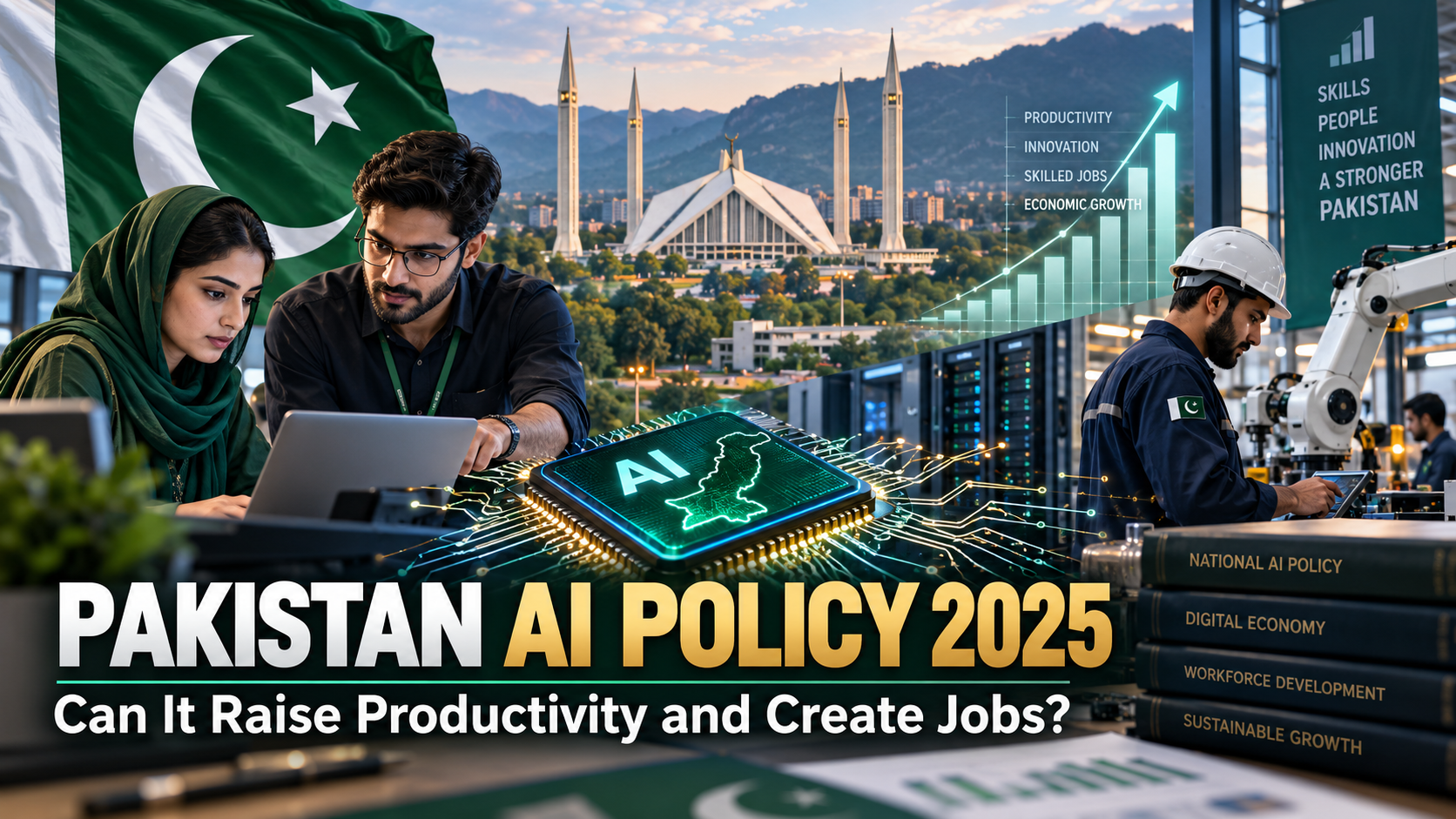
Pakistan AI Policy 2025 sets an ambitious direction. See its status, skills priorities, privacy risks and practical tests of economic impact.
Key Takeaways
- The Ministry of IT lists the National Artificial Intelligence Policy as approved on 31 July 2025, according to its policy registry.
- A 10 February 2026 government announcement described a proposed $1 billion AI investment by 2030 and 1,000 PhD scholarships; these are commitments, not audited disbursements.
- Real AI gains depend on usable data, electricity, institutional capability and whether employers redesign tasks.
- The relevant output is measured productivity, service quality and wages, not the number of events or policy slogans.
Pakistan does not need another grand technology announcement as much as it needs evidence that technology is saving time and creating better-paid work. The Pakistan AI Policy 2025 is officially listed as approved by the Ministry of Information Technology on 31 July 2025. The government subsequently announced skills and investment ambitions through 2030.
The stakes are tangible. Can a farmer get a more accurate warning about water stress? Can a public hospital process appointments without making patients wait half a day? Can a small IT company in Lahore sell more valuable services instead of competing solely on lower wages? This analysis looks past slogans, distinguishes policy approval from implementation, and proposes ways to measure whether artificial intelligence actually makes Pakistan more productive.
What has the Pakistan AI Policy 2025 actually approved?
The Ministry of IT policy portal records the National Artificial Intelligence Policy as approved on 31 July 2025. The portal separately lists a Data Governance Policy 2026 as a draft, a useful reminder that connected policy areas may be at different stages of adoption. An approved strategy is a statement of direction. It does not prove every proposed fund, institution or training programme is operating at scale.
A government statement dated 10 February 2026 said the administration intended to invest $1 billion in the AI sector by 2030, offer 1,000 fully funded AI PhD scholarships, and train one million non-IT professionals. These are stated goals. Before reporting them as achievements, an editor should request annual budgets, implementation milestones, university acceptance records and independently validated trainee completions.
| Policy test | What to verify | Why it matters |
|---|---|---|
| Approval | Official status and date | Separates draft from adopted policy |
| Funding | Budget allocation and disbursement | Distinguishes promise from spending |
| Skills | Completed training and job outcomes | Measures real human capital |
| Public-service pilots | Baseline and after-pilot performance | Demonstrates actual service gains |
| Safeguards | Published privacy and appeal mechanisms | Protects citizens and trust |
This distinction is particularly important for fast-moving technology. Announcements can be made quickly; safe procurement, testing and staff training take time.
Where could AI raise productivity first?
Start with routine, data-heavy tasks that employees already understand. In agriculture, models could help classify crop stress from satellite imagery, but only if their advice is checked against local irrigation conditions and field evidence. In industry, machine vision may detect defects earlier on an export production line. In health, decision-support tools can reduce administrative delays without replacing licensed clinicians.
Pakistan’s Economic Survey 2025–26 documents a growing digital-services sector, including $3.388 billion in ICT export remittances during July–March FY26. That is an economic base on which to build; it is not evidence that AI itself generated the receipts.
The best pilot usually starts with a narrow question. Can a customs clerk process a standard form in six minutes rather than nine, without an increase in errors? Can an irrigation office send useful alerts that farmers actually follow? A project that cannot state its before-and-after measures should not be called a productivity programme.
What is the employment opportunity and the employment risk?
AI can make a small software team more productive, allowing it to serve more clients. It can also automate basic work previously sold as data entry or simple content production. Both effects can occur at once. The question is whether Pakistan can move workers into higher-value design, engineering, assurance, cybersecurity and domain-specialist roles quickly enough.
A student who learns to call an AI application programming interface but cannot check its output has learned a tool, not necessarily a marketable profession. Strong programmes combine programming, statistics, communication, data privacy and business understanding. For non-IT workers, the equivalent is knowing when a model output must be verified by a human.
The World Bank’s Pakistan partnership framework places human capital and private-sector productivity at the heart of long-term growth. AI training should strengthen that agenda rather than produce certificates with little job value. Publish placement rates and earnings changes six and twelve months after courses finish, with clear caveats about selection bias.
Why are data quality and electricity economic issues?
AI tools run on information and computation. A land registry with inconsistent spelling, missing records and uncertain ownership cannot be transformed simply by installing a chatbot. Nor can a small business confidently use sensitive customer records if storage and access rules are unclear. Correcting data, designing privacy controls and defining responsibility are often the difficult, expensive part.
Reliable connectivity and energy matter too. A hospital pilot that fails whenever internet service drops can make service worse, not better. A factory that already experiences production interruptions may gain more from stable supply and basic digitisation than from sophisticated predictive software.
The government’s policy status register showing data governance still at draft stage in 2026 underlines the need to monitor regulatory foundations. AI adoption without a practical way for citizens to correct incorrect data or challenge harmful automated decisions creates a trust problem that can quickly become a political problem.
Worked example: when does an AI pilot pay for itself?
Imagine an export-services firm assigns eight employees to a repetitive document-verification process costing Rs160,000 per month in combined dedicated labour time. A proposed AI-assisted system would cost Rs35,000 per month to operate and require Rs300,000 upfront to implement and train staff. Suppose a controlled pilot shows it safely saves half the prior dedicated labour time, valued at Rs80,000 monthly. The net monthly saving is Rs80,000 − Rs35,000 = Rs45,000. Simple payback on the setup expense would be roughly 6.7 months.
These are hypothetical figures, not market-rate estimates. More importantly, the labour time might not translate into cash savings: the company may choose to redeploy staff to quality assurance or higher-value sales. That can still create value if output and revenue rise.
The calculation must also account for model mistakes, data breaches, staff retraining and downtime. A pilot that saves minutes but increases serious errors may have negative value. Compare against the next-best alternative, including basic workflow redesign without AI.
Is Pakistan AI Policy 2025 approved?
Yes. Pakistan’s Ministry of Information Technology lists the National Artificial Intelligence Policy as approved on 31 July 2025. Approval establishes policy status, but it does not mean every promised training, funding or technology programme has been implemented. Check agency budgets and progress reports for evidence of delivery.
What should a credible implementation scorecard show?
A useful public scorecard would publish a budget for each initiative; participating institutions; baseline cost and service time; pilot completion; error and complaint rates; independent audit findings; and evidence of value at scale. The February 2026 announced commitments can then be tracked against funded and delivered milestones rather than repeated as if already achieved.
Pakistan also needs a practical route for small firms to experiment without surrendering customer data to unknown vendors. Standard procurement terms, open technical benchmarks, shared testing resources and strong privacy rules would lower adoption costs.
AI should complement a larger growth strategy: competitive exports, education, dependable energy and firms capable of selling sophisticated services. If those fundamentals are neglected, imported models may add impressive demonstrations while leaving the underlying productivity gap intact.
What This Means for You
Student: Build one verified portfolio project solving a Pakistan-relevant problem, document your dataset and errors, and show the business or social value. Certificates alone provide weak evidence of skill.
Small-business owner: Pilot an assistant on a repetitive, low-risk workflow. Record hours saved, correction time, subscription costs and customer complaints before expanding. Keep sensitive data out of tools without appropriate safeguards.
Teacher or public official: Ask who is accountable when the model gets an answer wrong. Test workflows with real users and provide a human appeal route.
Investor: Evaluate paying customers, retention and unit economics of AI startups. Claims about the size of the future market are not a replacement for evidence of a product people use.
What to Watch Next
- 26 October 2026: The State Bank monetary-policy decision and any revision to its inflation assessment; verify any schedule change with the SBP.
- Early November 2026, exact release date to be confirmed: Pakistan Bureau of Statistics October inflation and merchandise-trade releases.
- Late October–November 2026, date not yet confirmed: Any IMF Executive Board announcement on the October staff-level agreement; staff agreement is not Board approval.
- Throughout FY2026–27: Updated SBP monthly balance-of-payments and remittance statistics; compare cumulative results rather than one month alone.
Frequently Asked Questions
Is Pakistan AI Policy 2025 approved?
Yes. Pakistan’s Ministry of Information Technology lists the National Artificial Intelligence Policy as approved on 31 July 2025. Approval establishes policy status, but it does not mean every promised training, funding or technology programme has been implemented. Check agency budgets and progress reports for evidence of delivery.
How much has Pakistan allocated to AI by 2030?
In February 2026, the government announced an ambition to invest $1 billion in AI by 2030. That is a stated future commitment, not proof that $1 billion has been spent or legally appropriated. The relevant checks are annual allocations, actual disbursements and independently measured project outcomes.
Will AI replace jobs in Pakistan?
Some repetitive tasks may be automated while new roles emerge in software, verification, cybersecurity and business operations. The net employment effect is uncertain and depends on demand, skills and firm investment. Workers are better protected by transferable knowledge and hands-on experience than by learning a single prompt technique.
Can AI help Pakistani farmers?
Potentially, through better crop monitoring, irrigation planning, demand forecasting and access to information. Benefits depend on local data, field validation and reliable delivery channels. Farmers should not make expensive planting or pesticide decisions solely on unverified algorithmic advice.
How should a small company measure AI productivity?
Choose one workflow, measure the baseline time, cost and error rate, then run a controlled pilot. Include software fees, setup, staff review and compliance costs. Compare the results with simpler automation or process redesign. Scale only if the measured benefit persists without unacceptable mistakes.The sensible standard for Pakistan’s AI policy is not whether AI is fashionable. It is whether a worker earns more, a firm exports more, or a citizen receives a better service at a cost the country can sustain.
Discover more from The Economy
Subscribe to get the latest posts sent to your email.

Asian equity markets have delivered a reminder that the AI investment boom is not simply an American technology story. South Korean memory producers, Taiwanese chip manufacturers, Japanese equipment suppliers and regional exporters are connected to global capital spending on computing. That creates an opportunity when orders surge and a vulnerability when assumptions change.
A Reuters market report on October 13 described a sharp risk-off episode in technology-linked Asian shares. Subsequent Wall Street Journal coverage described a partial rebound. Those moves are best understood as a test of expectations, not as proof that regional growth has reversed.
The first link: US AI spending and Asian earnings
The global chip supply chain has multiple layers. Advanced logic semiconductors, high-bandwidth memory, equipment, materials and packaging each respond differently to investment cycles. An AI server ordered in the United States can create revenue for numerous Asian firms, while supplier earnings remain vulnerable to delays or changes in product mix.
This concentration means broad stock indices may react strongly to a relatively narrow group of companies. The movement of an index is not necessarily a reliable representation of household consumption or the local services economy. Readers should check the contribution of leading constituents before interpreting a headline percentage drop.
Korea, Taiwan and Japan have different exposures
Korea’s market has significant memory-chip exposure. Taiwan has a major role in contract semiconductor manufacturing and its suppliers. Japan combines technology-related manufacturers with banks, exporters and domestic sectors. Exchange rates can amplify or offset changes in export competitiveness and returns for foreign investors.
Currency matters especially when an investor buys shares denominated in won, Taiwan dollars or yen. Even if a local index is unchanged, the return measured in dollars can change because of foreign-exchange movements. A regional market roundup should therefore include both equity and currency context.
Interest rates and oil can overwhelm the chip narrative
The AI industry competes for capital with governments, housing and ordinary businesses. When bond yields climb, distant profits are discounted more heavily; heavily indebted firms face rising refinancing expenses. Meanwhile high energy prices can pressure importers and manufacturers even when some technology exporters remain strong.
The IMF’s October outlook highlights both AI-related opportunities and inflation, conflict and fiscal vulnerabilities. That mixed picture argues against a single “Asia is booming” or “Asia is crashing” explanation.
The danger of extrapolating one trading session
A large daily decline can reflect positioning, forced selling or an abrupt change in sentiment. A rebound can reflect bargain hunting or short covering without resolving the original valuation issue. Neither movement establishes a sustainable trend. Investors should connect price action to revisions in earnings guidance, orders and financing conditions.
Useful evidence includes export orders, manufacturing surveys, semiconductor inventories, central-bank signals and capital flows. Compare the same measures over several months and distinguish expectations from realized data.
How to follow Asian markets responsibly
Build a dashboard with major indices, local-currency performance, exchange rates, benchmark bond yields and relevant oil prices. Record dates and market closing times; an Asian close may precede major US news that influences futures later. Avoid combining prices from different sessions as though they represent the same moment.
For a long-term investor, diversification across sectors and countries matters more than guessing the next technology stock to rebound. For a news reader, the essential question is whether a market move reflects an earnings change, financing risk or only a revision to how much investors are willing to pay.
Market structure can magnify headline moves
Market-capitalization-weighted benchmarks allocate more influence to companies with high market value. As chip and platform businesses grow, their success can make an index more concentrated. During a drawdown, selling pressure in those same names may dominate the index even if the median constituent is relatively stable. Equal-weighted sector comparisons and the share of stocks advancing can help distinguish broad weakness from concentration effects. Investors should also review whether an exchange was closed for a holiday and whether a quoted movement refers to a futures contract or the cash session. Time alignment is essential when comparing Asian and US markets.
Frequently asked questions
Why do Asian markets fall when US AI stocks sell off?
Regional firms supply chips, memory and equipment to the same global investment cycle, and investors frequently adjust exposure across markets at once.
Is a rebound proof the AI bubble is over?
No. Price recoveries do not necessarily resolve doubts about future returns and financing.
Which numbers are worth monitoring?
Earnings expectations, memory prices, exports, bond yields, currencies and oil prices give a more balanced picture than an index close alone.
Discover more from The Economy
Subscribe to get the latest posts sent to your email.

The debate over an artificial intelligence bubble has moved beyond whether the technology is impressive. The more difficult question is whether spending on chips, buildings, electricity and financing can produce profits quickly enough to justify the expectations embedded in market prices. That is a question about valuation and cash flow—not a claim that AI has no future.
The distinction matters after a turbulent October for technology-linked markets. Reuters reported a sell-off across parts of the Asian technology trade, while the Financial Times examined delays, financing strains and doubts about proposed US data-center projects. Neither proves that an industrywide collapse has begun. Both illustrate how sensitive an investment story becomes when growth expectations are extreme.
1. Spending and revenue are different quantities
Technology companies can purchase computing equipment today on the expectation that clients will pay for AI services tomorrow. The investment is visible immediately; the revenue may be booked over several years, and profit after depreciation can take longer still. An investor examining the sector should compare capital expenditure with actual cash generated from customers, not simply with announcements about model capabilities or contracted capacity.
For the largest cloud providers, cash-rich businesses may absorb a disappointing investment cycle. For smaller infrastructure providers, the same mismatch can be more serious because expensive hardware is often financed with debt or leases. The relevant question is not merely how many graphics processors a company owns. It is how reliably those processors will be used, at what price, and for how long before they become less competitive.
2. Watch utilization, not ribbon-cuttings
A data center on a presentation slide is not a data center delivering paid computing hours. Projects face permits, electricity connections, land constraints, equipment lead times and local resistance. Even completed facilities may ramp slowly. That makes the gap between announced capacity, financed capacity, connected power and paying workloads an unusually important indicator.
A useful reporting method is to track the same projects quarterly and label each milestone. When a company says a campus will provide a given number of megawatts, ask whether the figure describes a planning target, utility agreement, construction underway or energized capacity. Those are not interchangeable states, and treating them as equivalents can magnify perceived growth.
3. Credit markets can reveal stresses before earnings
Much of the AI debate is framed around share prices. Yet debt costs, collateral requirements and refinancing schedules may matter more to highly leveraged operators. If lenders demand higher yields, a projected return can disappear even while physical demand remains strong. That is especially relevant when the hardware serving as collateral loses value as new generations arrive.
Look for changes in interest coverage, financing commitments, customer concentration and off-balance-sheet obligations. A contract signed by a large technology tenant reduces some risks, but it is still necessary to read cancellation terms and delivery conditions. Financial engineering can bring forward construction; it cannot guarantee future margins.
4. The global economy is benefiting—but unevenly
The IMF’s October 2026 World Economic Outlook forecasts global growth of 3.1% for 2026 and identifies stronger AI investment as a possible upside while warning about a reassessment of AI expectations. Those two observations can both be true. Investment spending supports near-term demand even when the eventual owners of the assets may not earn attractive returns.
The benefits also differ by geography. Chip and memory suppliers can enjoy export demand, while energy-importing economies outside the technology supply chain face high prices without the same investment boost. For investors, an AI-related earnings surprise in one market need not imply the same outcome everywhere.
5. A better bubble checklist
The warning signs are persistent negative free cash flow with no credible route to improvement, utilization below underwriting assumptions, dependence on refinancing, rapid deterioration in hardware resale values, and contracting demand from a small group of customers. Evidence against the bubble thesis would include sustained paid usage, falling unit costs, broader enterprise adoption and measurable productivity gains flowing through customer accounts.
The prudent conclusion is conditional. AI can be an important general-purpose technology and still be the subject of bad investments. The internet was transformative; that fact never meant every telecommunications asset built during its early boom was fairly priced.
What happens next?
Watch quarterly filings for cash flow rather than promotional statements, listen for changes in construction schedules, and compare project-level cost assumptions with market electricity and financing costs. Readers should also distinguish a broad equity correction from solvency problems at specific operators. The first can be temporary; the second can permanently impair capital.
How to compare two AI companies fairly
A careful comparison should separate a profitable software supplier from an asset-heavy infrastructure provider. The former may collect recurring subscription revenue while using relatively little borrowed capital; the latter must purchase equipment, secure power, serve clients and replace depreciating machines. Compare enterprise value to earnings only after considering lease obligations and customer concentration. A business with fast revenue growth may still destroy shareholder value if every extra dollar of sales requires even more new investment. Conversely, a slower-growing software company with durable customer relationships may produce stronger free cash flow. This is why the expression “the AI trade” conceals companies with very different risks. Investors should also demand definitions for contracted revenue and remaining performance obligations before converting those figures into future profit estimates.
Frequently asked questions
Does an AI bubble mean AI technology will fail?
No. A bubble describes a possible mismatch between financial expectations and realizable returns. Adoption can keep increasing even if some investors overpay for infrastructure or company shares.
Which indicator matters most?
There is no single decisive indicator. Paid utilization alongside free cash flow and debt maturities offers a more revealing combination than stock-price performance alone.
Is this a prediction of a crash?
No. It is a framework for evaluating competing outcomes as new information arrives.
Discover more from The Economy
Subscribe to get the latest posts sent to your email.

Pakistan Real Estate Tax 2026: What Buyers, Sellers and Investors Must Check

SME Finance Pakistan 2026: Why Small Businesses Still Struggle for Credit

Pakistan IMF Programme 2026: Why Bailouts Keep Returning

Agri-Tech Pakistan 2026: Where Farming Innovation Could Actually Pay

Pakistan Tax Net: Why Agriculture, Retail and Property Are So Hard to Tax

KSE-100 Index 2026: Is Pakistan’s Stock-Market Recovery Sustainable?

Pakistan IT Exports 2026: What Would It Take to Reach $10 Billion?

Pakistan AI Policy 2025: Can It Raise Productivity and Create Jobs?

Pakistan Remittances 2026: How Overseas Workers Support the Economy

Can Pakistan Reach $34 Billion in Exports? The Real Barriers and Fastest Fixes

Why Pakistan’s Inflation Is Still Near 10% Despite Economic Stabilisation

Holiday Airfare 2026: Why Flights Cost More & Fares

California Prop 40 Explained: The 2026 Billionaire Wealth Tax Ballot Measure

US–Iran Conflict in October 2026: Hormuz, Oil Prices and Diplomacy

Crude Oil & Petroleum Market Analysis: OPEC+ Decisions and Price Forecasts

World’s Largest Economies: Ranking the Top Global Powers

Pakistan Economy 2026: Inside the SBP’s Balancing Act

Asian Stock Markets 2026: Japan, China, Pakistan & More

Silver Price Today: Why the Xi-Trump AI Standoff Is Fueling a Safe-Haven Rally

SpaceX IPO 2026: History’s Biggest Stock Debut?

Oil Prices 2026: Inside the Hormuz Crisis That Won’t End

Algorithmic Dogfights: Why the U.S. and China Must Establish Rules of Engagement for Autonomous Air Power

IMF Reports 2026: What the Latest Data Means for the Global Economy

Top US Convenience Store Chains: Store Counts, EV Charging, and Sales Trends

Who Is Shivon Zilis? The Neuralink Executive at the Center of the Musk–OpenAI Trial

Business Insurance: What Coverage You Actually Need and What It Costs in 2026

Is AI a Stock Bubble in 2026? What the Data Shows

Corporate America Faces a New Debt Test as US Borrowing Costs Surge
-

 Markets & Finance10 months ago
Top 15 Stocks for Investment in 2026 in PSX: Your Complete Guide to Pakistan’s Best Investment Opportunities
-

 Analysis8 months ago
Johor’s Investment Boom: The Hidden Costs Behind Malaysia’s Most Ambitious Economic Surge
-

 Analysis8 months ago
Top 10 Stocks for Investment in PSX for Quick Returns in 2026
-

 Banks9 months ago
Best Investments in Pakistan 2026: Top 10 Low-Price Shares and Long-Term Picks for the PSX
-

 Analysis9 months ago
Brazil’s Rare Earth Race: US, EU, and China Compete for Critical Minerals as Tensions Rise
-

 Investment9 months ago
Top 10 Mutual Fund Managers in Pakistan for Investment in 2026: A Comprehensive Guide for Optimal Returns
-

 Global Economy10 months ago
15 Most Lucrative Sectors for Investment in Pakistan: A 2025 Data-Driven Analysis
-

 Global Economy10 months ago
Pakistan’s Export Goldmine: 10 Game-Changing Markets Where Pakistani Businesses Are Winning Big in 2025