
Pakistan Economy
Pakistan Auto Policy 2026-31 Explained: EV Tax Cuts, $6 Billion Export Target

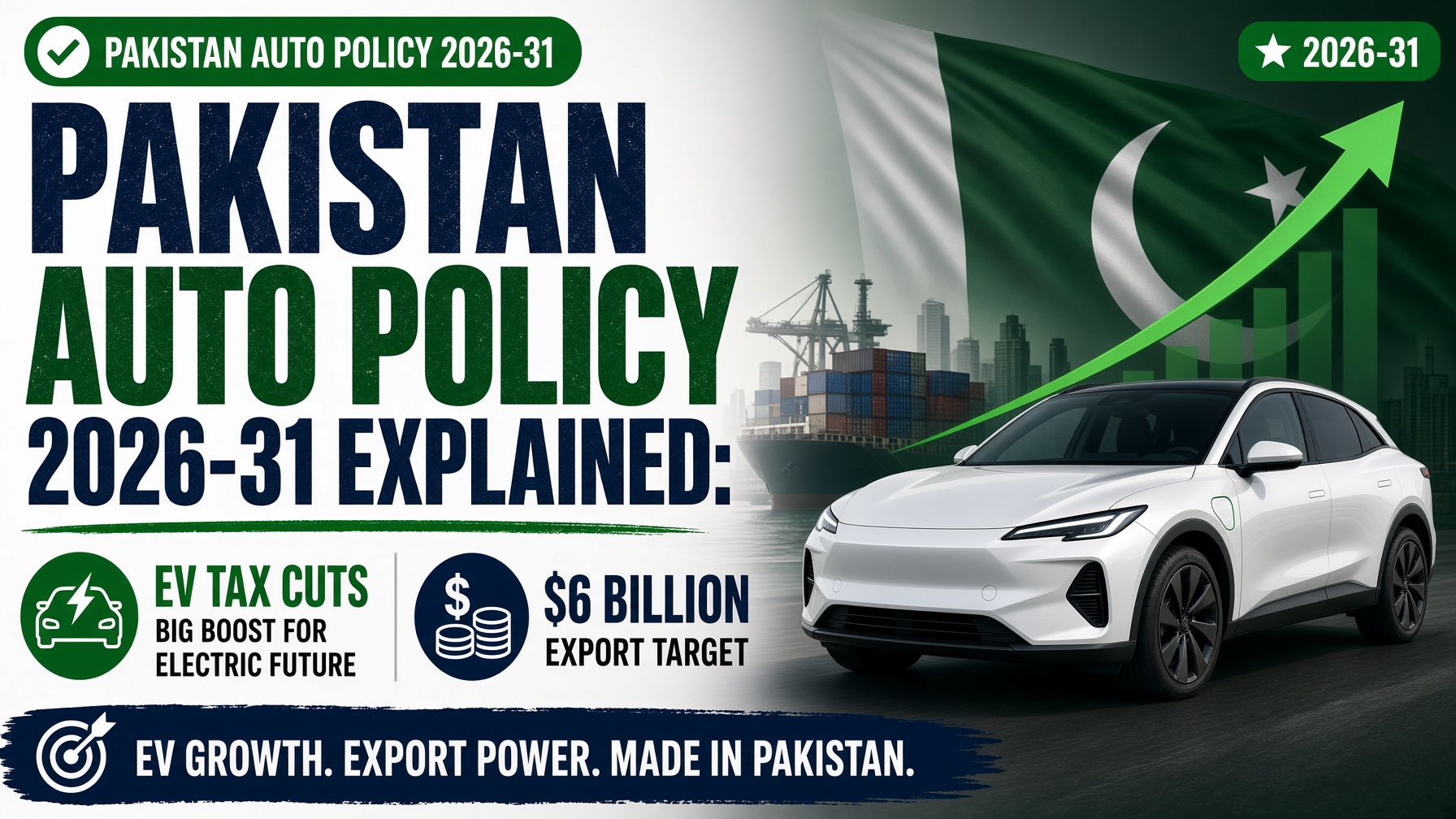
On 7 November 2026, Prime Minister Shehbaz Sharif approved the draft Automotive Industry Policy 2026-31 after securing the International Monetary Fund’s concurrence. The policy, announced by Adviser to the Prime Minister on Industries and Production Haroon Akhtar Khan and Information Minister Attaullah Tarar, aims to lower vehicle prices over time, accelerate electric vehicle adoption, raise localisation, improve safety standards, and generate $6 billion in auto exports over five years.
This long-form explainer breaks down every major provision, the tax changes, financing reforms, export incentives, consumer protections, and the likely impact on car prices and the broader economy.
Core Objectives of the Auto Policy 2026-31
The policy rests on six pillars repeatedly highlighted by the government:
- Make vehicles more affordable for middle- and lower-middle-income buyers.
- Shift 30% of new vehicle sales to electric power by 2030 (the government believes this can happen earlier).
- Increase domestic value addition and localisation.
- Build an export-oriented auto industry targeting $6 billion over five years.
- Introduce stricter safety and quality standards.
- Protect consumers from arbitrary price increases and excessive advance payments.
Revenue neutrality is a central constraint. Because Pakistan is under an IMF programme, any incentives for EVs and exports must be offset by higher collections from conventional internal combustion engine (ICE) vehicles above 1,000 cc. Vehicles up to 1,000 cc remain exempt from the new Automotive Development Levy.
EV Tax Structure: The Biggest Change for Buyers
The most consumer-facing reform is the proposed sales tax regime for new-energy vehicles:
| Vehicle Type | Proposed Sales Tax | Notes |
|---|---|---|
| Battery Electric Vehicles (BEV) | 1% | Already applicable in many cases |
| Range-Extended EVs (REEV) | 6% | |
| Plug-in Hybrid EVs (PHEV) | 9% | Significant reduction from previous rates |
| Conventional ICE (above 1,000 cc) | Normal rates + ADL | Funds EV and export incentives |
EVs priced up to $50,000 are also proposed to be exempt from capital value tax (CVT), withholding tax, and federal excise duty. Vehicles above this threshold will be treated as luxury items and taxed normally. These rates remain subject to final IMF approval, as repeatedly noted by Dawn, Express Tribune, and The News.
Charging infrastructure receives parallel support: customs duty on charging station equipment is set at zero, and sales tax on the machinery is reduced to 1%. The government has also committed to funding the “viability gap” that currently discourages private investment in charging stations.
Financing Reforms: EV Loans Up to Rs 10 Million
One of the most practical benefits for buyers is the expansion of vehicle financing:
- Maximum financing limit for electric vehicles rises from Rs 3 million to Rs 10 million.
- Loan tenure extends from three years to five years.
- Ordinary (non-EV) cars remain capped at the existing Rs 3 million / three-year limit.
This change, if implemented by the State Bank of Pakistan, dramatically improves affordability. Many popular electric models currently priced between Rs 6–12 million become realistically financeable for middle-class buyers. Gulf News and Pakistani outlets have highlighted this as one of the most significant demand-side measures in the policy.
Export Incentives and Localisation Targets
To reach the $6 billion export target, the policy introduces:
- 5% drawback of local taxes and levies (DLTL) for qualifying exporters.
- An additional 10% incentive on incremental annual export growth.
- Strict localisation and export volume targets; failure to meet them can trigger penalties.
- Gradual reduction in customs duties on completely built-up (CBU) vehicles and parts over five years.
- An Automotive Development Levy on ICE vehicles above 1,000 cc whose proceeds will help finance EV and export incentives.
Manufacturers will also be barred from demanding more than 20% of the vehicle price as an advance booking payment, with price-lock protections for consumers.
Safety Standards and Consumer Protection
The policy introduces approximately 45 new safety standards aligned with international norms. These cover crashworthiness, emission controls, child restraint systems, and electronic stability features. Over time, this is expected to raise the quality of locally produced vehicles and improve their acceptability in export markets.
Consumer protection measures include clearer pricing transparency, limits on advance payments, and stronger after-sales obligations. The government has framed these as necessary to rebuild public trust in the auto sector after years of complaints about arbitrary price increases.
Will Cars Actually Become Cheaper?
The government has stated that the combination of duty reductions, higher localisation, and increased competition should gradually lower prices for non-luxury vehicles. However, independent analysts caution that:
- Immediate price cuts are unlikely; most benefits will appear over 2–4 years as localisation rises and duties fall.
- Luxury and high-end models may see little or no reduction.
- EV prices should become more competitive sooner because of the 1% sales tax and higher financing limits.
- Inflation in raw materials, exchange rate movements, and any residual supply-chain issues could offset some of the intended gains.
Reports in Dawn and Profit note that the policy is designed for medium-term structural change rather than instant price relief.
Implications for the Economy and Energy Security
Transport is one of the largest consumers of imported petroleum products. A successful shift toward electric vehicles would reduce the oil import bill, ease pressure on the current account, and lower carbon emissions. The government has repeatedly linked the auto policy to the broader goal of energy security and has pointed to the solar boom as a model for what rapid policy-driven adoption can achieve.
Higher localisation and exports would also create skilled jobs in manufacturing, components, and charging infrastructure. The $6 billion export target, while ambitious, is intended to move the sector from a pure import-substitution model toward an export-oriented one.
Challenges and Implementation Risks
Several risks remain:
- IMF approval of the final tax rates is still required.
- Charging infrastructure must expand rapidly; without it, EV adoption will stall.
- Existing assemblers may resist localisation and export targets.
- Exchange rate volatility could erode the benefit of duty cuts.
- Consumer confidence must be rebuilt after years of high prices and long waiting periods.
Frequently Asked Questions
When does the Auto Policy 2026-31 come into force?
The draft has been approved by the Prime Minister. Final notification and implementation details are expected after Cabinet clearance and IMF sign-off.
Will petrol cars under 1,000 cc become more expensive?
No. Vehicles up to 1,000 cc are exempt from the new Automotive Development Levy.
Can I get a Rs 10 million loan for an EV today?
Not yet. The State Bank must issue the corresponding circular. The policy creates the framework for this change.
Are the 1%, 6% and 9% sales tax rates final?
They are proposed and subject to IMF approval.
Will used car imports be affected?
The policy focuses primarily on new vehicles and local manufacturing. Used-car import rules are governed by separate regulations.
Detailed Comparison with Previous Auto Policies
Pakistan has launched several auto policies over the past two decades, most notably the Auto Development Policy 2016-21 and subsequent interim measures. The 2026-31 policy differs in several important respects:
- Stronger and more explicit EV incentives than any previous framework.
- Explicit export volume and localisation targets with penalties for non-compliance.
- Consumer protection measures (20% advance payment cap) that were absent or weakly enforced earlier.
- Revenue-neutral design required by the IMF, which forces trade-offs between ICE and EV taxation.
- Integration with the National Electric Vehicle Policy launched the previous year.
Industry stakeholders have welcomed the clarity on EVs while expressing caution about the speed of localisation targets and the competitive pressure from lower CBU duties.
Impact on Specific Vehicle Segments
Small cars (under 1,000 cc): Largely protected. These remain the entry-level choice for many middle-class families and are exempt from the new levy. Prices should remain relatively stable or decline modestly with duty reductions on parts.
Mid-size sedans and SUVs (1,000–2,000 cc): These will bear the Automotive Development Levy. Some price increase is possible in the short term, partially offset by lower duties on CKD kits and higher competition.
Electric vehicles: Clear winners. The 1% sales tax, higher financing limits, and charging infrastructure support should accelerate adoption, especially in urban centres. Models from BYD, Jaecoo, and other new entrants are expected to benefit most.
Commercial vehicles and two-wheelers: The policy also promotes electric motorcycles and aims to reduce the fuel import bill from the two-wheeler segment, which is the largest in volume terms.
Charging Infrastructure Roadmap
The government has acknowledged that charging stations are the critical bottleneck. Measures include:
- Zero customs duty and 1% sales tax on charging equipment.
- Public funding to bridge the viability gap until utilisation rates rise.
- Coordination with distribution companies to ensure grid readiness.
- Incentives for private operators to install stations at petrol pumps, malls, and highways.
Analysts note that Pakistan’s rapid solar adoption provides a useful precedent. Once the economics improve and financing is available, private investment can scale quickly.
Employment and Industrial Development Effects
Higher localisation targets are expected to create jobs in component manufacturing, tooling, electronics, and battery assembly. Export growth would further support employment in logistics, quality control, and after-sales networks. The government has linked the policy to its broader industrialisation and “Made in Pakistan” objectives under the National Tariff Policy.
Risks of Implementation Delays
Past auto policies have sometimes suffered from slow notification, frequent amendments, and weak enforcement of localisation. Stakeholders will watch closely for:
- Timely issuance of SRO notifications.
- Clear guidelines from the State Bank on EV financing.
- Transparent monitoring of localisation and export targets.
- Consistent application of the Automotive Development Levy.
Frequently Asked Questions (Expanded)
How will the policy affect used car prices?
Indirectly. If new car prices moderate over time, the residual values of used cars may also stabilise or decline. Separate used-car import policies remain in force.
Can foreign manufacturers set up new plants under this policy?
Yes. The combination of duty reductions, export incentives, and EV support is intended to attract both existing players and new entrants.
What happens if a manufacturer fails to meet localisation targets?
The policy includes the possibility of penalties, including potential withdrawal of certain incentives. Exact enforcement mechanisms will be detailed in the final notifications.
Is there any special treatment for hybrid vehicles that are not plug-in?
Conventional hybrids are largely treated closer to ICE vehicles under the new framework, while plug-in hybrids receive the 9% rate.
Macroeconomic Context
The auto policy arrives at a moment when Pakistan’s foreign exchange reserves have strengthened, remittances remain robust, and the IMF programme is on track. A successful auto sector transformation would reduce the petroleum import bill (currently one of the largest components of the trade deficit) and generate export earnings. This aligns with the government’s $60 billion export target for the broader economy by the end of the decade.
Conclusion
If implemented effectively, the Auto Policy 2026-31 could mark a turning point for Pakistan’s automobile industry. Lower effective prices for EVs, larger financing options, gradual duty reductions, and stronger export incentives have the potential to expand the market, reduce the fuel import bill, and create a more competitive industrial base. Success will depend on consistent execution, rapid build-out of charging infrastructure, timely IMF approvals, and continued macroeconomic stability. For consumers, the most immediate benefits are likely to appear in the electric vehicle segment through lower taxes and substantially higher financing limits.
Discover more from The Economy
Subscribe to get the latest posts sent to your email.



Gold’s biggest trap is its reputation. Investors often describe the metal as a haven that should rise whenever markets become nervous. Yet gold can fall during a risk-off episode when investors need cash, bond yields rise or expectations about inflation and the dollar change.
That contradiction was on display in late October. Reuters reported that spot gold slipped below $4,000 per troy ounce intraday on October 23, after trading above $4,100 earlier in the week. The widely circulated gold at $4,100+ framing is therefore outdated as a timeless present-tense headline.
How global gold turns into a Pakistan tola price
The basic translation is straightforward. One troy ounce is approximately 31.1035 grams, while one traditional tola is about 11.664 grams. For a benchmark theoretical price:
PKR per tola ≈ (international USD price per troy ounce × USD/PKR × 11.664) ÷ 31.1035.
For illustration only, at $4,000/oz and Rs280 per dollar, the raw 24-karat equivalent is approximately Rs420,000 per tola before local premiums, taxes, fabrication, dealer margins and price differences. This is not an assertion of today’s actual Pakistan bullion-market quotation. Buyers must confirm a live local quote with a reputable dealer and specify purity.
The formula also explains why a falling international gold price does not guarantee a lower Pakistan rate. If the rupee weakens sufficiently, the local-currency price may stay flat or rise. A jeweller’s making charges can further separate the price of a finished ornament from bullion value.
Why the metal is under pressure
Gold pays no interest. When US Treasury yields rise, some investors find interest-bearing assets more attractive relative to metal. A stronger dollar can also pressure dollar-priced bullion. But this is not an iron law: reserve diversification, central-bank purchases, geopolitical concern and inflation fear can support gold even when real yields are high.
The World Gold Council’s data hub is useful for historical gold-price reference, while the Federal Reserve’s September rate decision provides context for the interest-rate side of the equation. Investors should not rely on a single screenshot or quote that fails to specify time zone, spot versus futures and unit.
Buy, hold or wait: choose the question first
A wedding buyer with a near-term obligation does not face the same decision as a long-term investor. If the metal must be purchased for a known event, price risk can be managed by spreading purchases over scheduled intervals rather than hoping to identify the exact bottom. Such a schedule reduces timing concentration but does not eliminate loss risk.
An investor using gold for diversification should determine what share of overall assets it occupies, how easily it can be sold, whether storage and authenticity are manageable, and what would cause a rebalancing. A speculative trader needs a different discipline: clear position sizing, loss limits and an understanding that highly volatile intraday moves can defeat confident price targets.
Physical jewellery versus investment bullion
| Feature | Jewellery | Certified bars or coins |
|---|---|---|
| Purpose | Wearable and cultural | Primarily investment exposure |
| Extra charges | Often significant making costs | Premiums and dealer spreads |
| Purity | Varies; verify hallmark | Verify assay and certification |
| Resale | Making charges usually not recovered | Buy/sell spreads still apply |
| Security | Storage and theft concerns | Storage and theft concerns |
Ask for a written invoice showing metal weight, purity, current per-gram or per-tola pricing, making charges and buyback terms. The bid–ask spread matters. A dealer may advertise one number for selling to customers and quote a materially lower number when repurchasing.
Three drivers of the next move
US real interest rates: if inflation expectations and Treasury yields shift, gold’s opportunity cost changes. Central-bank and private demand: persistent accumulation can support the market, but it should be documented rather than assumed. Pakistan’s exchange rate: the domestic outcome may differ sharply from global dollar returns.
The IMF’s October world outlook warns of geopolitical and inflation risks. Those risks can make gold valuable as a diversifier without making it a guaranteed hedge at any entry price.
The difference between a gold quote and an investment return
An investor can buy a physical gold item at one price and discover that its instant resale value is lower because of the dealer’s spread and making charges. The spread may be particularly important during volatile trading or for small pieces of jewellery. Measuring performance from the purchase invoice to the international spot quote exaggerates gains if the actual available buyback price is lower.
Purity is equally important. A 22-karat item contains less pure gold by weight than a 24-karat bar, while gemstones and decorative components make gross jewellery weight a misleading basis for a bullion valuation. A reliable invoice should record the relevant metal weight, fineness and separate charges. For inherited jewellery, an independent assay may be necessary before using a headline market rate to estimate value.
Gold also has portfolio opportunity costs. Cash and bonds may pay income; gold does not. That does not make either universally superior. It means a buyer should specify whether the objective is a cultural purchase, a short-term trade, inflation diversification or a long-term store of value. Each calls for a different view of transaction costs and holding period.
A disciplined buyer can document the dealer’s selling rate and repurchase policy on the same day. That small step often provides more useful information than another bold forecast of where the metal will trade next month.
Is the gold rate in Pakistan the international dollar price multiplied by USD/PKR?
Not exactly. You must convert the unit into tolas or grams and account for local premiums, taxes and trading spreads.
Is 22-karat jewellery worth the 24-karat rate?
No. Gold content differs. Check actual purity and weight, plus any stones or charges that complicate resale.
Could gold revisit its earlier highs?
Yes, but it could also fall further. An investment plan should consider both possibilities without assigning a fabricated probability.
Bottom line: a better decision begins with the purpose of the purchase, the correct unit conversion and a known exit cost. A price target is less useful than understanding what you actually own.
Discover more from The Economy
Subscribe to get the latest posts sent to your email.
There is an economic argument for diplomacy that rarely appears in the photographs of negotiators. Each tanker delayed, shipping premium raised or energy contract disrupted can become a higher fuel bill for an importer thousands of kilometres away. For Pakistan, involvement in talks concerning the United States, Iran and the Strait of Hormuz therefore has a practical domestic dimension.
On October 24, Iran’s ambassador in Islamabad said Tehran was open to further talks under an interim agreement brokered by Pakistan in June, according to Associated Press reporting. The ambassador described disagreements over the US naval blockade and reopening the strait. Those claims reflect Iran’s account of the talks, not proof that all parties have accepted a final settlement.
What would the dividend actually be?
The first potential benefit is not a new investment pledge. It is risk reduction. More predictable shipping through a major energy corridor could reduce the uncertainty priced into fuel contracts, maritime insurance and freight. This would matter for Pakistan’s import bill even without an immediate drop in benchmark oil prices.
Second, stability could support business planning. Refiners, large industrial consumers and shipping firms struggle to price future activity when cargo timing is unpredictable. A credible security arrangement would reduce costly contingency measures. Third, calmer regional relations could improve the prospects for lawful trade and energy cooperation—subject to sanctions rules, commercial feasibility and financing constraints.
None of these benefits is automatic. A pause in fighting can be fragile. A shipping route can be nominally open yet commercially unattractive if insurers and crews judge risks too high. And a diplomatic breakthrough might not remove domestic weaknesses in Pakistan’s energy sector.
Why Islamabad’s role matters beyond prestige
Pakistan has relationships across competing regional camps and faces powerful incentives to limit escalation along the Gulf. Its geography, diaspora links and reliance on imported energy give it a stake in outcomes. Qatar has also played a role in mediation; depicting Islamabad as the only channel would be misleading. The AP account specifically describes a Pakistan-brokered agreement reached with Qatar’s help.
A successful intermediary can sometimes gain diplomatic credibility that facilitates subsequent economic engagement. But credibility is earned through confidentiality, sustained contact and practical implementation, not by announcing an imaginary peace dividend in advance.
How the effect would reach Pakistan
Consider four linked markets. Crude oil responds to threats to supply. Tanker freight responds to route length, vessel availability and security. Marine insurance reacts to exposure and perceived escalation risk. Foreign exchange reflects the dollars needed to settle import transactions. Improvements in only one of these areas could leave the total landed bill elevated.
The World Bank’s October Pakistan report credits stabilization and remittances for supporting reserves, while acknowledging the Middle East conflict’s effects. That is the relevant context for diplomacy: external relief would support reform, not replace it.
Three possible diplomatic outcomes
| Outcome | Economic implications | What to verify |
|---|---|---|
| Durable shipping arrangement | Lower disruption risk and improved cargo predictability | Insurer terms, actual tanker movement, official commitments |
| Limited temporary understanding | Short-lived relief, risk of reversal | Monitoring mechanism and duration |
| Talks stall | Continued elevated energy and freight risk | Official statements, sanctions and blockade status |
A credible article about US–Iran talks should identify whose proposal is being discussed, which conditions remain disputed and whether shipping operators can actually use the route. Diplomatic language such as close to a deal is not the same as a binding document.
The investment narrative needs realism
Suggestions that a mediation role will immediately unlock billions in foreign investment are speculative unless linked to signed contracts, financing structures and feasibility studies. Pakistan could instead prioritize incremental gains: energy-security planning, better logistics, diaspora finance channels and trade facilitation that remains consistent with international obligations.
The wider economy matters too. The IMF’s October forecast projects global growth of 3.1% for 2026 and warns about conflict-related downside risks. Lower geopolitical uncertainty is welcome, but it does not instantly erase weak export productivity or fiscal bottlenecks.
How to measure a peace dividend without inventing a number
An economic dividend needs a counterfactual: what would energy, freight and trade costs have been without an agreement? That is inherently difficult to establish during simultaneous shifts in global demand and US interest rates. An analyst could compare tanker transit counts, average freight quotations and cargo arrival delays before and after a verified arrangement, while acknowledging unrelated market influences.
The most immediate indicators would likely be operational. Did ships complete voyages that had been postponed? Did underwriters alter war-risk premiums? Did counterparties begin offering more normal delivery windows? Only after those changes can analysts reasonably discuss effects on Pakistan’s import payments and inflation. A fall in crude on the day of a diplomatic announcement is suggestive, not conclusive evidence of causation.
There is also a policy lesson for Islamabad: mediation can create room for reforms that improve shock absorption. Energy efficiency, diversified procurement, stronger reserves and more productive exports reduce the cost of the next disruption regardless of who negotiates it. A foreign-policy success becomes more economically valuable when domestic institutions can make use of it.
The appropriate headline should therefore distinguish potential from realised savings. Diplomatic momentum is valuable, but an accounting entry requires more than optimistic language.
Has a comprehensive US–Iran agreement been finalized?
Not established by the cited October 24 reporting. The parties remain divided over the blockade and passage arrangements.
Would peace immediately lower Pakistan’s petrol prices?
Not necessarily. Domestic prices depend on refined-product benchmarks, the exchange rate, freight, taxes and procurement lags.
What is the strongest measure of diplomatic success?
Implementation: safer transit, sustained dialogue and measurable reduction in disruption, rather than the number of meetings or headlines.
The real prize for Pakistan is predictability. If mediation helps turn a volatile strategic corridor into a safer commercial route, the economic benefit will be felt in quieter import invoices and more confident business decisions—long before any grand diplomatic dividend can be calculated.
Discover more from The Economy
Subscribe to get the latest posts sent to your email.
Stabilization buys time; investment and productivity create lasting prosperity. Pakistan needs an achievable growth strategy that combines trade reliability, energy reform, digital capabilities and broad access to skills. This feature explains the mechanisms, risks and practical decisions that matter through 2027, with particular attention to Pakistan’s different exposure to energy prices, external financing, global trade and AI investment.
At a glance
- World output is forecast to rise, but opportunities and costs are uneven across countries.
- Global inflation forecasts do not predict household prices in Pakistan.
- The AI capital expenditure cycle lifts trade in electronics but may not translate into productivity gains everywhere.
- Pakistan’s IMF staff-level agreement is a milestone, not final Board approval.
- Stronger exports, competitive energy, fiscal credibility and skills are essential to durable growth.
The verified starting point: what the numbers actually say
The IMF October 2026 World Economic Outlook projects global growth of 3.1% in calendar 2026 and 3.4% in calendar 2027, alongside global headline inflation of 4.7% and 4.1%, respectively. Its statistical cutoff is 1 October 2026. The WTO October 2026 trade outlook projects merchandise trade volume growth of 3.9% in 2026 and 4.1% in 2027, versus commercial-services trade volume growth of 3.3% and 6.4%. These are forecasts from different statistical systems, not interchangeable growth measures.
For Pakistan, the IMF Pakistan October 7 staff-level agreement estimated FY2026 growth of 3.6%, September headline inflation of approximately 10.3%, and gross reserves near $21.5 billion at end-September. The fourth EFF review and third RSF review had reached staff-level agreement only, pending IMF Executive Board approval as of the release. Pakistan’s fiscal years run July–June; IMF global growth figures refer to calendar years.
| Indicator | 2026 | 2027 | Important distinction |
|---|---|---|---|
| IMF world GDP growth | 3.1% | 3.4% | Calendar-year projection |
| IMF world headline inflation | 4.7% | 4.1% | Global estimate, not Pakistan CPI |
| WTO goods trade volume growth | 3.9% | 4.1% | Real volume, not nominal trade value |
| WTO commercial services volume growth | 3.3% | 6.4% | Conditional rebound, not guaranteed |
The World Bank June 2026 Global Economic Prospects provides an earlier comparison framework, but its publication date and methodology differ from the October IMF and WTO releases. A thoughtful analysis should compare like with like and should never treat projections as realized outcomes. For a Pakistan-focused story, the crucial question is how global conditions enter domestic economic life.
Why this story matters now
The WTO October 2026 executive summary says AI-enabling goods accounted for 47% of year-on-year growth in the value of world merchandise trade during the first half of 2026. That does not mean 47% of all merchandise trade was AI-related. It identifies a contribution to growth, and in nominal value terms. The same source notes that AI-enabling goods trade rose 67% year-on-year in that period. These figures show how a narrow technology cycle can make global trade appear stronger even as other sectors struggle.
Meanwhile the Reuters October 2026 IMF annual meetings reports persistent concern about global financial risks, geopolitical disruptions and the uneven sharing of AI gains. The Reuters October 2026 Asian growth describes a region where technology investment supports some exporters while energy costs and higher yields challenge others. Pakistan is therefore exposed simultaneously to a potential technology opportunity and to more conventional fuel, financing and trade vulnerabilities.
Why stabilization is necessary but insufficient
For why stabilization is necessary but insufficient, A development strategy should prioritize the few reforms that unlock many activities at once. Reliable electricity improves factories, digital services, education and hospitals; smoother customs procedures help both traditional exporters and smaller new firms.
This matters for economic decision-making because firms and households cannot adjust instantaneously when conditions shift. Prices, contracts, worker skills and financial obligations move on different schedules. Analysts should identify the timetable, who bears the immediate cost, and who may capture the longer-term benefit.
A credible implementation plan requires named institutions, measurable indicators and regular public reporting. The point is not to promise an effortless transition; it is to make policy options concrete enough to compare their benefits and trade-offs.
Pakistan-specific decision test. For why stabilization is necessary but insufficient, ask four questions: (1) Which import cost, export opportunity, credit channel or productivity constraint is affected? (2) Which groups face the first-round effects? (3) What could policymakers or firms change within six months? (4) Which published indicator would demonstrate improvement rather than merely announce activity?
What to monitor: (i) official monthly or quarterly data; (ii) movements in export receipts and import bills; (iii) price changes versus changes in physical volumes; (iv) borrowing and working-capital costs; and (v) job quality and household purchasing power. A single monthly reading can be noisy. Comparing several releases helps distinguish a trend from a short-lived disturbance.
Export complexity and practical specialization
For export complexity and practical specialization, AI can augment business services and agriculture information, but only if workers have useful skills and firms can obtain affordable connectivity. Technology adoption is not a substitute for management, competition and trustworthy institutions.
This matters for economic decision-making because firms and households cannot adjust instantaneously when conditions shift. Prices, contracts, worker skills and financial obligations move on different schedules. Analysts should identify the timetable, who bears the immediate cost, and who may capture the longer-term benefit.
A credible implementation plan requires named institutions, measurable indicators and regular public reporting. The point is not to promise an effortless transition; it is to make policy options concrete enough to compare their benefits and trade-offs.
Pakistan-specific decision test. For export complexity and practical specialization, ask four questions: (1) Which import cost, export opportunity, credit channel or productivity constraint is affected? (2) Which groups face the first-round effects? (3) What could policymakers or firms change within six months? (4) Which published indicator would demonstrate improvement rather than merely announce activity?
What to monitor: (i) official monthly or quarterly data; (ii) movements in export receipts and import bills; (iii) price changes versus changes in physical volumes; (iv) borrowing and working-capital costs; and (v) job quality and household purchasing power. A single monthly reading can be noisy. Comparing several releases helps distinguish a trend from a short-lived disturbance.
AI as a business tool, not a slogan
For ai as a business tool, not a slogan, The real benchmark for policy success is sustained output per worker and the creation of better-paid work, not a single year of faster GDP growth financed by another round of borrowing.
This matters for economic decision-making because firms and households cannot adjust instantaneously when conditions shift. Prices, contracts, worker skills and financial obligations move on different schedules. Analysts should identify the timetable, who bears the immediate cost, and who may capture the longer-term benefit.
A credible implementation plan requires named institutions, measurable indicators and regular public reporting. The point is not to promise an effortless transition; it is to make policy options concrete enough to compare their benefits and trade-offs.
Pakistan-specific decision test. For ai as a business tool, not a slogan, ask four questions: (1) Which import cost, export opportunity, credit channel or productivity constraint is affected? (2) Which groups face the first-round effects? (3) What could policymakers or firms change within six months? (4) Which published indicator would demonstrate improvement rather than merely announce activity?
What to monitor: (i) official monthly or quarterly data; (ii) movements in export receipts and import bills; (iii) price changes versus changes in physical volumes; (iv) borrowing and working-capital costs; and (v) job quality and household purchasing power. A single monthly reading can be noisy. Comparing several releases helps distinguish a trend from a short-lived disturbance.
Investing in people and participation
For investing in people and participation, A development strategy should prioritize the few reforms that unlock many activities at once. Reliable electricity improves factories, digital services, education and hospitals; smoother customs procedures help both traditional exporters and smaller new firms.
This matters for economic decision-making because firms and households cannot adjust instantaneously when conditions shift. Prices, contracts, worker skills and financial obligations move on different schedules. Analysts should identify the timetable, who bears the immediate cost, and who may capture the longer-term benefit.
A credible implementation plan requires named institutions, measurable indicators and regular public reporting. The point is not to promise an effortless transition; it is to make policy options concrete enough to compare their benefits and trade-offs.
Pakistan-specific decision test. For investing in people and participation, ask four questions: (1) Which import cost, export opportunity, credit channel or productivity constraint is affected? (2) Which groups face the first-round effects? (3) What could policymakers or firms change within six months? (4) Which published indicator would demonstrate improvement rather than merely announce activity?
What to monitor: (i) official monthly or quarterly data; (ii) movements in export receipts and import bills; (iii) price changes versus changes in physical volumes; (iv) borrowing and working-capital costs; and (v) job quality and household purchasing power. A single monthly reading can be noisy. Comparing several releases helps distinguish a trend from a short-lived disturbance.
Measuring progress beyond GDP
For measuring progress beyond gdp, AI can augment business services and agriculture information, but only if workers have useful skills and firms can obtain affordable connectivity. Technology adoption is not a substitute for management, competition and trustworthy institutions.
This matters for economic decision-making because firms and households cannot adjust instantaneously when conditions shift. Prices, contracts, worker skills and financial obligations move on different schedules. Analysts should identify the timetable, who bears the immediate cost, and who may capture the longer-term benefit.
A credible implementation plan requires named institutions, measurable indicators and regular public reporting. The point is not to promise an effortless transition; it is to make policy options concrete enough to compare their benefits and trade-offs.
Pakistan-specific decision test. For measuring progress beyond gdp, ask four questions: (1) Which import cost, export opportunity, credit channel or productivity constraint is affected? (2) Which groups face the first-round effects? (3) What could policymakers or firms change within six months? (4) Which published indicator would demonstrate improvement rather than merely announce activity?
What to monitor: (i) official monthly or quarterly data; (ii) movements in export receipts and import bills; (iii) price changes versus changes in physical volumes; (iv) borrowing and working-capital costs; and (v) job quality and household purchasing power. A single monthly reading can be noisy. Comparing several releases helps distinguish a trend from a short-lived disturbance.
Policy options: three alternative paths, not numerical forecasts
| Scenario | Assumptions | Implications for Pakistan | Early warning or confirmation |
|---|---|---|---|
| More favorable | Energy costs stabilize; export markets remain open; AI use generates measurable efficiency | Space for investment, steadier purchasing power and stronger services exports | Export orders, real income and private investment improve together |
| Central case | Global growth follows the broad institutional outlook; commodity and funding pressures fluctuate | Gradual recovery with uneven gains across sectors | Stable external balances without a broad productivity surge |
| Adverse | Energy disruptions persist; financing costs rise; AI investment is repriced | Imports become more costly, credit tighter and fiscal choices harder | Reserves, inflation expectations and financing costs weaken at once |
These are qualitative editorial scenarios, not probabilities assigned by an econometric model. Their value lies in clarifying which evidence would require an updated judgment. The IMF October 2026 World Economic Outlook explicitly emphasizes downside risks involving conflict, trade tension, debt and reassessment of AI expectations.
A practical action agenda
For policymakers, the first responsibility is to protect hard-won macroeconomic stability while removing barriers to productivity. Regulatory predictability, tax administration, targeted social protection and transparent energy decisions are more useful than shifting incentives that are impossible for businesses to plan around. The IMF Pakistan 2026 country report identifies revenue mobilization, reform of state enterprises, energy-sector viability and improvements in human capital as linked policy priorities.
For exporters, resilience means identifying where demand is growing, investing in reliable delivery and obtaining credible certifications. Export strategies should track volumes, domestic value added and customer retention; gross receipts alone do not disclose profitability. For small businesses, the practical priority is to map exposure to fuel, electricity, imports and foreign-exchange requirements and to stress-test cash flows before making expansion commitments.
For households, risk management begins with an affordable budget, attention to debt servicing and a realistic distinction between nominal wage gains and purchasing power. For workers, portable skills and credible training can expand options across changing industries. None of this makes external shocks harmless; it simply offers concrete ways to be less exposed.
How this analysis differs from generic global coverage
Major international reporting is indispensable for establishing what happened. The Reuters October 2026 WTO briefing emphasizes the boost from AI to merchandise trade and the pressure of geopolitical disruption. Institutional releases provide detailed projections. This article goes a step further by asking how those macroeconomic signals might translate into local import costs, export competitiveness, employment, household budgets and reform choices. It is an interpretation of attributed evidence, not a claim of exclusive interviews or original field reporting.
The difference is particularly relevant for Pakistan because a global technology boom may coincide with higher costs for countries that import fuel but do not manufacture the equipment in highest demand. No serious strategy should assume that a worldwide headline rate automatically delivers the same benefits locally.
Frequently asked questions
What is the IMF’s global growth forecast for 2027?
The IMF’s October 2026 World Economic Outlook projects 3.4% global GDP growth in 2027, following 3.1% in 2026. These are calendar-year forecasts and may be revised as new data becomes available. See the IMF October 2026 World Economic Outlook.
Is global inflation expected to fall in 2027?
Yes, the October IMF forecast projects global headline inflation easing from 4.7% in 2026 to 4.1% in 2027. That describes the world aggregate and does not imply that prices in Pakistan will fall in absolute terms.
Is Pakistan’s latest IMF financing already approved?
The 7 October 2026 IMF release announced staff-level agreement for the fourth EFF and third RSF reviews, subject to Executive Board approval. The release should not be described as a completed Board decision. See the IMF Pakistan October 7 staff-level agreement.
Will AI investment create jobs in Pakistan?
It could create demand for implementation, software services and specialist support, while also changing tasks in existing occupations. The result depends on skills, investment, electricity reliability and competitive access to customers. No credible source guarantees a particular employment gain.
Does the WTO predict rapid growth in all kinds of trade?
No. Its October outlook differentiates merchandise volume growth from commercial-services volume growth and notes uneven performance by sector and region. Read the WTO October 2026 executive summary.
What should Pakistani companies monitor through 2027?
Export order books, input costs, electricity reliability, financing terms, exchange-rate conditions and customer demand are more operationally useful than a single global growth figure. Businesses should compare these against their own cash flows and margins.
Conclusion: the decisive issue is transmission, not the headline
Stabilization buys time; investment and productivity create lasting prosperity. Pakistan needs an achievable growth strategy that combines trade reliability, energy reform, digital capabilities and broad access to skills. The balance of risks is mixed: advanced technology can expand world production and trade, but it does not neutralize an energy shock or a financing squeeze. For Pakistan, policy credibility, internationally competitive exports and productivity-enhancing investment will determine how much of a fragile global expansion becomes better living standards at home.
This article is informational economic analysis, not individualized investment, tax or legal advice. Forecasts reflect sources available as of 21 October 2026 and should be checked before publication or subsequent updates.
Discover more from The Economy
Subscribe to get the latest posts sent to your email.

Pakistan Auto Policy 2026-31 Explained: EV Tax Cuts, $6 Billion Export Target

When Dollar Debt and Food Imports Collide: The Currency Squeeze

Why Freight and Storage Costs Keep Food Prices High After Oil Falls

Personal Injury Lawyer Near Me in NYC: How to Find the Right Attorney After an Accident

Why Falling World Food Prices Do Not Always Lower Grocery Bills

Oil Shocks and Core Inflation: Why the Two Move Differently

Singapore Cannot Fight Financial Fraud by Making Victims Bear the Risk Alone

Singapore Banking’s Real Test: Beyond Profits, Who Will Safeguard Financial Trust?

Nvidia’s Share Price Is Not a Scorecard for Singapore’s AI Future

The Australian Dollar Is Not Asia’s Oracle. Singapore Should Listen Anyway

Singapore’s Bank Sell-Off Is Really a Test of What Stability Is Worth

Why a Weaker Currency Makes Imported Food More Expensive

How Oil Price Shocks Raise Food Prices in Importing Countries

Petrol and Diesel Prices in Pakistan Today: Complete Update for 9 November 2026

Stock Market Crash in 2026? Warning Signs, Scenarios and a Calm Investor Checklist

US–Iran Conflict in October 2026: Hormuz, Oil Prices and Diplomacy

Dow Jones Today: Dow Slips 237 Points After the Worst Day Since April 2025

Pakistan IMF Programme 2026: Why Bailouts Keep Returning

US–China AI Export Controls in 2026: Chips, Testing Rules and Corporate Risk

SSI November 2026 Payment: Why Benefits Arrive October 30

2027 Federal Tax Brackets: New IRS Rates and Standard Deductions Explained

Singapore Stock Market Outlook 2027: The STI’s Bank-and-Yield Test

Stock Market Crash 2026? What the November Rout Actually Tells Us

World Bank Debt Report 2026: The $9.4 Trillion Burden Behind the Recovery

IMF Global Outlook 2027: The Recovery Is Real, but the Divide Is Growing

KSE-100 Index 2026: Is Pakistan’s Stock-Market Recovery Sustainable?

Germany–France ‘Made in Europe’ Deal Could Reshape China’s EV Ambitions

Power Grid Emergency Across 13 States? What the October 2026 PJM Order Actually Says
-

 Markets & Finance10 months ago
Top 15 Stocks for Investment in 2026 in PSX: Your Complete Guide to Pakistan’s Best Investment Opportunities
-

 Analysis9 months ago
Johor’s Investment Boom: The Hidden Costs Behind Malaysia’s Most Ambitious Economic Surge
-

 Analysis9 months ago
Top 10 Stocks for Investment in PSX for Quick Returns in 2026
-

 Banks10 months ago
Best Investments in Pakistan 2026: Top 10 Low-Price Shares and Long-Term Picks for the PSX
-

 Analysis9 months ago
Brazil’s Rare Earth Race: US, EU, and China Compete for Critical Minerals as Tensions Rise
-

 Investment10 months ago
Top 10 Mutual Fund Managers in Pakistan for Investment in 2026: A Comprehensive Guide for Optimal Returns
-

 Global Economy11 months ago
15 Most Lucrative Sectors for Investment in Pakistan: A 2025 Data-Driven Analysis
-

 Global Economy11 months ago
Pakistan’s Export Goldmine: 10 Game-Changing Markets Where Pakistani Businesses Are Winning Big in 2025