
Growth
Malaysia’s Chip Exports Defy the Wall Street Selloff


While chip stocks tumble on Wall Street, Malaysia’s semiconductor exports and GDP are surging on the same AI boom. Here’s how the real economy and equity markets have diverged.
Key Takeaways
- Malaysia’s electrical and electronics exports are on pace to exceed RM800 billion in 2026, with GDP growing 5.8% in Q2, beating the 5.2% consensus estimate.
- JPMorgan raised Malaysia’s 2026 GDP forecast to 5.3%, putting it ahead of most regional peers.
- Between January 2024 and March 2026, Malaysia’s semiconductor sector secured about MYR92 billion ($22.5 billion) in approved investments, roughly 90% of it foreign direct investment.
- HSBC frames Malaysia’s political and supply-chain neutrality as an increasingly valuable differentiator as chipmakers reassess location risk.
- Global semiconductor sales growth accelerated to 118.4% year-on-year in 2026, far exceeding prior upcycles — a pace RHB warns is unlikely to be sustained indefinitely.
While Wall Street questions whether the AI trade is a bubble (see Article 2), Malaysia’s real economy is delivering a very different verdict. Per The Star, the country’s exports of electrical and electronic products — including semiconductors — are expected to exceed RM800 billion this year, with GDP surging 5.8% in Q2 2026, comfortably beating a 5.2% consensus estimate.
The growth is broad-based rather than confined to chip exports alone. The Star’s reporting notes construction and engineering firm Gamuda’s order book hit a record RM52 billion in June as data centre projects more than offset weakness in property and infrastructure, with the company’s engineering managing director describing Malaysia’s investment case as resting on “a skilled English-speaking workforce and lower cost.” Malaysia’s overall competitiveness has also improved markedly: the same reporting notes the country climbed eight spots to 15th among 70 economies in the 2026 IMD World Competitiveness Ranking, after an 11-rung jump the year before. JPMorgan subsequently raised its 2026 GDP forecast for Malaysia to 5.3%, putting it ahead of most regional peers — a contrast The Star draws explicitly against “precarious” growth conditions in Indonesia (see Article 11) and a Philippines weighed down by high energy costs and a graft scandal.
The scale of investment underpinning this is substantial. Per TechNode Global’s coverage of HSBC research, Malaysia’s semiconductor sector secured around MYR92 billion ($22.5 billion) in approved investments between January 2024 and March 2026, of which roughly MYR83 billion ($20.3 billion) — about 90% — was foreign direct investment. HSBC frames the country’s position within global chip geopolitics as a genuine strategic asset: by maintaining working relationships with both the US and China, and complementing land- and resource-constrained Singapore, Malaysia can keep attracting diversified investment, with its “neutral reputation” becoming more valuable as multinational chipmakers reassess location risk around more geopolitically exposed Asian hubs.
That said, the gains aren’t evenly distributed across the industry. The same HSBC research, per TechNode, describes Malaysia’s chip-sector benefits as “uneven,” with supply risks and the ongoing challenge of moving further up the value chain — beyond assembly, testing and packaging into higher-value design and fabrication — weighing on the country’s longer-term outlook.
There’s also a sustainability question hanging over the entire regional AI-export story. Research house RHB, per TNGlobal’s coverage, notes that global semiconductor sales growth accelerated to 118.4% year-on-year in 2026 — far exceeding the peaks of previous upcycles — while cautioning that such elevated growth “is unlikely to be sustained indefinitely” as AI infrastructure investment matures and inventory and capex gradually normalize. RHB’s analysis flags integrated circuits specifically as Malaysia’s primary transmission channel between global semiconductor demand and domestic export and GDP growth — meaning the country is more directly exposed to a cyclical downturn than its diversified investment base might suggest.
Why It Matters
Malaysia’s real-economy strength offers the clearest evidence yet that the AI-driven demand cycle unsettling Wall Street investors (Article 2) has genuine physical-economy underpinnings in Southeast Asia’s chip-assembly hub — even as analysts at the same research houses warn the current growth pace can’t continue indefinitely.
Data and Evidence
- 2026 E&E export forecast: RM800bn+
- Q2 2026 GDP growth: 5.8%, vs. 5.2% consensus
- JPMorgan’s revised 2026 GDP forecast: 5.3%
- Semiconductor sector approved investment, Jan 2024–Mar 2026: MYR92bn ($22.5bn), ~90% FDI
- Global semiconductor sales growth, 2026: 118.4% YoY
- Malaysia’s 2026 IMD competitiveness ranking: 15th of 70, up 8 spots
Global Impact
Malaysia’s ability to attract diversified investment by staying neutral in US-China chip tensions is a live case study for other mid-sized manufacturing economies weighing how to position themselves amid intensifying great-power competition over semiconductor supply chains.
What Happens Next
Watch whether Malaysia’s approved investments continue converting into realized capacity at the current pace, and whether the country makes visible progress moving beyond assembly-test-package work into higher-value segments of the chip value chain, as HSBC’s research flags as the key longer-term challenge.
Frequently Asked Questions
Why is Malaysia’s economy outperforming while chip stocks fall? Malaysia’s exports and investment reflect real, contracted semiconductor demand, which has remained strong even as equity investors reprice future growth expectations. How exposed is Malaysia to a chip-demand downturn? Significantly — RHB’s research identifies integrated circuits as the primary transmission channel between global semiconductor cycles and Malaysia’s exports and GDP. What makes Malaysia attractive to chipmakers specifically? A skilled, English-speaking workforce, lower costs relative to Singapore, and political neutrality between the US and China. Is Malaysia moving up the value chain? Not yet significantly — HSBC notes this remains a key challenge, with most activity still concentrated in assembly, testing and packaging. How does Malaysia compare to Singapore’s AI-export story? Complementary — HSBC frames Malaysia as benefiting partly because it can absorb investment that land-constrained Singapore cannot.
Discover more from The Economy
Subscribe to get the latest posts sent to your email.


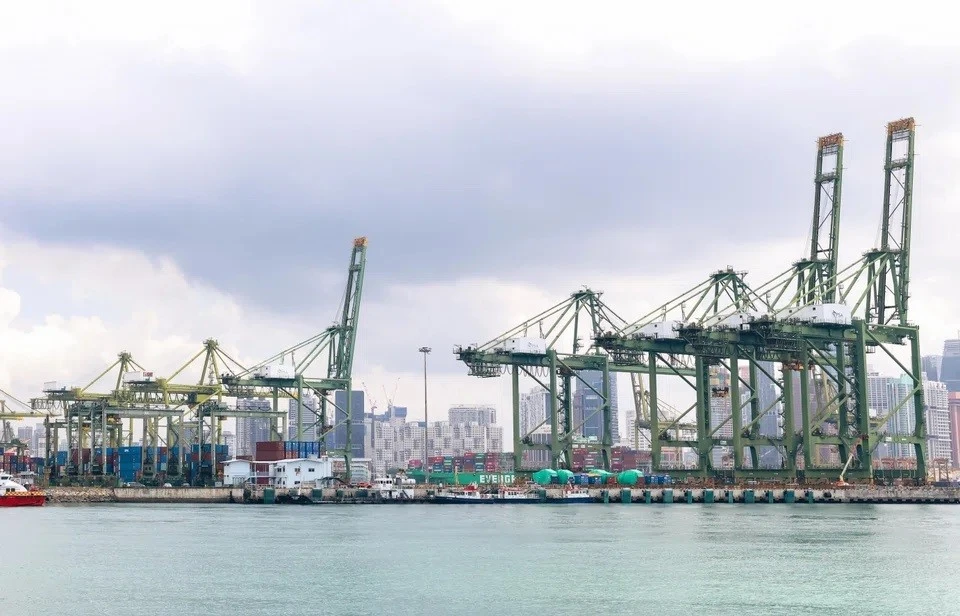
Singapore raised its 2026 GDP forecast to 4.5-5.5% for the second time this year, powered by AI-linked semiconductor exports. Here’s what’s driving the upgrade — and the risk behind it.
Singapore just told the world, in numbers, how deeply its economy has become an AI-trade barometer. Per TechRepublic, Singapore raised its 2026 growth forecast to 4.5-5.5% after stronger-than-expected global AI investment lifted semiconductor demand, exports and manufacturing output — the second upgrade this year, after the Ministry of Trade and Industry moved its outlook from 1-3% to 2-4% in February before this August revision.
Key Takeaways
- Singapore’s Ministry of Trade and Industry raised its 2026 growth forecast to 4.5-5.5%, its second upgrade of the year.
- The economy grew 5.9% year-on-year in Q2 2026, pushing first-half growth to 6.1%.
- AMRO estimates roughly half of global AI-related trade passes through ASEAN+3, with AI-linked exports generating about two-thirds of the region’s export growth in Q1.
- The same exposure that’s lifting Singapore’s growth is also its biggest downside risk if global AI capex growth slows.
- AMRO modeled a scenario where a slowdown to 2024-era AI investment growth could cut ASEAN+3 growth to 2.5% in 2027 — its weakest rate outside the pandemic.
The scale of the upgrade reflects genuinely strong underlying data, not just optimistic forecasting. The same TechRepublic reporting notes Singapore’s economy grew 5.9% year-over-year in Q2 2026, pushing first-half growth to 6.1% — with MTI attributing the strength specifically to stronger-than-expected global AI investment supporting producers and exporters of AI-related products such as semiconductors.
What makes this more than a single-country story is the regional read-through TechRepublic’s reporting highlights: the ASEAN+3 Macroeconomic Research Office (AMRO) estimates that roughly half of all global AI-related trade passes through ASEAN+3 economies, and that AI-linked exports generated around two-thirds of the region’s total export growth in Q1 2026 alone. AMRO subsequently raised its own 2026 regional growth forecast to 4.1%, citing the same AI-demand strength.
That concentration cuts both ways, and AMRO’s own modeling — cited in the same TechRepublic piece — makes the downside risk explicit: if global AI investment growth cools back to its 2024 pace, ASEAN+3 growth could slow to as little as 2.5% in 2027, which would be the region’s weakest growth rate outside the pandemic. In other words, the same exposure driving Singapore’s upgrade today is the single largest swing factor for the region’s growth trajectory over the next 12-18 months.
This dynamic isn’t new to 2026 — it has been building for months. Earlier reporting from Nikkei Asia in May 2026 already described how the AI boom had pushed Singapore and Malaysia’s electronics shipments to historic highs despite the supply-chain shock from the Middle East conflict — evidence that AI-linked demand has proven more resilient to regional geopolitical shocks than most other export categories. And the granular trade data backs the framing: per Malay Mail’s reporting on Enterprise Singapore data, non-oil domestic exports grew 9.3% in January 2026 alone, with electronics exports specifically up 56.1%, driven primarily by integrated circuits and disk media products — even as non-electronics exports actually declined 3%, underlining how narrowly concentrated the growth engine is.
Why It Matters
Singapore’s story is the clearest real-economy counterpoint to the Wall Street semiconductor selloff detailed in Article 2: even as chip stocks fall on sentiment concerns, the physical trade flows underpinning Singapore’s economy show no sign of the demand softness equity investors are pricing in — reinforcing the “fundamentals vs. sentiment” tension at the heart of the stock story.
Data and Evidence
- Singapore 2026 growth forecast: raised to 4.5-5.5% (second upgrade of the year, from 2-4% in February)
- Q2 2026 GDP growth: 5.9% YoY; H1 2026 growth: 6.1%
- ASEAN+3 AI-linked trade share: ~50% of global AI-related trade passes through the region
- ASEAN+3 Q1 2026 export growth attributable to AI-linked exports: ~two-thirds
- AMRO’s downside scenario: ASEAN+3 growth could fall to 2.5% in 2027 if AI investment growth normalizes to 2024 levels
Global Impact
Singapore’s trajectory is a leading indicator for how global AI capex decisions translate into real Southeast Asian economic outcomes — relevant not just to regional investors but to any nine-market reader tracking whether the AI investment cycle (also central to Articles 2, 7 and 10) is genuinely durable or narrowly concentrated.
What Happens Next
Watch Singapore’s Q3 2026 trade data and any signal from major hyperscalers on 2027 capex plans — both will be read as tests of whether the current AI-export windfall is sustainable or peaking, per AMRO’s own stated risk scenario.
Frequently Asked Questions
Why did Singapore raise its growth forecast again?
Stronger-than-expected global AI investment lifted semiconductor demand, exports and manufacturing output beyond what MTI had projected.
How much of Singapore’s growth is AI-related?
A large and growing share — electronics exports, driven substantially by AI-linked demand, have been the primary growth engine in 2026.
Is this growth model risky?
Yes — AMRO’s own modeling shows a slowdown in global AI investment could sharply cut regional growth as soon as 2027.
How does this compare to Malaysia?
Similar dynamic — see Article 10 — with both countries benefiting from the same AI-hardware supply chain.
Did the Middle East conflict affect Singapore’s exports?
Less than expected — AI-linked export demand has proven more resilient to the conflict than most other trade categories.
Discover more from The Economy
Subscribe to get the latest posts sent to your email.
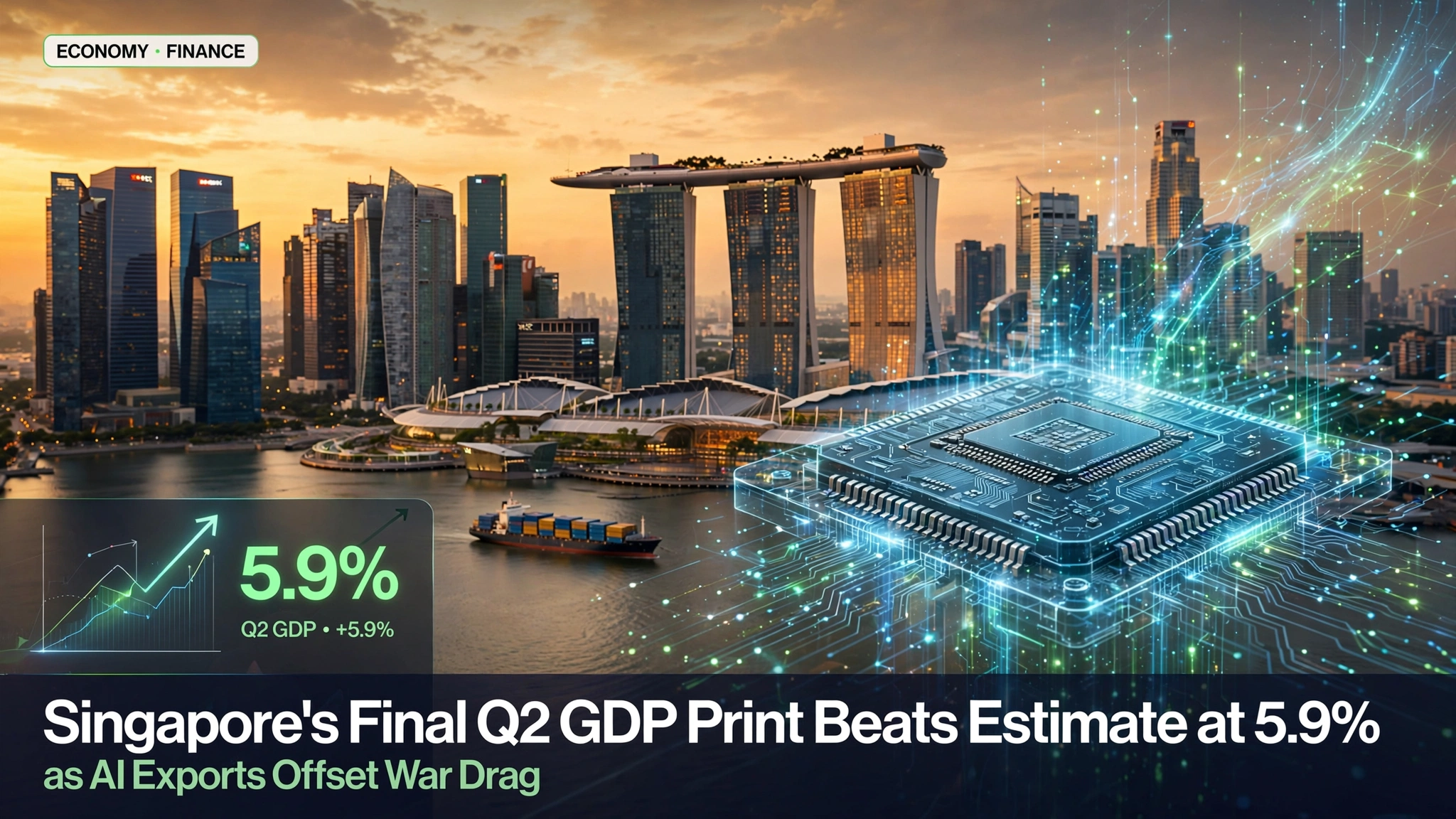
Singapore’s economy closed out the second quarter stronger than first thought, with confirmed data showing growth of 5.9% year-on-year — a full 0.2 percentage points above the advance estimate — as artificial intelligence-linked technology exports proved more resilient to the Middle East conflict than officials had feared.
The Numbers Behind the Upgrade
Singapore’s economy grew 5.9% in the second quarter of 2026 from a year earlier, according to finalised government data, above the official advance estimate of 5.7%. For the first half of the year as a whole, GDP growth came in at 6.1%, the Trade Ministry said. On a quarter-on-quarter, seasonally adjusted basis, the economy expanded 1.4% in the April-June period, comfortably ahead of the 1.1% advance estimate.
The confirmation prompted the Ministry of Trade and Industry to formally lock in its upgraded full-year growth forecast of 4.5% to 5.5%, more than double the original 2.0% to 4.0% range set back in February — before the outbreak of the Iran war. It marks the second upward revision to the outlook this year, following an initial estimate of just 1%-3% set last year.
Why AI Is Doing the Heavy Lifting
The ministry’s own language captures the split-screen nature of Singapore’s 2026 story: the 2026 outlook for AI-technology-linked sectors has improved, while sectors directly affected by Middle East supply disruptions remain weak. Denise Cheok, head of Southeast Asia Economics at Moody’s Analytics, said the economy has proved more resilient than expected largely because of a surge in technology exports tied to the AI boom, extending beyond cutting-edge GPUs to a broader range of electronic components.
UOB Global Economics and Markets Research has raised its own 2026 GDP forecast to 5%, from 4.8% previously, while flagging that momentum in the semiconductor and electronics sectors could moderate into year-end. DBS Group Research lifted its forecast to the same 5% level, up from 4.3%, citing the stronger-than-expected first half.
The Oil-Price Escape Valve
A key reason the war’s drag has been smaller than initially modelled: the Trade Ministry noted that a drawdown of oil inventories and substitution toward alternative energy sources has capped the rise in global energy prices that Singapore, as a trade- and energy-intensive economy, would otherwise have absorbed directly.
That relief has not been complete, however. The Monetary Authority of Singapore unexpectedly tightened monetary policy in late July, citing persistent inflationary risks as the Middle East conflict keeps energy cost pressures elevated — an unusual move for a central bank simultaneously watching growth run hot. MAS had already raised both its core and headline inflation forecasts for 2026 to a range of 1.5% to 2.5% back in April, and annual inflation stood at 1.6% in June, with the central bank expecting it to pick up and stay elevated into the first half of 2027.
Cushioning Households
The government has moved on the fiscal side to blunt the impact on households and businesses. Officials announced a S$900 million support package to help with high energy prices in July, on top of almost S$1 billion announced in April — a combined near-S$1.9 billion in targeted relief this year alone, reflecting how seriously the city-state is treating the risk that energy-driven inflation could erode the political and social benefits of an otherwise buoyant growth story.
The Risk Case
Enterprise Singapore has been careful to flag that the current resilience is not guaranteed to persist. The agency noted that the global economy has remained more resilient than expected, bolstered by sustained AI-related demand and capex spending, but added that downside risks include the Iran war and the new round of US tariffs. MAS itself has explicitly flagged the sustainability of the AI investment boom as a major risk to its own growth-firm-for-2026 outlook — an acknowledgment that Singapore’s current strength is a bet on a capex supercycle continuing, not a diversified, structurally embedded gain.
Key Takeaways
- Singapore’s finalised Q2 2026 GDP growth came in at 5.9%, beating the 5.7% advance estimate; H1 growth reached 6.1%.
- The Ministry of Trade and Industry confirmed its upgraded 2026 forecast of 4.5%-5.5%, more than double the original range.
- AI-linked technology exports are offsetting weakness in sectors hit directly by Middle East supply disruptions.
- MAS unexpectedly tightened policy in July on inflation risk, even as growth outperforms, and the government has rolled out nearly S$1.9 billion in energy-cost support this year.
Frequently Asked Questions
What was Singapore’s final Q2 2026 GDP growth rate? Singapore’s economy grew 5.9% year-on-year in the second quarter of 2026, above the 5.7% advance estimate, with first-half growth at 6.1%.
Why has Singapore’s growth outlook improved so much this year? A surge in AI-linked technology exports has more than offset the drag from Middle East supply disruptions, prompting two upward revisions to the 2026 GDP forecast.
Why did Singapore’s central bank tighten policy despite strong growth? MAS tightened monetary policy in late July to address persistent inflation risk from elevated energy costs linked to the ongoing Middle East conflict.
Discover more from The Economy
Subscribe to get the latest posts sent to your email.
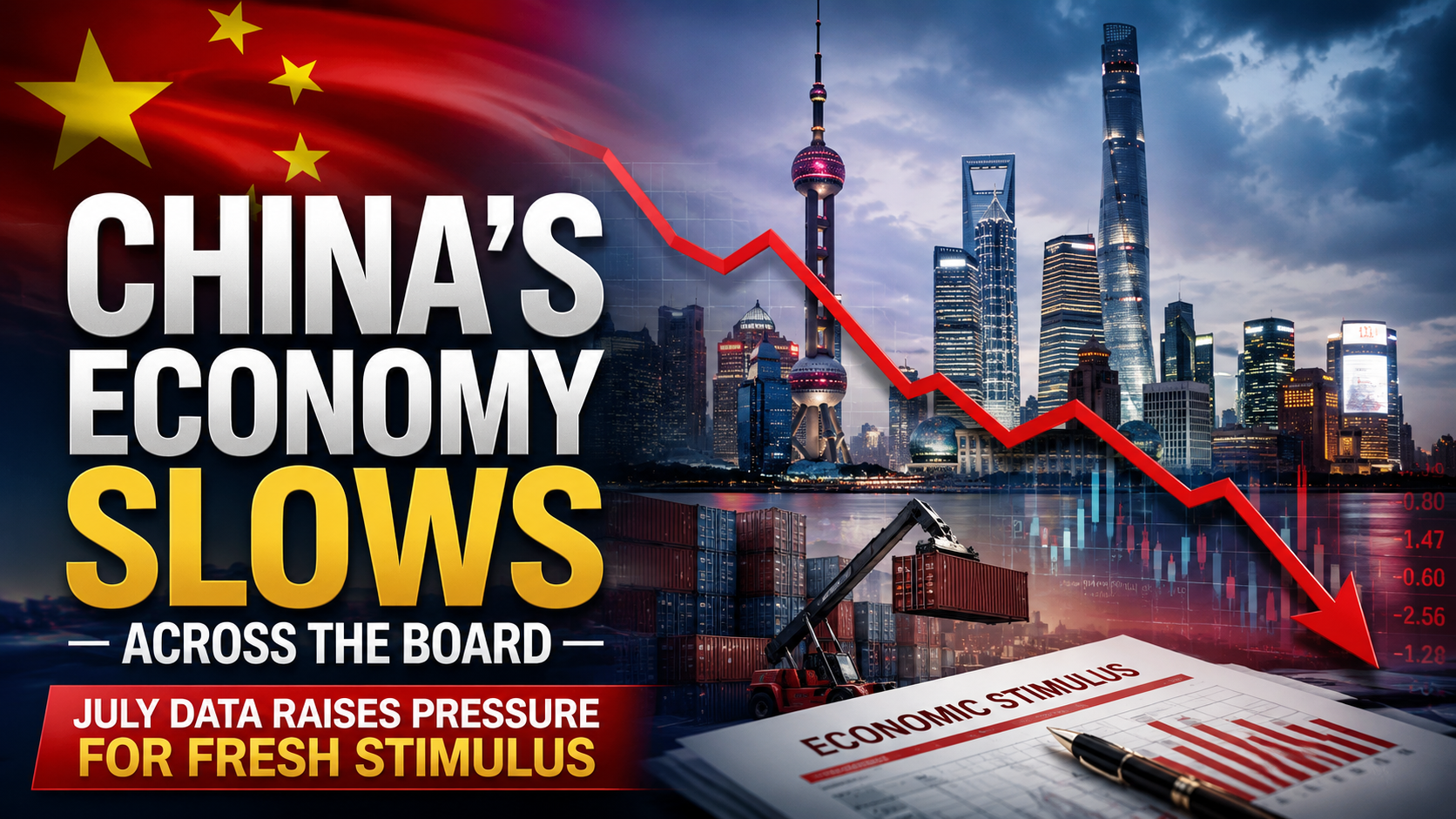
China’s economy opened the second half of 2026 on weaker footing than markets had hoped, with July data released Monday showing industrial output, retail sales, and fixed-asset investment all undershooting forecasts simultaneously — a broad-based miss that intensifies pressure on Beijing to deliver further policy support.
The Numbers Behind the Slowdown
Industrial production rose 4.5% year-on-year in July, missing the 4.8% consensus estimate and slowing from June’s 5.3% pace — the first deceleration in three months. Retail sales fared even worse: consumption grew just 0.6% year-on-year, well below the 1.5% forecast in a Bloomberg survey and down from 1% growth in June. In yuan terms, total retail sales of consumer goods reached 3,902.2 billion yuan (roughly $578.7 billion), up just 0.06% on a month-on-month basis — effectively flat.
Investment told a similarly downbeat story. China’s urban fixed-asset investment, spanning real estate and infrastructure, contracted 6.7% in the year to end-July, worse than the roughly 6% decline economists had expected. The labour market showed strain too, with the urban unemployment rate ticking up to 5.2% in July from 5% in June. Manufacturing sentiment reinforced the picture: July’s Purchasing Managers’ Index fell to 49.2%, back below the 50-point expansion threshold.
Why It’s Happening
China’s National Bureau of Statistics pointed to a combination of external and domestic pressures behind the soft patch. Spokesman Fu Linghui told reporters that international geopolitical conflicts persisted through July and the global energy market was marked by significant instability, a reference to the same Iran-linked oil volatility that has been rattling markets from London to Washington. Authorities also cited extreme weather conditions in parts of the country during the month as a contributing drag on activity.
Beijing is targeting national growth of 4.5%–5.0% for 2026 — already the lowest official goal in decades — and the economy fell short of that pace in the second quarter even before July’s figures. The property downturn remains the most stubborn drag: new home prices extended their decline in July, continuing a slump that has weighed on household wealth and, by extension, consumer confidence for well over two years.
The AI Export Lifeline
Not every part of the economy is struggling. Investment in high-tech industries grew a solid 5.0% year-on-year, with information services up 19.2%, aerospace vehicle and equipment manufacturing up 12.3%, and electronic and communication equipment manufacturing up 7.1%. More broadly, industrial production and exports tied to the global AI investment boom have helped cushion weak consumption and private investment, though July’s data suggest that offsetting support “may be thinning” as the headline numbers show broader weakness breaking through.
Trade data released earlier this month told a more encouraging story on the export side, with exports and imports both climbing on the back of overseas demand for AI-related technology products — a dynamic that has also shown up as a tailwind in Malaysia’s and Singapore’s most recent growth prints, both of which have leaned heavily on AI-hardware and data-centre exports this year.
What Comes Next: The Stimulus Question
The scale and timing of the data release itself became a story in its own right. China’s statistics bureau shifted Monday’s briefing to 3 p.m. local time — a break from its usual 10 a.m. slot and a move that coincided with the close of China’s stock market, fuelling speculation among analysts about whether officials were managing market reaction as much as reporting data.
With growth undershooting Beijing’s already-modest target, investors are now watching for a policy response. The People’s Bank of China and fiscal authorities have levers available — from further rate cuts to expanded consumer trade-in subsidies and infrastructure spending — but have so far proceeded cautiously given concerns about debt sustainability and the limited effectiveness of prior stimulus rounds in reviving the property sector specifically.
Key Takeaways
- Industrial output (4.5%), retail sales (0.6%) and fixed-asset investment (-6.7%) all missed forecasts in July, marking a broad-based slowdown.
- Urban unemployment rose to 5.2% and the manufacturing PMI slipped back below the 50 expansion threshold.
- Officials cited Middle East-linked energy market instability and extreme domestic weather as contributing factors.
- AI-related high-tech investment and exports remain a bright spot, growing 5% and helping offset weaker consumption.
- Markets are now watching for fresh stimulus signals after China fell short of its already-reduced 2026 growth target in the first half.
Frequently Asked Questions
Why did China’s July economic data disappoint? Industrial output, retail sales and fixed-asset investment all grew more slowly than forecast, with officials citing global energy market instability and extreme weather, on top of a prolonged property-sector downturn.
What is China’s 2026 GDP growth target? Beijing is targeting growth of 4.5%–5.0% for 2026, its lowest official target in decades, and the economy fell short of that range in the second quarter.
Is any part of China’s economy still growing strongly? Yes — high-tech investment and exports linked to global AI infrastructure demand grew solidly in July, helping offset weakness in consumption and property investment.
Discover more from The Economy
Subscribe to get the latest posts sent to your email.

Indonesia’s Rupiah and FDI Confidence Gap Widens Despite Headline Growth

Global Aviation Split: Cargo Boom Masks Falling Passenger Demand

Malaysia’s Chip Exports Defy the Wall Street Selloff

Singapore Upgrades 2026 Growth Forecast Again as AI Exports Surge

Dubai’s Property Market Posts Second-Best H1 Ever — While Hotels Sit Empty

Gold’s Wild 2026 Round Trip Resumes as Chip Selloff Revives Haven Demand

Russia’s Black Sea Oil Exports Fall for a Fifth Straight Week

Oil Surges as Strait of Hormuz Traffic Collapses Again

Pakistan’s Deficit Hits 22-Year Low — But Its Debt Stock Just Rose Again

Bank of England Set to Hold Rates Through Year-End, Reuters Poll Shows

Global Chip Selloff Deepens: What’s Driving the Aug. 19 Semiconductor Rout

Trump Extends Canada Tariff Deadline: What the 50% Duty Threat Means for CUSMA

Pakistan’s Flood Recovery Collides With Rising Spending

Gold’s Wild 2026: From a Record $5,600 Peak to a 24% Crash and Back Toward $4,500

China Politburo July 2026: Stimulus Signals Explained

Russia Fuel Shortages 2026: Inside a Cracking War Economy

Top 15 Financial Stocks for Investment in PSX

Pakistan Passed Its Third IMF Review

Andy Burnham, UK Gilts and Mortgages: July 2026 Explainer

SpaceX Stock Lockup Expiration Explained: Why $123B in Shares Could Hit the Market

Pakistan IMF Program 2026: Inside the Push Toward an Interest-Free Economy

Pakistan’s 2026 Monsoon Floods Threaten Fragile Economic Recovery as Inflation Nears 9%

Russia Oil Revenue 2026: How Sanctions on Rosneft and Lukoil Are Draining the War Chest

Russia’s Budget Deficit Blew Past Its Full-Year Target in Three Months

Russia Oil Revenue 2026: The Iran War Windfall and What a Hormuz Deal Means for Moscow

Canada US Trade War 2026: Inside Carney’s Push to Cut Ties With Trump’s Tariffs

Oil Prices Fall as Strait of Hormuz Reopens: 2026 Update

China Economy 2026: How AI Exports and a Property Crash Are Splitting Growth in Two
-

 Markets & Finance7 months ago
Top 15 Stocks for Investment in 2026 in PSX: Your Complete Guide to Pakistan’s Best Investment Opportunities
-

 Analysis6 months ago
Johor’s Investment Boom: The Hidden Costs Behind Malaysia’s Most Ambitious Economic Surge
-

 Analysis6 months ago
Top 10 Stocks for Investment in PSX for Quick Returns in 2026
-

 Analysis6 months ago
Brazil’s Rare Earth Race: US, EU, and China Compete for Critical Minerals as Tensions Rise
-

 Banks7 months ago
Best Investments in Pakistan 2026: Top 10 Low-Price Shares and Long-Term Picks for the PSX
-

 Investment7 months ago
Top 10 Mutual Fund Managers in Pakistan for Investment in 2026: A Comprehensive Guide for Optimal Returns
-

 Global Economy8 months ago
15 Most Lucrative Sectors for Investment in Pakistan: A 2025 Data-Driven Analysis
-

 Global Economy8 months ago
Pakistan’s Export Goldmine: 10 Game-Changing Markets Where Pakistani Businesses Are Winning Big in 2025