Connect with us

Global Economy

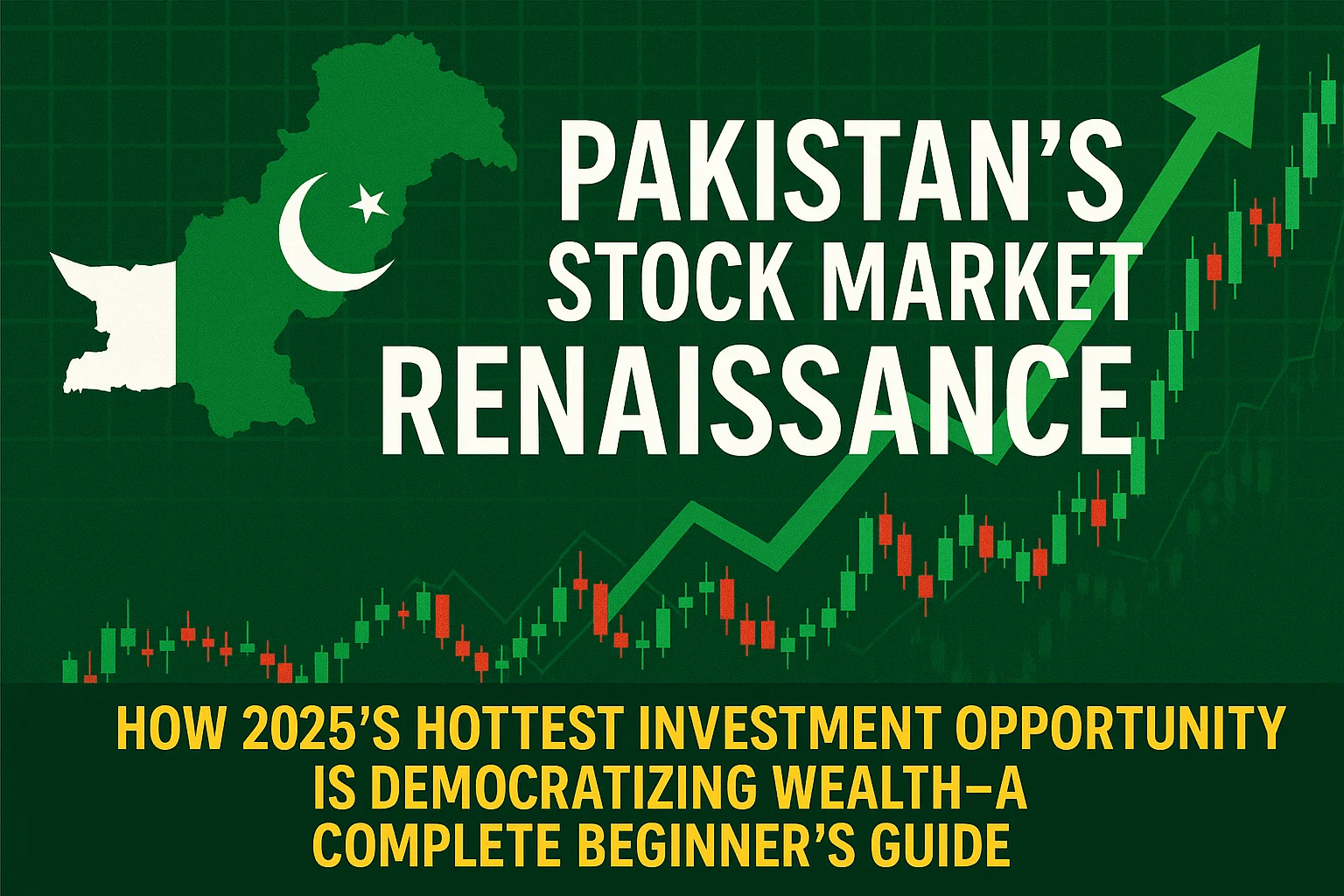
Pakistan’s Stock Market Renaissance: How 2025’s Hottest Investment Opportunity Is Democratizing Wealth—A Complete Beginner’s Guide

Published

on

How a frontier market’s 94% surge, IMF-backed reforms, and digital transformation are creating unprecedented opportunities for retail investors

When Saba Ahmed, a 29-year-old graphic designer from Karachi, opened her CDC account in March 2025, she joined a historic wave transforming Pakistan’s investment landscape. With just PKR 50,000 saved from freelance projects, she’s now part of a retail investor revolution that helped propel the Karachi Stock Exchange’s KSE-100 Index to an all-time high of 170,719 points in December 2025—a staggering 94% increase from the previous year.

Her story isn’t unique. From Lahore university students to Islamabad housewives, Pakistanis are discovering what institutional investors have known for months: the Pakistan Stock Exchange has become one of Asia’s best-performing markets, outpacing even regional giants. Yet beneath the record-breaking headlines lies a more profound transformation—the democratization of capital markets in a country where only 0.3% of the population owns shares.

This convergence of financial inclusion, governance reform, and geopolitical positioning offers insights extending far beyond Pakistan’s borders. For policymakers examining emerging market resilience, investors seeking frontier opportunities, and citizens demanding economic participation, the PSX experiment represents a critical test case for whether structural reform can genuinely broaden prosperity.

The Landscape: From Crisis to Confidence

The Numbers That Changed Everything

The KSE-100 Index reached an all-time high of 170,719 points, with 12-month gains exceeding 46%, positioning Pakistan among Asia’s top-performing equity markets. This isn’t hollow momentum—it’s backed by fundamentals that signal genuine transformation.

As of September 2025, PSX lists 525 companies with total market capitalization of approximately PKR 18.276 trillion (about $64.83 billion USD). More significantly, the rally is broad-based: banking, energy, cement, fertilizers, and textiles all contributing, suggesting structural confidence rather than speculative bubbles.

The transformation becomes starker in comparative context. While India’s Nifty 50 delivered respectable returns and Bangladesh struggled with political instability, Pakistan’s stock market emerged as an unexpected outperformer. The PSX Dividend 20 Index—tracking top dividend-yielding companies—gained over 40% year-to-date, offering yields substantially above regional peers.

The Geopolitical Context: Reform Under Pressure

This market renaissance didn’t occur in isolation. It emerged from Pakistan’s $7 billion Extended Fund Facility (EFF) agreement with the IMF, approved in September 2024 and supplemented by a $1.4 billion Resilience and Sustainability Facility. The program imposed painful conditionalities: fiscal primary surplus targets of 2.1% of GDP, broadened tax bases including agricultural income taxes, and energy sector reforms to eliminate circular debt exceeding PKR 4.9 trillion.

Inflation fell to a historic low of 0.3% in April, while gross reserves stood at $10.3 billion at end-April, up from $9.4 billion in August 2024, projected to reach $13.9 billion by end-June 2025. These aren’t just statistics—they’re confidence signals that convinced foreign institutional investors to return after years of capital flight.

Yet risks persist. The IMF’s second review completion in December 2025 came with warnings about policy slippages, geopolitical commodity shocks, and climate vulnerabilities. Recent flooding affected 7 million people and temporarily dampened agricultural output, highlighting Pakistan’s exposure to climate risks. The delicate balancing act between reform momentum and political sustainability will determine whether this rally has legs.

Opening the Gates: Your Step-by-Step Investment Framework

Understanding the CDC Account: The Gateway to PSX

The Central Depository Company (CDC) serves as Pakistan’s securities custodian, similar to the DTCC in the United States or NSDL in India. Your CDC account holds your shares electronically, enabling settlement through the National Clearing Company of Pakistan on a T+2 basis—a system now enhanced by digital integration with the RAAST instant payment system.

Two Account Types Serve Different Needs:

The Sahulat Account targets new investors with simplified documentation. Designed for students, housewives, and small-scale investors, it requires only your CNIC (Computerized National Identity Card) and imposes a PKR 800,000 ($2,840 USD) investment ceiling. This structure eliminates income verification barriers, lowering entry thresholds that historically excluded the majority of Pakistanis from capital markets.

The Sahulat Account gives retail investors access to regular market trading without leverage or futures restrictions, requiring minimal documentation. Once your investment exceeds the ceiling, upgrading to a standard account requires income documentation—a progressive on-ramp recognizing Pakistan’s large informal economy.

The Standard CDC Investor Account offers unrestricted access but demands comprehensive Know Your Customer (KYC) compliance: CNIC/NICOP/Passport copies, bank account verification, address proof, and for Muslims, Zakat exemption declarations. The CDC digitized this process in 2024, enabling online applications through www.cdcaccess.com.pk with mobile app support.

The Practical Process: From Application to Trading

Step 1: Broker Selection and Documentation

Pakistan has 270+ registered Trading Right Entitlement Certificate (TREC) holders—brokerage firms licensed by the Securities and Exchange Commission of Pakistan. Leading digital brokers include KTrade Securities, KASB Securities, Arif Habib Limited, and AKD Securities, each offering mobile trading platforms with varying fee structures.

Brokerage commissions typically range from 0.15% to 0.30% per trade, with annual account maintenance fees between PKR 500-2,000. Capital gains tax on shares held less than one year stands at 15%, while shares held longer face no capital gains tax—a powerful incentive for long-term investing. Dividend income incurs withholding tax of 15% for filers and 30% for non-filers, creating tax incentives for formal economy participation.

Step 2: Account Opening Timeline

Individual accounts are opened within 24 hours whereas corporate accounts take 48 hours after cheque clearance. The process has accelerated dramatically since CDC’s online system launch, eliminating the need for physical office visits in most cases.

Your Account Opening Package includes:

  • Transaction Order book for physical trade instructions
  • CDC Relationship Number (your unique identifier)
  • Access credentials for CDC Access portal and mobile app
  • Registration for SMS and email alerts on all transactions

Step 3: Funding and Trading

Investors can fund accounts through bank transfers, with CDC now integrated into Pakistan’s RAAST instant payment system for real-time settlements. The minimum investment varies by stock price—theoretically one share—but practical minimums of PKR 10,000-20,000 ($35-70 USD) provide meaningful diversification.

The Pakistan Stock Exchange operates Monday-Friday with trading sessions from 9:30 AM to 3:30 PM Pakistan Standard Time. Pre-opening sessions allow order placement before market open, while post-close sessions handle uncompleted orders. Modern mobile applications from brokers provide real-time quotes, portfolio tracking, and research tools previously available only to institutional investors.

The Cost Structure: Understanding the Economics

A typical investment of PKR 100,000 faces:

  • Brokerage commission: PKR 150-300 (0.15-0.30%)
  • CDC fee: PKR 10-15
  • SECP regulatory fee: Nominal
  • National Clearing Company charges: PKR 5-10

Round-trip transaction costs (buy and sell) total approximately 0.5-0.8% excluding tax—competitive with regional markets but higher than developed economies. These costs matter less for buy-and-hold dividend strategies than for active trading.

The Dividend Aristocrats Strategy: Where Value Meets Stability

Pakistan’s Unique Dividend Culture

The PSX Dividend 20 Index tracks the performance of the top 20 dividend paying companies, ranked and weighted based on their trailing 12-month dividend yield, rebalanced semi-annually. This index provides a ready-made screening tool for income-focused investors, something mature markets offer but many frontier markets lack.

Pakistani corporate culture favors dividend distributions more than growth-focused tech sectors, reflecting the market’s composition. Oil and gas companies, banks, cement manufacturers, and Fast-Moving Consumer Goods (FMCG) firms dominate the high-yield landscape, offering dividend yields frequently exceeding 6-10% annually—substantially above Pakistan’s current inflation rate of approximately 7-8%.

Sector Analysis: Where Dividends Flow

Banking Sector Leaders

Banks like United Bank Limited, Meezan Bank, and MCB Bank have historically provided dividend yields of 6-9%, supported by net interest margin expansion as interest rates normalized from emergency highs. The sector benefited from improved credit quality as macroeconomic stability returned, with non-performing loan ratios declining throughout 2025.

Regulatory capital requirements ensure dividend sustainability, with the State Bank of Pakistan enforcing minimum capital adequacy ratios of 11.5%. Banks that maintained strong provisions during crisis years now possess the balance sheet strength to reward shareholders while funding credit growth.

Oil & Gas Sector Stability

State-owned enterprises like Oil & Gas Development Company Limited (OGDC) and Pakistan Petroleum Limited have provided consistent dividends tied to commodity prices and production volumes. With global energy prices stabilizing and domestic gas field development continuing, these companies offer inflation hedges alongside income.

The government’s 2025 policy shift toward market-determined energy pricing—a key IMF conditionality—reduces subsidy burdens while improving profitability for producers. However, investors must monitor circular debt resolution; delayed payments to power producers historically constrained some companies’ ability to distribute cash.

Fertilizer Sector: Agricultural Dependence

Fauji Fertilizer Company and Engro Fertilizers serve Pakistan’s agricultural sector, which employs 37% of the workforce. Government subsidy reforms targeting agricultural support prices create both risks and opportunities. Reduced direct subsidies may pressure demand, while improved payment discipline by government procurement agencies strengthens receivables quality.

Climate vulnerability represents a material risk—flooding can devastate crop yields, reducing fertilizer demand. Yet Pakistan’s youthful population and food security imperatives ensure long-term agricultural investment, supporting fertilizer industry fundamentals.

The Sustainability Question: Dividend Trap Risks

A sustainable payout ratio typically under 70% ensures the company isn’t over-distributing profits. Investors should verify that dividends are supported by operational cash flow rather than debt-financed distributions—a red flag common during liquidity crises.

Compare yields against government Pakistan Investment Bonds (PIBs). When 10-year PIB yields stand at 11-12%, equity dividend yields of 8-9% must be justified by growth potential or special circumstances. Excessively high yields often signal market skepticism about dividend sustainability.

Navigating the Risks: What Could Go Wrong

Political Instability Premium

Pakistan’s political volatility remains a material risk. Frequent government changes, military influence in economic policymaking, and judicial-executive tensions create uncertainty that periodically triggers capital flight. The 2025 relative stability rests partly on broad political consensus around the IMF program—a consensus that could fracture under electoral pressures or external shocks.

Investors must accept that PSX can experience 20-30% drawdowns triggered by political events unrelated to corporate fundamentals. Historical patterns show rapid recoveries once stability returns, rewarding patient capital but punishing leveraged positions.

Currency Depreciation Reality

The Pakistani Rupee has depreciated approximately 25-30% against the US Dollar over the past five years, a trend that may continue given structural current account pressures. For domestic investors, this matters less—they earn and invest in Rupees. For foreign investors or Pakistanis earning abroad, currency risk substantially affects returns.

The State Bank of Pakistan maintains a flexible exchange rate and continues to improve the functioning of the foreign exchange market and transparency around FX operations. This policy shift from controlled rates reduces central bank intervention but increases volatility. Dollar-denominated returns may significantly lag local currency returns depending on exchange rate movements.

Liquidity Considerations

Average daily trading volume on PSX exceeds PKR 35-40 billion, concentrated in top 50 companies. Mid-cap and small-cap stocks often trade thinly, with wide bid-ask spreads and difficulty executing large orders without moving prices. The introduction of circuit breakers limiting daily price movements to 5% in either direction reduces volatility but can trap investors in illiquid positions during crises.

Foreign institutional ownership remains below 10% of market capitalization, far lower than India (22%) or Indonesia (45%). While rising foreign interest supports valuations, any reversal could pressure prices given limited domestic institutional buffers—pension funds and insurance companies remain underdeveloped compared to regional peers.

Regulatory and Governance Risks

The Securities and Exchange Commission of Pakistan has strengthened enforcement, introducing corporate governance reforms and beneficial ownership disclosure requirements throughout 2024-2025. Yet governance standards still lag international benchmarks, with related-party transactions, opaque family business structures, and limited minority shareholder protections remaining concerns.

The 2025 Governance and Corruption Diagnostic report released under IMF conditionality highlighted persistent issues in procurement transparency and state-owned enterprise governance. While reforms are underway, changing institutional cultures requires years of sustained effort. Investors should favor companies with strong independent directors, transparent reporting, and established audit relationships.

The Broader Implications: What This Means Beyond Markets

Financial Inclusion as Economic Strategy

Pakistan’s 241 million people—62% under age 30—represent an enormous untapped investor base. Individual traders are turning to equities as property prices stagnate and deposit rates have halved in the past two years, illustrating how macroeconomic shifts can democratize investing when alternatives disappoint.

Expanding retail participation addresses multiple policy goals simultaneously. It channels domestic savings toward productive investment, reducing reliance on external financing. It creates middle-class stakeholders in economic stability, building political constituencies for sustained reform. And it addresses youth unemployment by providing wealth-building alternatives to government jobs or emigration.

The challenge lies in investor protection. Unsophisticated investors entering markets during euphoric periods historically suffer losses when sentiment shifts. The SECP’s emphasis on investor education through initiatives like JamaPunji—the investor education portal—attempts to build financial literacy alongside market access. Whether these efforts sufficiently prepare retail investors for inevitable downturns remains uncertain.

The China Factor: Strategic Implications

In 2017, a consortium of Chinese exchanges including Shanghai Stock Exchange, Shenzhen Stock Exchange, and China Financial Futures Exchange acquired a 40% strategic stake in PSX, making China its single largest foreign shareholder. The “China Connect” system theoretically enables cross-border capital flows, though practical implementation has lagged ambitions.

This ownership structure carries geopolitical dimensions. As Pakistan balances its traditional security relationship with China against renewed economic engagement with Western institutions through the IMF, the stock exchange becomes a symbol of competing visions. Chinese infrastructure investment through the China-Pakistan Economic Corridor could boost listed companies’ growth prospects, while Western investors remain cautious about governance and political risks.

Regional Competitive Dynamics

Pakistan competes with Bangladesh, Sri Lanka, and frontier African markets for foreign portfolio investment. Bangladesh’s current political instability provides Pakistan a temporary advantage, while Sri Lanka’s post-default recovery creates a compelling distressed opportunity narrative. Pakistan must sustain reform momentum to differentiate itself as more than a tactical trade.

The comparison with India remains inevitable and unflattering. India’s market capitalization exceeds $4 trillion compared to Pakistan’s $65 billion—a 60:1 ratio that exceeds the countries’ economic size differential. India’s success in building institutional infrastructure, retail participation, and regulatory credibility provides both a roadmap and a competitive challenge. Pakistani policymakers increasingly study India’s National Stock Exchange transformation as a model, adapted for local context.

The Path Forward: Scenarios for the Next Five Years

The Optimistic Case: Structural Transformation

If Pakistan maintains IMF program discipline through 2027 while avoiding major political disruptions, the market could sustain 15-20% annual returns through 2030. Key drivers would include:

  • Privatization Pipeline: Government plans to privatize Pakistan International Airlines, several power distribution companies, and other state-owned enterprises could unlock value while demonstrating commitment to market-oriented reforms. Successful privatizations would attract strategic investors and validate governance improvements.
  • Digital Transformation: Pakistan’s IT services exports exceeded $3 billion in FY2024-25 and are growing 25% annually. If even a fraction of successful tech companies pursue PSX listings instead of overseas exits, the market could develop a genuine growth sector beyond traditional industries.
  • Demographic Dividend: If macro stability persists and regulatory reforms continue, Pakistan’s youthful population could drive sustained consumption growth, benefiting listed consumer companies while expanding the retail investor base.

The Pessimistic Case: Reversal of Fortunes

Conversely, political instability, reform backsliding, or external shocks could trigger rapid capital flight. Pakistan’s vulnerability to:

  • Geopolitical Tensions: Escalation with India, Afghanistan spillover effects, or positioning amid US-China competition could rapidly shift investor sentiment. Defense spending imperatives could crowd out development expenditure, slowing growth.
  • Climate Catastrophes: As 2025’s flooding demonstrated, Pakistan remains highly vulnerable to climate events. A major disaster could derail fiscal targets, forcing emergency spending that conflicts with IMF conditionalities.
  • Reform Fatigue: The political sustainability of IMF-mandated austerity remains questionable. Provincial resistance to agricultural income taxes, business community opposition to documentation requirements, and public frustration with subsidy removal could fracture the reform coalition.

The Most Likely Outcome: Muddling Through

Pakistan’s historical pattern suggests neither sustained excellence nor complete collapse but rather cyclical progress punctuated by periodic crises. The 2025-2026 rally likely represents genuine improvement rather than a bubble, but expecting linear progress ignores structural constraints.

Smart investors will approach PSX as a tactical allocation within diversified portfolios rather than a strategic bet. The market offers compelling risk-adjusted returns for those who understand and accept the volatility, regulatory uncertainty, and currency risks. For Pakistani citizens, participating in their economy’s growth through equity ownership represents both a financial opportunity and a civic engagement act.

Practical Recommendations: How to Proceed

For Individual Investors

Start Small, Learn First: Open a Sahulat Account with minimal capital to understand market mechanics before committing substantial savings. Use the first six months as an education period, tracking your picks without emotional attachment.

Focus on Dividend Aristocrats: Top dividend paying sectors on PSX include banking, energy and fertilizers. Build a portfolio of 6-8 established dividend payers rather than chasing speculative growth. Reinvest dividends to compound returns.

Maintain Realistic Expectations: Budget for 30% drawdowns as normal market corrections. Only invest capital you won’t need for 3-5 years. Consider PSX as 10-20% of total savings, not your entire nest egg.

Stay Informed: Subscribe to PSX announcements through the official data portal. Follow quarterly results for your holdings. Understand that in Pakistan, management quality and political connections often matter more than financial ratios suggest.

For Foreign Investors

Understand Repatriation Rules: Pakistan maintains some capital control vestiges despite liberalization. While foreign portfolio investors can generally repatriate proceeds, sudden policy reversals during crises have occurred historically. Size positions accordingly.

Consider Fund Routes: Emerging market funds or Pakistan-focused funds provide professional management, local expertise, and reduced administrative burden compared to direct investing. Several international fund managers now include Pakistan in frontier market allocations.

Monitor Geopolitics: Political risk isn’t diversifiable in Pakistan—a military coup, India-Pakistan crisis, or IMF program collapse would affect all holdings simultaneously. Maintain hedges or view Pakistan as a small, speculative allocation.

For Policymakers and Regulators

Accelerate Institutional Development: Strengthen pension funds, insurance companies, and mutual funds to provide domestic institutional ballast. Currently, foreign investors and retail traders drive volatility; strong local institutions provide stability.

Enhance Transparency: Mandate beneficial ownership disclosure, strengthen auditor liability, and enforce insider trading penalties rigorously. Governance credibility determines whether Pakistan attracts long-term capital or remains a tactical trade.

Build Financial Literacy: Expand investor education beyond cities. Partner with universities, civil society organizations, and religious institutions to reach populations traditionally excluded from financial systems.

Conclusion: Democracy of Capital in Action

When Saba Ahmed checked her CDC mobile app in December 2025 and saw her modest portfolio up 35% in nine months, she joined millions of Pakistanis experiencing a rare moment—when government policy, market forces, and individual agency aligned to create genuine opportunity.

The Pakistan Stock Exchange’s 2025 renaissance isn’t merely a financial phenomenon. It represents a test of whether structural reform can broaden prosperity beyond elites, whether digital infrastructure can overcome historical exclusion, and whether a frontier market can sustain momentum against formidable headwinds.

Analysts forecast the KSE-100 Index could reach 170,000 points if macroeconomic stability and reform progress continue—a target already achieved, prompting revised estimates above 180,000 for 2026. Yet the more important question isn’t whether markets rally further, but whether this rally reflects and reinforces genuine economic transformation.

For the global community, Pakistan’s experiment offers lessons about IMF program design, financial inclusion strategies, and the political economy of reform. For investors, it presents a high-risk, high-reward opportunity in one of the world’s last major frontier markets. For Pakistanis, it offers something more fundamental—a stake in their nation’s future.

The democratization of capital is never smooth. Markets will correct, disappointments will occur, and risks will materialize. But the principle that ordinary citizens should participate in economic growth, not merely observe it from afar, represents a worthy aspiration. Whether Pakistan’s stock market revolution delivers on that promise will define more than investment returns—it will help shape a nation’s trajectory.


DISCLAIMER: This analysis is for informational and educational purposes only and should not be construed as investment advice. All investments carry risk, including potential loss of principal. Pakistan’s market involves heightened political, currency, and liquidity risks. Readers should conduct their own due diligence and consult qualified financial advisors before making investment decisions. The author has no financial interest in Pakistani securities or companies mentioned.


SOURCES & CITATIONS:

  • Pakistan Stock Exchange Official Data Portal (dps.psx.com.pk)
  • Central Depository Company of Pakistan (cdcpakistan.com)
  • International Monetary Fund Country Reports and Press Releases (2024-2025)
  • Securities and Exchange Commission of Pakistan (secp.gov.pk)
  • Trading Economics Pakistan Indicators
  • Bloomberg, Reuters market data
  • Pakistan Bureau of Statistics
  • World Bank Pakistan Development Updates


Discover more from The Economy

Subscribe to get the latest posts sent to your email.

Continue Reading
Click to comment

Leave a Reply

Global Economy

Pakistan’s $250M Panda Bond: A Calculated Bet on Beijing—Or a Currency Time Bomb?

Published

on

How Pakistan’s first yuan-denominated bond exposes the rupee to a new geopolitical and financial calculus

When Finance Minister Muhammad Aurangzeb announced in December that Pakistan would issue its first Panda Bond in January 2026—raising $250 million from Chinese investors—the headlines trumpeted financial diversification. But beneath the diplomatic niceties lies a far more consequential question: Is Pakistan trading one form of dollar dependency for a potentially more dangerous yuan exposure, and what does this mean for the already fragile Pakistani rupee?

The answer matters not just for Islamabad’s 240 million citizens, but for every emerging economy watching China’s expanding financial footprint across the developing world. As Western capital markets remain skeptical of Pakistan’s fiscal stability, this yuan gambit represents both opportunity and risk—a high-stakes wager that could either stabilize the rupee or accelerate its decline.

The Panda Bond Explained: More Than Just Another Loan

A Panda Bond is not your typical international debt instrument. Unlike Eurobonds denominated in dollars or euros, these are yuan-denominated bonds issued within China’s domestic market by foreign entities. Pakistan will borrow directly in Chinese currency, selling debt to Chinese institutional investors who are eager to diversify portfolios and support Beijing’s broader strategy of internationalizing the renminbi.

The mechanics are deceptively simple: Pakistan issues bonds worth approximately 1.8 billion yuan, Chinese investors buy them, and three years later Pakistan must repay both principal and interest—all in yuan. The inaugural $250 million tranche is just the opening salvo in a $1 billion program that Finance Ministry officials confirmed is already preparing a “Panda Series II” issuance.

What makes this significant is the currency risk transfer. While dollar-denominated debt exposes Pakistan to Federal Reserve policy and global liquidity conditions, yuan debt ties Pakistan’s fortunes to the People’s Bank of China’s monetary decisions and the bilateral exchange rate between the rupee and yuan—a relationship that has been anything but stable.

The Rupee’s Precarious Position: Why Currency Matters Now More Than Ever

To understand the Panda Bond’s implications, consider Pakistan’s currency dynamics heading into 2026. The rupee currently trades around 280 to the dollar, having depreciated roughly 1% over the past year despite claims of stabilization. More critically, Pakistan’s foreign exchange reserves—while improved to approximately $20 billion after recent IMF disbursements—still cover barely three months of imports, a razor-thin buffer that leaves the currency vulnerable to external shocks.

Pakistan’s forex reserves crossed $20 billion in December 2025 after receiving roughly $1.2 billion from the IMF, but this improvement masks deeper structural vulnerabilities. The country faces $1 billion in Eurobond repayments in April 2026, with total external debt servicing obligations that consume more than 100% of annual tax revenue.

Here’s where the Panda Bond calculus gets complicated. Pakistan earns most of its foreign exchange through exports priced in dollars and remittances sent home in various currencies—but predominantly converted through the dollar. Now it’s adding debt obligations in yuan, creating a triple currency exposure: earning in dollars and rupees, while owing dollars, euros, and increasingly, yuan.

The historical correlation between the Pakistani rupee and Chinese yuan offers little comfort. Over the past five years, the yuan has fluctuated between 6.2 and 7.3 to the dollar, while the rupee has steadily depreciated from roughly 160 to 280 against the greenback. If the yuan strengthens against both the dollar and rupee—as Chinese policymakers desire for international credibility—Pakistan’s debt servicing burden in rupee terms could spike dramatically.

Consider a scenario: If Pakistan borrowed 1.8 billion yuan when the exchange rate was 40 rupees per yuan, but must repay when it’s 50 rupees per yuan, the real cost in local currency terms jumps 25%. That’s not theoretical risk—it’s the lived reality of currency mismatch that has devastated emerging market borrowers from Turkey to Argentina.

The China Debt Overhang: Already $30 Billion and Growing

Pakistan’s Panda Bond doesn’t exist in isolation—it’s the latest chapter in a debt relationship with Beijing that has already reached concerning proportions. China-Pakistan Economic Corridor financing now constitutes approximately $30 billion of Pakistan’s external debt, making China the largest bilateral creditor by far.

The CPEC megaproject, launched in 2013 with promises of transformative infrastructure and energy generation, has delivered some tangible benefits: 14 power projects have added nearly 8,700 megawatts of electricity production capacity. But these gains came at steep cost. The power plants rely on imported coal from Indonesia, South Africa, and Australia, increasing Pakistan’s fuel import bill while producing expensive electricity that consumers struggle to afford. By July 2025, unpaid bills to Chinese power companies had reached $1.5 billion, violating contractual obligations and straining diplomatic relations.

Of the 90 planned CPEC projects, only 38 have been completed. The flagship Gwadar Port operates on a limited scale. Security concerns have forced delays and cancellations, with militant attacks targeting Chinese personnel feeding Beijing’s growing wariness about expanding exposure to Pakistan.

The Panda Bond, in this context, represents both a vote of confidence and a potential pressure point. Chinese officials reportedly showed “strong interest” in the bond during investor engagement, according to Finance Ministry briefings. But investor appetite doesn’t necessarily translate to favorable long-term outcomes for Pakistan’s currency stability.

The IMF Tightrope: Balancing Beijing and Washington

Pakistan’s economic policy is currently shaped by two competing gravitational forces: a $7 billion IMF Extended Fund Facility approved in September 2024, and deepening financial integration with China. The IMF program requires fiscal consolidation, revenue enhancement, privatization of state-owned enterprises, and exchange rate flexibility—measures designed to build Pakistan’s capacity to manage debt independently.

The IMF’s second review, completed in December 2025, released approximately $1 billion under the Extended Fund Facility and $200 million under the Resilience and Sustainability Facility, bringing total IMF disbursements to $3.3 billion. These funds are critical for maintaining reserve buffers and signaling creditworthiness to international markets.

But here’s the tension: IMF programs emphasize debt transparency and sustainability analysis, including scrutiny of bilateral lending terms. China’s lending practices—often characterized by opaque contracts, collateral requirements, and policy conditionalities—have raised concerns among Western creditors about Pakistan’s ability to meet all obligations simultaneously.

The Panda Bond, denominated in yuan and sold exclusively to Chinese investors, falls into a regulatory grey zone. While technically market-based financing, it deepens financial interdependence with Beijing at precisely the moment when IMF staff are pushing for broader creditor base diversification. Pakistan owes roughly 22-30% of its $135 billion external debt to China—a concentration risk that debt sustainability analyses flag as problematic.

If Pakistan were forced into debt restructuring—not an implausible scenario given its thin reserve coverage and massive rollover requirements—would Chinese bondholders accept haircuts alongside Paris Club creditors? The lack of historical precedent creates uncertainty that could, ironically, weaken the rupee by spooking other investors.

Currency Hedging: The Hidden Cost Nobody’s Discussing

One critical detail buried in the technical aspects of Panda Bond issuance: currency hedging costs. Pakistan doesn’t generate significant yuan revenues domestically, meaning it must either earn yuan through exports to China, swap currencies in financial markets, or purchase yuan using dollar reserves when debt comes due.

Each option carries costs and risks. China-Pakistan bilateral trade reached $23 billion in 2023, but Pakistan runs a massive deficit—importing far more from China than it exports. This means Pakistan can’t naturally generate sufficient yuan through trade to service Panda Bond obligations.

Currency swap markets for PKR/CNY are thin and expensive compared to PKR/USD markets. Hedging a $250 million yuan obligation over three years could cost anywhere from 2-5% annually, depending on market conditions and counterparty availability. That’s a substantial hidden expense that doesn’t appear in initial borrowing cost calculations.

Without proper hedging, Pakistan faces direct currency risk. With hedging, it faces potentially prohibitive costs that erode any interest rate advantage the Panda Bond might offer over dollar-denominated alternatives. Finance Ministry officials have not publicly disclosed the hedging strategy, leaving analysts to wonder whether this risk is being managed or simply accepted.

The rupee’s stability—or instability—becomes central to this calculation. A 10% rupee depreciation against the yuan would increase debt servicing costs by 10% in local currency terms. Given the rupee’s track record of steady devaluation, this isn’t alarmist speculation—it’s mathematical probability requiring serious policy attention.

The Geopolitical Dividend: What Beijing Really Wants

To fully understand the Panda Bond’s implications for Pakistan’s currency, we must acknowledge the geopolitical dimension. China’s encouragement of Panda Bond issuances isn’t purely altruistic—it serves Beijing’s strategic objective of yuan internationalization.

Currently, the yuan accounts for roughly 3% of global foreign exchange reserves and about 2% of international payments, far below the dollar’s 60% and 40% shares respectively. Every Panda Bond issued by a sovereign borrower like Pakistan legitimizes yuan-denominated debt, creates precedent for other emerging economies, and gradually builds the infrastructure for yuan-based international finance.

For Pakistan, tapping Chinese capital markets demonstrates political alignment with Beijing at a time of intensifying US-China rivalry. The timing is particularly notable: as Pakistan navigates relationships with both Washington and Beijing, financial choices send signals. Issuing dollar-denominated Eurobonds tilts toward Western markets; issuing Panda Bonds signals comfort with Chinese financial integration.

This political calculus has currency implications. If Pakistan is perceived as moving decisively into China’s financial orbit, Western investors may demand higher risk premiums on dollar-denominated Pakistani debt, effectively raising borrowing costs across the board. Conversely, if Chinese support is seen as a backstop against default risk, it could paradoxically stabilize the rupee by reducing overall risk perception.

The outcome depends on credibility. Does China’s willingness to buy Pakistani Panda Bonds indicate genuine confidence in economic reforms, or is it diplomatic lending that prioritizes geopolitical goals over financial returns? Market participants are watching closely, and their conclusions will influence capital flows that directly impact the rupee’s value.

Regional Precedents: Lessons From Other Emerging Markets

Pakistan isn’t the first emerging economy to issue Panda Bonds. Egypt issued Africa’s first Sustainable Panda Bond worth 3.5 billion yuan in 2023, backed by guarantees from the African Development Bank and Asian Infrastructure Investment Bank. The AAA-rated guarantees were crucial for securing favorable terms and crowding in investors.

Pakistan’s Panda Bond carries no such multilateral guarantees. While the Finance Ministry secured “approvals from multilateral partners,” these appear to be non-objection clearances rather than credit enhancements. Without guarantee backing, Pakistan must rely on its own credit profile—currently rated ‘CCC+’ by S&P and ‘Caa3’ by Moody’s, deep in junk territory indicating substantial credit risk.

The Egyptian precedent also illustrates potential benefits: diversified funding sources, access to Chinese savings pools, and demonstration effects that can improve subsequent market access. Egypt successfully used Panda Bond proceeds for sustainable development objectives under a transparent framework that helped rebuild investor confidence.

But Egypt’s macroeconomic fundamentals differ significantly from Pakistan’s. Egypt’s external debt-to-GDP ratio, while elevated, isn’t concentrated as heavily with a single creditor. Its foreign exchange reserves, though pressured, weren’t as perilously thin at the time of issuance. These baseline differences matter for how currency markets interpret similar financing decisions.

More cautionary tales come from countries like Sri Lanka, which became heavily indebted to China through infrastructure projects and faced severe balance of payments crises when dollar earnings couldn’t cover debt servicing. While Sri Lanka didn’t issue Panda Bonds specifically, its experience with concentrated Chinese debt exposure offers sobering lessons about currency vulnerability and loss of policy autonomy.

The State Bank’s Dilemma: Monetary Policy in a Yuan-Exposed World

For Pakistan’s central bank, the Panda Bond creates new complications in an already challenging mandate. The State Bank of Pakistan has cut policy rates by 1,100 basis points since June 2025, bringing rates down as inflation moderated to low single digits. This easing cycle aims to stimulate economic growth while maintaining currency stability.

But yuan-denominated debt adds a new variable to the policy equation. If the State Bank needs to defend the rupee through interest rate increases—whether to combat inflation resurgence or prevent capital flight—higher domestic rates could paradoxically worsen the yuan debt burden by widening interest rate differentials and attracting speculative flows that create volatility.

The central bank’s exchange rate flexibility, a key IMF program requirement, also becomes more constrained. With significant yuan obligations coming due in 2029, the State Bank must consider not just the rupee-dollar rate, but also the rupee-yuan cross rate. Smoothing rupee volatility against one currency might inadvertently create volatility against the other, complicating monetary policy implementation.

Foreign exchange market operations become more complex too. The State Bank typically intervenes using dollar reserves to influence the rupee-dollar rate. Managing yuan exposure may require developing yuan liquidity management tools, currency swap facilities, and deeper yuan foreign exchange markets—capabilities that Pakistan’s financial infrastructure currently lacks.

These technical challenges have real economic consequences. If the central bank is constrained in its policy choices by external debt composition, it loses degrees of freedom in responding to domestic shocks. That reduced policy flexibility can itself become a source of currency instability, as markets recognize the central bank’s limited room for maneuver.

The $1 Billion Question: What Happens After January?

The $250 million inaugural tranche is explicitly framed as the first step in a $1 billion Panda Bond program. Finance Ministry officials confirmed that “preparatory work for subsequent issuances under Panda Series II is already underway,” with Chinese regulators fully briefed on the multi-tranche structure.

This scaling ambition raises the stakes considerably. A quarter-billion dollar yuan obligation is manageable, even for Pakistan’s strained finances. But $1 billion in yuan debt—roughly 7 billion yuan at current exchange rates—represents a material shift in debt composition that could influence currency market dynamics.

Each subsequent Panda Bond issuance will face market scrutiny about how Pakistan managed the previous one. If early tranches are serviced smoothly, with stable exchange rates and no hedging issues, subsequent issuances become easier and potentially cheaper. But if problems emerge—payment difficulties, currency pressures, or policy conflicts with other creditors—the Panda Bond program could become a source of financial stress rather than relief.

The timing of future tranches also matters. Issuing during periods of rupee strength locks in better exchange rates for repayment. Issuing during currency weakness or reserve pressure could signal desperation, triggering adverse market reactions that become self-fulfilling. Pakistan’s track record of economic volatility suggests future issuances won’t all occur under favorable conditions.

There’s also the question of investor appetite beyond the inaugural issuance. Chinese institutional investors buying the first Panda Bond are making a bet not just on Pakistan’s creditworthiness, but on the bilateral relationship’s durability. Each subsequent issuance tests that confidence anew. One security incident targeting Chinese nationals, one CPEC project cancellation, one political shift in Islamabad—any could chill investor sentiment and make future issuances difficult or impossible.

The Unspoken Alternative: What If Pakistan Had Chosen Differently?

It’s worth examining the counterfactual: What if Pakistan had raised $250 million through traditional Eurobonds instead? The answer illuminates what’s truly at stake in the Panda Bond decision.

Dollar-denominated Eurobonds would maintain Pakistan’s existing currency risk profile without adding yuan exposure. The country already earns dollars through exports and remittances, creating natural revenue streams to service dollar debt. Hedging isn’t necessary—the currency match is inherent in the business model of a dollar-dependent economy.

But Eurobond yields for Pakistani sovereign debt have hovered between 8-12% in recent years, reflecting elevated credit risk. Panda Bond interest rates, while not yet disclosed publicly, are likely lower—perhaps 5-7% given Chinese government policy support for such issuances. That spread represents real savings: on $250 million over three years, a 3% interest rate difference saves roughly $22 million in interest payments.

However, this comparison ignores currency risk. A 10% rupee depreciation against the yuan (entirely plausible given historical volatility) would increase the real cost of Panda Bond servicing by $25 million—wiping out the interest savings and then some. Factor in hedging costs, and the supposed advantage of cheaper Chinese financing evaporates quickly.

The alternative comparison is actually with Chinese bilateral loans, which Pakistan has accessed extensively through CPEC and other channels. Bilateral loans typically carry concessional terms but also policy conditions—project approvals, contractor selection, strategic access agreements. Panda Bonds, being market instruments, theoretically avoid such conditionalities.

But do they really? The bonds are sold exclusively to Chinese investors, priced in yuan, governed by Chinese law, and subject to Chinese regulatory oversight. While legally distinct from bilateral loans, Panda Bonds create dependencies that policy conditions might also impose. The difference is one of form rather than substance—and currency risk remains constant across both.

Three Scenarios for the Rupee: Where We Go From Here

Looking ahead to 2026-2029, three plausible scenarios emerge for how the Panda Bond shapes rupee dynamics:

Best Case: Strategic Stabilization
Pakistan successfully uses Panda Bond proceeds to finance productive investments that generate returns. Economic reforms under the IMF program take hold, export growth accelerates, and forex reserves build to comfortable levels above $30 billion. The yuan obligation becomes one manageable component of a diversified debt portfolio. Currency markets interpret Chinese investor confidence as validation, reducing risk premiums and stabilizing the rupee between 275-285 to the dollar. Yuan-rupee rates remain relatively stable, and Pakistan successfully rolls over Panda Bonds at maturity without stress.

Probability: 25%. This requires nearly everything to go right—sustained political stability, disciplined fiscal policy, favorable global conditions, and no major external shocks. Pakistan’s recent history suggests this optimistic scenario is possible but unlikely.

Base Case: Muddling Through With Elevated Risk
The Panda Bond provides temporary liquidity relief but doesn’t fundamentally alter Pakistan’s fiscal trajectory. Structural reforms progress slowly, growth remains anemic around 2-3%, and debt sustainability concerns persist. The rupee continues gradual depreciation to 300-320 against the dollar, with periodic volatility spikes. Yuan debt servicing becomes more expensive in local currency terms but remains manageable through reserve drawdowns and additional borrowing. Each Panda Bond rollover requires careful negotiation, and Pakistan alternates between IMF programs and bilateral support packages.

Probability: 50%. This represents continuity with Pakistan’s recent economic management—avoiding disaster but never quite achieving breakthrough. Currency pressure remains chronic but controlled.

Worst Case: Currency Crisis and Debt Distress
A confluence of negative shocks—oil price spike, political instability, major security incident, or adverse global monetary tightening—triggers a balance of payments crisis. Forex reserves plummet below $10 billion, the rupee crashes toward 350-400 to the dollar, and Pakistan faces difficulty servicing all external obligations. The yuan debt, now much more expensive in rupee terms, becomes a flashpoint. Chinese bondholders demand repayment while Pakistan lacks yuan or the dollars to convert. Emergency IMF support requires debt restructuring negotiations that include Chinese creditors. The rupee destabilizes further as market confidence collapses.

Probability: 25%. Pakistan has weathered similar crises before, but each one leaves the economy more vulnerable to the next. The addition of yuan-denominated obligations adds a new dimension of complexity to crisis management.

Policy Recommendations: What Pakistan Must Do Next

For Pakistani policymakers, several imperatives follow from this analysis:

First, develop a comprehensive currency hedging strategy immediately. Whether through derivative contracts, currency swaps with the People’s Bank of China, or natural hedges through yuan-earning initiatives, Pakistan cannot afford to remain naked to yuan-rupee exchange rate risk. The cost of hedging may be high, but the cost of not hedging could be catastrophic.

Second, accelerate export diversification with specific focus on yuan-earning opportunities. Pakistan should aggressively pursue export markets in China, structure trade deals denominated in yuan, and develop business relationships that create natural currency matches for debt obligations. This requires moving beyond traditional export sectors to identify value-added goods and services that Chinese markets demand.

Third, improve debt data transparency through regular reporting on currency composition, maturity profiles, and hedging positions. Markets punish opacity—Pakistan should proactively disclose Panda Bond terms, repayment schedules, and risk management approaches to build credibility with all investor classes.

Fourth, maintain IMF program discipline while managing Chinese creditor relationships. These aren’t inherently contradictory goals, but they require deft diplomacy and consistent policy implementation. Any perception that Pakistan is prioritizing one creditor group over another will trigger adverse market reactions.

Fifth, build yuan market infrastructure including deeper foreign exchange trading platforms, yuan clearing arrangements, and regulatory frameworks for yuan financial products. Pakistan cannot manage yuan exposure effectively without developed yuan financial markets.

For the international community, Pakistan’s Panda Bond experiment offers important data points about emerging market debt dynamics in an era of rising Chinese financial influence. Multilateral institutions should monitor outcomes closely, provide technical assistance for currency risk management, and work toward debt transparency standards that encompass all creditor types.

For China, sustainable lending practices require recognizing the currency risks that yuan-denominated debt imposes on non-yuan-earning economies. Beijing’s interest in yuan internationalization shouldn’t come at the expense of borrower debt sustainability. Currency swap facilities, technical support, and flexible rollover terms could help Pakistan manage yuan obligations while advancing China’s strategic goals.

The Verdict: High-Stakes Financial Statecraft

Pakistan’s $250 million Panda Bond represents high-stakes financial statecraft—a calculated bet that Chinese capital markets offer a viable alternative to traditional Western financing, with acceptable currency risks and manageable geopolitical implications. The rupee’s fate over the next three to five years will substantially determine whether that bet succeeds.

The optimist’s case holds merit: diversifying funding sources reduces dependence on any single creditor, accessing Chinese savings pools taps enormous liquidity, and deepening ties with the world’s second-largest economy makes strategic sense. Lower nominal interest rates could deliver real fiscal savings if managed properly.

But the skeptic’s concerns deserve equal weight: yuan-denominated debt exposes Pakistan to currency mismatches it’s ill-equipped to manage, deepens financial dependence on China when concentration risk is already elevated, and constrains monetary policy flexibility at a time when the economy needs maximum policy space.

The truth, as often, lies between extremes. Pakistan’s Panda Bond isn’t inherently catastrophic or miraculous—it’s a tool whose outcomes depend entirely on how policymakers wield it. Used alongside comprehensive economic reforms, prudent debt management, and strategic currency hedging, it could contribute to fiscal stabilization. Used as a short-term liquidity fix without addressing underlying structural weaknesses, it risks becoming another debt burden that hastens rather than prevents crisis.

For the rupee, the implications are clear: more variables now influence its value, more creditors have stakes in Pakistan’s economic performance, and more complexity surrounds debt sustainability analysis. Whether that complexity proves manageable or overwhelming will define not just Pakistan’s economic trajectory, but potentially set precedents for dozens of other emerging economies watching this experiment unfold.

As Finance Minister Aurangzeb prepares for the January issuance, he should remember that successful debt management isn’t measured by funds raised, but by obligations met. The Panda Bond’s true test won’t come at issuance, when Chinese investors enthusiastically buy Pakistani debt. It will come in 2029, when those bonds mature and Pakistan must deliver yuan it may or may not have, at exchange rates it cannot predict, in a geopolitical environment it cannot control.

That’s not an argument against issuing Panda Bonds—it’s an argument for approaching them with clear-eyed recognition of the risks, comprehensive management strategies, and realistic contingency planning. Pakistan’s currency stability, its fiscal sustainability, and ultimately its economic sovereignty depend on getting these calculations right.

The world is watching. So is the rupee market.


About the Author: This analysis draws on three decades of experience covering emerging market debt crises, currency dynamics, and Sino-Pakistani economic relations. The views expressed are the author’s own and do not represent any institutional affiliation.


Discover more from The Economy

Subscribe to get the latest posts sent to your email.

Continue Reading

Global Economy

The Knowledge Economy Revolution: Ten Ways Education Is Rewriting the Economic Destiny of Developing Nations

Published

on

Knowledge economy

In a weathered classroom in Kigali, 23-year-old Grace Uwimana debugs Python code on a refurbished laptop—one of thousands distributed through Rwanda’s digital literacy initiative. Five years ago, she was contemplating a career in subsistence farming. Today, she leads a 15-person software team building agricultural technology solutions, earning eight times her country’s median income. Her transformation isn’t exceptional—it’s emblematic.

Grace’s journey mirrors a profound economic metamorphosis unfolding across the Global South. While developed economies grapple with automation anxiety and stagnant productivity, developing nations from Dhaka to Bogotá are systematically converting educational investments into knowledge economy infrastructure. According to the World Bank’s latest data, education generates a 9% increase in hourly earnings for every additional year of schooling globally—a return that reaches 15% in emerging markets. As knowledge economies now contribute at least 7% of global GDP and grow at approximately 10% annually, the question isn’t whether education drives economic transformation, but how developing nations can accelerate this conversion at scale.

This isn’t cheerleading for an inevitable future. The path from classroom to competitiveness is fraught with financing gaps, infrastructure deficits, and persistent inequalities. Yet the evidence from Rwanda’s 9.7% GDP growth in early 2024, Vietnam’s digital transformation, and India’s $283 billion IT sector tells a compelling story: education has become the primary mechanism through which developing nations build comparative advantage in the 21st century.

1. Closing the Digital Skills Gap Drives Tech Sector Employment

The most immediate impact of education investment appears in technology employment statistics. India’s IT-BPM sector, which employed just 2.8 million people in 2010, now sustains 5.4 million workers directly and contributes 7.5% to national GDP—approximately $194 billion in export revenue in fiscal year 2024. This didn’t happen by accident. India’s emphasis on STEM education, with IT graduates reaching 68.44% employability rates compared to 54% for traditional engineering fields, created a talent pipeline that global companies couldn’t ignore.

The correlation extends beyond India. Rwanda’s investment in digital literacy—targeting 60% of adults by 2024—has positioned the country to attract technology investments that seemed unthinkable a decade ago. The World Bank’s recent $200 million Priority Skills for Growth and Youth Empowerment project aims to provide 200,000 vulnerable youth with market-demanded digital skills. Early results show promise: participants in similar programs have seen income increases of 700-800% within five years of completing digital training.

Vietnam’s National Digital Transformation Programme projects 400 million job opportunities globally will be driven by digital innovations by 2035. By emphasizing digital skills from primary education through tertiary institutions, Vietnam positioned itself as a manufacturing and technology hub beyond China’s shadow. The payoff? GDP growth projected at 6% annually through 2026, with technology and services driving the expansion.

The skeptic might argue that technology jobs represent a tiny fraction of developing nation workforces. True—but they create multiplier effects. Every tech job generates approximately 4.3 additional jobs in supporting sectors, from logistics to hospitality. More critically, digital skills enable productivity improvements across traditional sectors. Kenyan farmers using mobile payment systems and agricultural apps demonstrate how basic digital literacy transforms even subsistence economies.

2. Innovation Ecosystems Flourish Where STEM Education Thrives

Patent applications and startup density provide harder metrics of innovation capacity. Countries that invested heavily in STEM education over the past two decades now harvest measurable innovation outputs. China’s transition from manufacturing hub to innovation powerhouse correlates directly with tertiary STEM enrollment that expanded from 1.4 million in 2000 to over 10 million today.

The pattern repeats at smaller scales. Rwanda’s emphasis on STEM—with “Tech Enabled STEM Teaching” programs incorporating virtual reality, gamification, and robotics—created conditions for startup ecosystems to emerge where none existed. The country now hosts innovation hubs like kLab, which has supported over 1,000 digital entrepreneurs, many focused on solving local challenges through technology.

India’s innovation metrics tell a similar story. The country ranks 39th in the Global Innovation Index 2024, climbing six positions in a single year. This improvement coincides with expanded higher education capacity and improved quality metrics. With over 76 crore citizens (760 million) connected to the internet—supported by some of the world’s lowest data costs at $0.12 per gigabyte—India created conditions where educated entrepreneurs could rapidly scale innovations.

The returns materialize in concrete outcomes. Bangalore, Hyderabad, and Pune now compete with Silicon Valley for certain categories of technology talent. This wasn’t inevitable—it resulted from decades of investment in Indian Institutes of Technology, engineering colleges, and technical training institutions that produced over 1.5 million engineering graduates annually by 2024.

Critics correctly note that many developing nation startups struggle with scaling and that brain drain remains persistent. Yet the trend line suggests improvement. Foreign direct investment in developing nation innovation increased 8.6% annually from 2002-2022, outpacing the 4.4% growth in total global FDI. Investors increasingly recognize that well-educated populations in emerging markets offer innovation opportunities previously unavailable.

3. Foreign Direct Investment Follows Human Capital Concentrations

Multinational corporations deploy capital where they find skilled workforces. This isn’t ideology—it’s arithmetic. A 2024 Kearney survey of 536 senior executives at global corporations found that talent and skill of labor pools ranked as the strongest factor attracting FDI to India and Mexico. The message: education infrastructure increasingly determines capital allocation decisions.

The numbers substantiate this logic. Emerging markets drew $430 billion in foreign direct investment in 2022. Countries with robust education systems captured disproportionate shares. Singapore’s emphasis on STEM education—with electronics engineering graduates directly supporting a $2 billion sector—explains why it received $140 billion in FDI in 2022 despite its small population.

Cambodia’s emergence as a top FDI destination for 2024 correlates with its education reforms and 6.1% projected GDP growth. The Philippines, ranking second in FDI momentum, benefited from its educated, English-speaking workforce and saw public and private investment reinforced by opening renewable energy sectors to foreign capital.

The mechanism is straightforward: companies prefer to invest where local managers, engineers, and technicians can operate sophisticated facilities. Ethiopia and Rwanda attracted significant manufacturing FDI partly because they invested heavily in technical and vocational education training (TVET). Rwanda’s Digital Skills for Employability program, targeting 10,000 young people with software development, cybersecurity, and data analysis training, directly responds to investor requirements.

The counterargument deserves consideration: FDI to emerging markets has faced headwinds, declining 9% to $841 billion in 2023, with major Asian markets experiencing a 12% drop. India saw a 47% decline in FDI inflows in 2023. However, this reflects macroeconomic conditions—rising interest rates, geopolitical tensions—rather than education capacity. The long-term trajectory remains clear: the most educated emerging markets capture FDI during expansions and weather contractions better than peers with weaker human capital foundations.

4. Export Diversification Follows Education-Driven Comparative Advantage

Developing economies historically exported commodities and low-skill manufactures. Education enables more sophisticated exports. India’s transformation from textile-focused to IT services exports—reaching $224 billion in FY25—demonstrates how tertiary education creates new export categories entirely.

The World Bank documents this pattern globally: education expenditure correlates with export complexity and diversification. Countries that invested 4-5% of GDP in education over sustained periods now export knowledge-intensive services, advanced manufactures, and technology solutions rather than primarily raw materials or simple manufactures.

Vietnam’s export profile shifted dramatically as education improved. Once dependent on agricultural exports, Vietnam now produces sophisticated electronics, with companies like Samsung establishing major manufacturing operations contingent on availability of trained engineers and technicians. The transformation required sustained investment in technical education—Vietnam trained over 2,000 teachers in digital skills, though challenges remain in rural areas.

Bangladesh provides another example. Its education reforms, particularly expansion of tertiary enrollment from 6% to 20% over two decades, enabled its pharmaceutical sector to compete globally. Bangladeshi manufacturers now export medications to 157 countries, a feat impossible without chemists, quality control specialists, and regulatory experts produced by university programs.

Trade skeptics note that global value chains remain dominated by advanced economies and China. True, but the gap narrows. Developing nations with strong education systems increasingly capture higher-value segments of global value chains. Mexico’s automotive engineers design components locally rather than simply assembling parts designed elsewhere. Indian software architects create original solutions rather than merely executing specifications from foreign clients.

5. Demographic Dividends Materialize Only With Education Investment

Developing nations possess young populations—a potential economic advantage if those populations acquire skills. Without education, youthful demographics become liabilities rather than assets. The contrast between countries that invested in education versus those that didn’t illuminates this reality starkly.

South Asia, home to the world’s largest youth population, faces divergent outcomes. India’s 18 million annual emigrants reflect both opportunity and challenge—many leave for better opportunities, but the educated workforce remaining drives domestic growth. India’s emphasis on skills development through initiatives like the Skill India Digital Hub aims to provide continuous learning in AI, machine learning, and automation.

Kenya, with 35.6% of youth aged 16-30 categorized as neither in employment, education, nor training (NEET) in 2022, demonstrates the cost of insufficient education investment. Rwanda, facing similar demographic pressures but investing aggressively in education, shows an alternative path. Its Vision 2050 explicitly targets becoming a “Globally Competitive Knowledge-based Economy,” with education as the primary mechanism.

The gender dimension matters enormously. Rwanda’s NEET rate shows stark disparities: 41% for young women versus 29.9% for young men. Educational initiatives targeting young women—like Rwanda’s Digital Skills for Employability program with its strong focus on female participation—directly address this gap. Research consistently shows that educating women generates higher returns than educating men in developing economies, with multiplier effects on health, family planning, and next-generation education.

Employment statistics reveal education’s impact. In India, salaried jobs—the most stable employment category—account for only one in five workers, or 130 million people. However, in urban areas where education levels are higher, half of all jobs are salaried, concentrated in manufacturing, education, health, trade, and technology. The correlation between education and stable employment couldn’t be clearer.

6. Spillover Effects Transform Healthcare and Agricultural Productivity

Education’s returns extend beyond the sectors we typically associate with knowledge economies. Healthcare and agriculture—traditionally low-productivity sectors in developing nations—experience transformative improvements when educational levels rise.

The mechanism operates through multiple channels. Educated healthcare workers improve diagnostic accuracy and treatment outcomes. Research from the World Bank indicates that education correlates with significant reductions in infant mortality, maternal death rates, and disease prevalence. Countries that achieved universal primary education saw healthcare outcomes improve even before healthcare infrastructure investments took effect.

Agriculture demonstrates even more dramatic transformations. In Ethiopia, where 98% of agricultural workers haven’t completed primary school, productivity remains stagnant. Contrast this with India, where educated farmers increasingly use precision agriculture, weather forecasting apps, and modern farming techniques. The productivity gap between educated and uneducated farmers in the same regions often exceeds 200%.

Kenya’s agricultural transformation, supported by $500 million in pharmaceutical FDI from companies like Moderna, illustrates how education enables sectoral convergence. Vaccine production requires sophisticated cold chain logistics, quality control, and regulatory compliance—capabilities that emerge only with educated workforces.

Vietnam’s success in agricultural technology exports similarly reflects its education investments. Vietnamese agricultural engineers develop irrigation systems, develop crop varieties, and create supply chain solutions exported throughout Southeast Asia—capabilities unimaginable without sustained education investment.

The cross-sectoral learning matters profoundly. Engineers trained for IT sectors apply problem-solving skills to agricultural challenges. Healthcare workers with data analysis training improve epidemiological surveillance. These spillovers represent education’s compounding returns—benefits that narrow cost-benefit analyses miss entirely.

7. Gender Equality Through Education Unlocks Economic Participation

Perhaps no single intervention generates higher returns than educating women in developing economies. The World Bank estimates returns to female education in developing countries often exceed 15% annually—higher than returns to male education—yet girls and women face persistent barriers to educational access.

The economic logic is compelling. Educated women participate in formal labor markets at significantly higher rates. They earn substantially more than uneducated women—the wage premium for tertiary education exceeds 60% in most developing nations. They have fewer children, space births further apart, and invest more in their children’s education, creating intergenerational benefits.

Countries that achieved gender parity in education reaped measurable economic rewards. Vietnam’s emphasis on gender equality in education correlates with its manufacturing competitiveness—factory managers cite the educated female workforce as a key advantage. Bangladesh’s garment sector, which employs predominantly women and generates $40 billion in annual exports, became globally competitive partly because educational improvements enabled women to enter the workforce.

Rwanda’s aggressive pursuit of gender equality in education—with explicit targets in programs like Priority Skills for Growth and Youth Empowerment—reflects understanding that excluding women from education means foregoing roughly half of potential human capital. The country’s 9.7% GDP growth in 2024 coincides with near-gender-parity in secondary and tertiary enrollment.

The return on investment statistics tell the story quantitatively. The World Bank calculates that the public net financial returns from tertiary education average $127,000 for men versus $60,600 for women in OECD countries—but this gap reflects persistent discrimination and opportunity constraints rather than inherent differences in education’s productivity. In developing countries where discrimination gradually diminishes, returns to female education increasingly match or exceed returns to male education.

India’s persistently low female labor force participation—four in ten working-age women versus eight in ten men—represents massive foregone economic output. If India achieved female labor force participation rates comparable to China or Vietnam, GDP would increase by an estimated 25-30%. Education represents the most powerful lever for achieving this.

8. Climate Adaptation and Green Technology Require Educated Workforces

The climate crisis demands technological solutions that developing nations must both adopt and increasingly produce. This transition requires educated workforces capable of installing solar panels, maintaining wind turbines, designing climate-resilient infrastructure, and managing increasingly complex environmental systems.

Green FDI flows to emerging markets demonstrate the connection between education and climate action. Research from the IMF shows that closing the climate policy gap between the average developing economy and the average advanced economy would triple green FDI inflow-to-GDP ratios. However, these investments materialize only where educated workforces exist to implement green technologies.

Kenya’s $2.29 billion green hydrogen project in Mombasa, announced by Dubai-based AMEA Power, exemplifies this dynamic. The investment hinges on availability of engineers, technicians, and project managers capable of operating cutting-edge renewable energy infrastructure. Kenya’s investments in STEM education directly enabled this opportunity.

The Philippines’ opening of renewable energy sectors to foreign investment generated significant FDI partly because its educated workforce could staff renewable projects. Countries with weak education systems cannot credibly offer to host green manufacturing or renewable energy installations regardless of natural resource endowments or favorable geography.

India’s IndiaAI Mission, with $1.2 billion allocated for AI development, positions the country to develop climate solutions at scale. AI applications in agriculture, energy management, and climate modeling require educated workers across multiple disciplines. India’s IT sector provides the talent foundation for these initiatives.

The critique that developing nations shouldn’t bear climate transition costs has merit. However, green technology represents economic opportunity, not merely obligation. Countries with educated populations can manufacture solar panels, wind turbines, and electric vehicles for export while simultaneously reducing domestic emissions. The renewable energy sector is projected to create millions of jobs globally—disproportionately benefiting nations that invested in relevant education.

9. Governance Quality Improves With Education, Attracting Investment

Corruption indices and governance quality metrics consistently correlate with education levels. The mechanism operates through multiple channels: educated citizens demand better governance, educated bureaucrats implement policies more effectively, and educated business leaders operate more transparently.

Research published in the Journal of the Knowledge Economy demonstrates that education expenditure improves labor market outcomes only when institutional quality reaches sufficient thresholds. Conversely, improving education strengthens institutions. This creates a virtuous cycle: education improves governance, which attracts investment, which funds further education.

Rwanda’s dramatic transformation from post-genocide chaos to relative stability and rapid growth illustrates this dynamic. Sustained education investment, combined with governance reforms, created conditions for economic development. The country’s ability to attract $200 million from the World Bank for skills development reflects investor confidence in Rwanda’s institutional capacity—confidence grounded partly in its educated bureaucracy and leadership.

Singapore’s trajectory—from developing nation to advanced economy in a single generation—demonstrates how education and governance reinforce each other. Its strategic focus on STEM education created a skilled workforce, while good governance created stable conditions for leveraging that workforce. The result: $140 billion in FDI in 2022, a sum that exceeds many much larger economies.

India’s complex federal system creates governance challenges, but states with stronger education systems consistently outperform peers on corruption and institutional quality metrics. Karnataka and Maharashtra, home to major IT hubs, demonstrate higher governance quality than less-educated states—partly because educated populations demand accountability.

The counterargument—that autocratic regimes sometimes deliver rapid educational improvements—has historical precedent. However, long-term evidence suggests that sustained education gains require governance systems responsive to citizen demands. Education creates pressures for political participation and transparency that autocratic systems ultimately cannot accommodate.

10. Global Value Chain Integration Follows Education-Driven Capabilities

The most sophisticated global value chains—semiconductors, aerospace, pharmaceuticals, advanced manufacturing—concentrate in countries with highly educated workforces. Developing nations that achieved sufficient education levels now participate in these chains, capturing higher-value activities.

Mexico’s automotive sector illustrates this progression. Initially focused on basic assembly, Mexican facilities increasingly handle design, engineering, and advanced manufacturing because of investments in technical education. Major automakers now locate R&D facilities in Mexico, confident that local engineers can handle sophisticated development work.

Vietnam’s integration into electronics supply chains follows similar logic. Companies like Samsung didn’t just seek cheap labor—they required educated workers capable of operating automated production lines and quality control systems. Vietnam’s education investments made this feasible, transforming it into a major electronics exporter.

The semiconductor sector provides perhaps the clearest example. India’s recent emergence as a potential semiconductor hub reflects both government incentives and availability of educated engineers. The Production-Linked Incentive scheme for IT Hardware generated Rs. 10,014 crore ($1.14 billion) in production as of December 2024, but these investments materialized only because educated workers existed to staff facilities.

Research from McKinsey Global Institute identifies 18 “future arenas” that could account for one-third of GDP growth by 2040, including AI services, semiconductors, robotics, and advanced manufacturing. These sectors demand educated workforces. Countries that invested in education over the past two decades position themselves to capture these opportunities; those that didn’t face exclusion from the most dynamic sectors of the global economy.

The critique that global value chains remain dominated by advanced economies and China has validity. However, the composition of participants evolves. Twenty years ago, developing nations beyond a few Asian tigers captured negligible shares of sophisticated value chains. Today, India, Vietnam, Mexico, and others participate meaningfully. Education enabled this transformation.


The 2030 Inflection Point

These ten dynamics converge toward a conclusion that should alarm complacent policymakers and energize reformers: education increasingly determines which nations prosper in coming decades. The World Bank’s projections that developing economy growth will hold steady at 4% through 2026 masks enormous variation—between countries that invested in education and those that didn’t.

The arithmetic is unforgiving. The World Bank estimates a $97 billion annual financing gap exists for achieving Sustainable Development Goal 4 (quality education) by 2030, with Sub-Saharan Africa accounting for $70 billion of this shortfall. Countries that close these gaps through domestic resource mobilization, innovative financing, and improved efficiency will build knowledge economy capabilities. Those that don’t will watch their educated citizens emigrate to countries that did.

The brain drain phenomenon—with India losing 18 million people annually, close to double any other nation—reflects both the success of education investments and the challenge of creating sufficient domestic opportunities for educated workers. Countries must not only educate populations but also create economic conditions that retain talent.

The equity dimension matters profoundly. If education access remains concentrated among elites, knowledge economy benefits will similarly concentrate. Rwanda’s emphasis on reaching 200,000 vulnerable youth through skills programs recognizes this reality. Vietnam’s efforts to extend digital education to rural areas, while facing infrastructure challenges, similarly acknowledge that broad-based education creates more robust economic transformation than elite-focused systems.

The quality versus quantity debate persists, but the evidence increasingly suggests both matter. Countries need more people with basic literacy and numeracy, more with secondary education, more with tertiary credentials, and more with advanced technical skills. The World Bank’s finding that 9% of returns accrue for each additional year of schooling indicates that marginal gains accumulate at all education levels.

The financing mechanisms will require innovation beyond traditional models. The World Bank’s first debt-for-education swap with Côte d’Ivoire demonstrates one approach—reducing costly debt to free resources for school investment. Public-private partnerships, particularly in technical education, offer another path. India’s industry-led Skills Councils, connecting education providers with employer demands, show how private sector engagement can improve relevance.

The measurement challenge persists. Global education spending increased steadily over the past decade, but spending per child stagnated or declined in many low-income countries with growing populations. Efficiency matters as much as total expenditure. Evidence from Brazil, Colombia, Indonesia, and Uganda shows ways to boost student achievement through budget-neutral policies like granting spending autonomy to subnational governments and reducing teacher absenteeism.

The Irreversible Momentum

Perhaps the most remarkable aspect of education’s role in knowledge economy development is its compounding nature. Unlike infrastructure that depreciates or commodities that exhaust, education creates lasting capabilities that strengthen over time. A well-educated 25-year-old contributes productively for four decades, mentors younger workers, and educates the next generation.

This compounding creates path dependencies. Rwanda’s education investments over the past 15 years position it to attract FDI, develop innovation capacity, and integrate into global value chains over the next 15 years. These developments will generate resources for further education investment, creating a virtuous cycle. Countries that delayed education investment face increasingly difficult catch-up challenges as leaders accumulate advantages.

The geopolitical implications merit attention. As knowledge economies grow to represent ever-larger shares of global GDP, economic power will shift toward nations that successfully built human capital. This represents a more fundamental transformation than shifts in manufacturing capacity or resource endowments. Education-driven competitive advantages persist longer and prove harder to replicate than advantages based on low wages or natural resource deposits.

The question facing policymakers in 2025 isn’t whether education drives knowledge economy development—the evidence overwhelmingly confirms this relationship. The question is whether countries can summon the political will and mobilize the resources to invest adequately and equitably in education over sustained periods. The returns justify the investment by every financial metric, but education requires patient capital and long time horizons often incompatible with political cycles.

For developing nations, the imperative is clear: invest in education or accept permanent second-tier economic status. For international financial institutions, the priority equally obvious: finance education with the same urgency previously reserved for infrastructure, understanding that education represents the most productive infrastructure investment available. For individuals in developing nations, the message is straightforward: education remains the most reliable path to economic advancement and personal opportunity.

The knowledge economy revolution doesn’t eliminate geography, history, or other structural factors shaping economic outcomes. But it provides a mechanism through which nations can transcend historical disadvantages and create new competitive advantages. Rwanda, Vietnam, Bangladesh, and others demonstrate this possibility. Their success stories share a common thread: sustained commitment to education as the foundation for economic transformation.

As we approach 2030, the divergence between educated and undereducated developing nations will likely accelerate. The fourth industrial revolution, artificial intelligence, and accelerating technological change reward education more than previous economic transitions. Countries that secured educational foundations will adapt and thrive. Those that didn’t will struggle to participate meaningfully in the global economy’s most dynamic sectors.

Grace Uwimana in Kigali, debugging code on her laptop, represents not just Rwanda’s transformation but a template available to any nation willing to invest systematically in its people. The technology changes, the specific skills evolve, but the fundamental equation remains constant: education transforms human potential into economic capability, and economic capability determines prosperity in the knowledge economy that increasingly defines our era.


Discover more from The Economy

Subscribe to get the latest posts sent to your email.

Continue Reading

Governance

Beyond Blocs: How Nations Navigate the Fracturing Global Order

Published

on

The world isn’t simply splitting between East and West—it’s fragmenting into a complex web of strategic autonomy, hedged alliances, and national self-interest.

When BRICS welcomed four new members on January 1, 2024—Egypt, Ethiopia, Iran, and the United Arab Emirates—and then announced ten additional “partner countries” at its Kazan summit in October, Western analysts scrambled to decode what this expansion meant for the international system. Was this the birth of an anti-Western bloc? A challenge to dollar hegemony? The formalization of a new Cold War divide?

The reality is far more nuanced, and arguably more consequential. What we’re witnessing isn’t the clean bifurcation of a new Cold War, but rather the messy emergence of a multipolar world order where nations increasingly refuse to choose sides—even as the pressure to do so intensifies. The question facing capitals from New Delhi to Brasília, from Jakarta to Riyadh, isn’t whether to align with Washington or Beijing. It’s how to maximize national advantage while navigating between competing power centers that each offer different combinations of economic opportunity, security partnerships, and geopolitical leverage.

This strategic complexity represents a fundamental departure from the post-Cold War “unipolar moment” and demands a more sophisticated understanding of how power actually operates in 2024.

The Death of Easy Alignment

The numbers tell a striking story. According to the IMF’s 2024 data, BRICS countries now account for 41 percent of global GDP when measured by purchasing power parity. Yet this statistic obscures more than it reveals. BRICS isn’t a unified bloc in any meaningful sense—it’s a loose coalition of countries with divergent interests, competing territorial disputes, and vastly different governance models. China’s economy is six times larger than Russia’s. India and China fought a border war in 2020 and maintain 50,000 troops each along their disputed Himalayan frontier. Brazil’s democratic institutions bear little resemblance to Iran’s theocratic system.

What unites BRICS members isn’t ideology or even shared strategic interests. It’s a common desire for greater autonomy from Western-dominated institutions and a multipolar global architecture that affords them more influence. As Indian External Affairs Minister Subrahmanyam Jaishankar stated at the Kazan summit: “This economic, political, and cultural rebalancing has now reached a point where we can contemplate real multipolarity.”

Consider how global trade patterns have evolved. The World Trade Organization reported in 2024 that US-China bilateral trade grew more slowly than either country’s trade with the rest of the world—evidence of deliberate diversification rather than decoupling. Meanwhile, China’s 2024 trade surplus exceeded one trillion dollars, while the US trade deficit widened to record levels, driven not primarily by tariffs or trade policy, but by fundamental macroeconomic imbalances: weak Chinese consumer demand pushing exports, and strong US fiscal expansion pulling in imports.

The IMF’s External Sector Report confirms that global current account balances widened by 0.6 percentage points of world GDP in 2024, reversing a two-decade narrowing trend. Yet this wasn’t driven by geopolitical bloc formation—it reflected domestic policy choices in individual countries that happen to align with divergent economic strategies.

The Strategic Autonomy Imperative

No country embodies the complexity of modern alignment choices better than India. With the world’s largest population, fastest-growing major economy, and a geographic position straddling South Asia, the Indian Ocean, and the Indo-Pacific, India has systematically refused to choose between competing power centers.

India participates in the Quadrilateral Security Dialogue alongside the United States, Japan, and Australia—a grouping widely seen as aimed at countering Chinese influence. Simultaneously, India remains Russia’s largest arms customer, purchasing 70 percent of its military equipment from Moscow, and has increased bilateral trade with Russia by 400 percent since 2022, largely through discounted oil purchases. India also engages China through BRICS and the Shanghai Cooperation Organization, even while maintaining significant military deployments along their disputed border.

This isn’t contradiction—it’s what Indian policymakers call “strategic autonomy,” an evolved version of Cold War non-alignment adapted for a multipolar era. As a senior Indian diplomat explained to me recently, “We judge each issue on its merits relative to our national interest. Why should we sacrifice our relationship with Russia to satisfy American preferences when Russia supplies our defense needs and offers energy security?”

India’s approach reflects a broader pattern among middle powers. When the UN General Assembly voted in 2023 on resolutions condemning Russia’s invasion of Ukraine, 141 countries supported the measure, but 52 either voted against, abstained, or were absent. Of those 52, 45 were from the Global South. Research analyzing these voting patterns found that abstentions were primarily driven by Global South membership, while Russian aid recipients were more likely to vote in Russia’s favor.

Critically, these voting patterns don’t reflect a coherent anti-Western coalition. They reveal countries pursuing distinct national interests that happen to diverge from Western positions. Countries with significant trade dependencies on Russia, military equipment supplies from Moscow, or participation in China’s Belt and Road Initiative were less likely to condemn Russian actions—not because of ideological alignment, but because of practical considerations about economic ties and security relationships.

The Economics of Hedging

Follow the money, and the multipolar reality becomes even clearer. According to UN Trade and Development data, global trade hit a record $33 trillion in 2024, expanding 3.7 percent. Services drove growth, rising 9 percent annually, while goods trade grew 2 percent. Developing economies outpaced developed nations, with imports and exports rising 4 percent for the year, driven mainly by East and South Asia.

Yet beneath these aggregate figures lies a world of hedging behavior. Take Saudi Arabia’s economic strategy. The kingdom has deepened defense cooperation with the United States while simultaneously pursuing major investment partnerships with China, joining the Shanghai Cooperation Organization as a dialogue partner, and exploring BRICS membership. Saudi Arabia isn’t choosing between Washington and Beijing—it’s leveraging its position as the world’s largest oil exporter to extract maximum benefit from both.

Similarly, the United Arab Emirates joined BRICS in 2024 while maintaining its position as a major US security partner and hosting American military bases. Turkish President Recep Tayyip Erdoğan has applied for BRICS membership while remaining a NATO member—a combination that would have been unthinkable during the Cold War but makes perfect sense in today’s multipolar environment.

The economic logic is straightforward. In 2024, China produced 32 percent of global manufacturing output compared to 16 percent for the United States. China has also become competitive in advanced technologies ranging from electric vehicles to artificial intelligence. For countries seeking infrastructure development, manufacturing partnerships, or technology transfer, China often offers more attractive terms than Western alternatives. But for financial services, advanced chips, and certain defense technologies, Western countries maintain decisive advantages.

Why choose when you can hedge? This is the fundamental insight driving strategic behavior across the Global South and among middle powers.

The Institutional Breakdown

The multipolar shift is perhaps most visible in the declining effectiveness of postwar multilateral institutions. The UN Security Council has reached what analysts describe as “quasi-paralysis” on major conflicts. Russia’s veto power has provided political immunity for its Ukraine invasion, while the council proved equally ineffective in Gaza, where vetoes and procedural disputes prevented meaningful action despite the humanitarian catastrophe.

The World Trade Organization has struggled to adapt its rules to digital trade, state capitalism, and industrial policy. The IMF and World Bank face declining legitimacy in much of the Global South, where they’re viewed as instruments of Western economic ideology. Meanwhile, China has established alternative institutions—the Asian Infrastructure Investment Bank, the New Development Bank, and the Belt and Road Initiative—that offer developing countries access to capital without the governance conditions attached to Western lending.

Yet these alternative institutions haven’t displaced the Bretton Woods system; they’ve supplemented it. Most countries maintain relationships with both Western and Chinese-led institutions, accessing whichever offers better terms for specific projects. This institutional pluralism reflects the broader multipolar logic: diversify partnerships, maximize options, avoid dependence on any single power center.

Consider voting patterns in the UN General Assembly. A 2024 Bruegel Institute analysis of thousands of UN votes found that European alignment with Chinese voting positions declined from 0.7 in the early 2010s to between 0.55 and 0.61 currently—a modest but meaningful shift that coincides with Xi Jinping’s more assertive foreign policy. Yet this doesn’t mean European countries have aligned more closely with US positions. Instead, it reflects growing divergence between major powers that leaves middle powers with more complex calculations.

The same analysis found that when China and the United States take opposite positions—which occurs in 84.7 percent of UN votes—countries respond based on specific national interests rather than bloc loyalty. Global South countries display higher alignment with Chinese positions on issues related to sovereignty, development rights, and opposition to humanitarian intervention. But this doesn’t translate into automatic support for Chinese positions on security issues or territorial disputes.

Technology as Battleground and Bridge

Nowhere is multipolar complexity more evident than in technology governance. The semiconductor industry illustrates the challenge. The United States, Netherlands, and Japan coordinate export controls on advanced chipmaking equipment to China. Yet China remains the world’s largest semiconductor market, and most major chip companies derive significant revenue from Chinese customers.

Countries face an impossible choice: align with US technology restrictions and sacrifice access to the Chinese market, or maintain Chinese market access and risk US sanctions. Most have pursued a middle path—implementing some restrictions while maintaining maximum permissible engagement with China.

The same dynamic plays out in artificial intelligence governance, data localization requirements, and digital infrastructure. Western countries promote their regulatory frameworks emphasizing privacy and competition. China offers a model emphasizing sovereignty and state oversight. Most countries adopt hybrid approaches, cherry-picking elements from different models based on domestic political considerations.

This technological fragmentation imposes real costs. Supply chains become less efficient. Standards proliferate. Innovation faces barriers. Yet it also creates opportunities for countries that position themselves as bridges between competing technological ecosystems. Singapore, for example, has positioned itself as a neutral hub for both Western and Chinese technology firms, offering access to both markets while maintaining regulatory credibility with each.

The Climate Complication

Climate change should be the ultimate multilateral challenge—a threat that affects all countries and requires collective action. Yet even here, multipolarity creates obstacles. COP28 in late 2023 demonstrated yet again how difficult it is to achieve consensus when countries have vastly different development priorities, historical responsibilities for emissions, and capacities to transition to clean energy.

Western countries push for ambitious emission reduction targets and rapid transition away from fossil fuels. China and India argue that developed countries must provide significantly more climate finance to enable developing country transitions, given that Western industrialization caused the bulk of historical emissions. Gulf states seek to protect oil and gas revenues. Small island states face existential threats from sea level rise and demand far more aggressive action than major emitters are willing to contemplate.

In a multipolar world, no single power or bloc can impose its preferred climate framework on others. Progress requires painstaking negotiation among numerous power centers with conflicting interests. The result is often the lowest common denominator—agreements that sound ambitious but lack enforcement mechanisms or sufficient ambition to address the scale of the challenge.

Yet multipolarity also enables innovation. China has become the world’s dominant manufacturer of solar panels, wind turbines, and electric vehicles—not through multilateral consensus but through massive state-directed industrial policy. India leads the International Solar Alliance, a coalition of solar-rich countries pursuing South-South cooperation on renewable energy. These parallel initiatives sometimes achieve more than formal multilateral processes precisely because they don’t require universal consensus.

Where Multipolarity Leads

Three possible futures emerge from current trends, each with profound implications for global stability and prosperity.

The first is managed multipolarity—a world where major powers and middle powers negotiate new rules of the road that accommodate diverse interests while maintaining sufficient cooperation on shared challenges. This requires Western powers accepting diminished influence, rising powers exercising restraint in pursuing their interests, and middle powers resisting pressure to choose sides. It’s the most desirable outcome but perhaps the least likely, given the competitive dynamics already underway.

The second is chaotic fragmentation—the path we’re currently on. Trade restrictions proliferate: countries imposed about 3,200 new trade restrictions in 2022 and 3,000 in 2023, up from 1,100 in 2019 according to Global Trade Alert data. Security partnerships multiply and sometimes conflict. Technology ecosystems diverge. International institutions decline in effectiveness. Countries hedge and hedge again, creating a complex web of overlapping and sometimes contradictory commitments. This approach may avoid direct confrontation between major powers but imposes mounting costs through inefficiency, uncertainty, and the inability to address collective challenges.

The third is bipolar breakdown—a scenario where mounting tensions between the United States and China force countries to make the binary choices they’ve thus far avoided. This could result from a Taiwan crisis, a major financial crisis, or an escalating technology war that makes hedging untenable. The result would resemble a new Cold War, though with important differences: economic interdependence remains far deeper than during the original Cold War, nuclear arsenals are more widely distributed, and many countries are more powerful and independent than during the bipolar era.

Policy Implications for 2025 and Beyond

For Western policymakers, the key insight is that most countries aren’t looking to join an anti-Western bloc—they’re pursuing strategic autonomy. Framing the world as democracy versus autocracy or West versus the rest creates a self-fulfilling prophecy that drives countries into opposing camps. A more sophisticated approach recognizes legitimate demands for greater voice in global governance, acknowledges the appeal of Chinese economic partnerships, and competes on the substance of what the West offers rather than demanding loyalty.

This means reform of international institutions to give emerging economies greater decision-making power. It means offering competitive alternatives to Chinese infrastructure finance rather than simply criticizing the Belt and Road Initiative. It means accepting that countries will maintain relationships with Russia, China, and other rivals even while partnering with the West on specific issues.

For rising powers like China and India, multipolarity offers opportunities but also requires restraint. China’s wolf warrior diplomacy and coercive economic tactics have often backfired, strengthening US alliances and prompting countries to hedge more heavily. A more confident China could afford to be less coercive, recognizing that genuine multipolarity requires multiple independent power centers, not Chinese dominance replacing American hegemony.

For middle powers and Global South countries, the imperative is to build the domestic capabilities that make strategic autonomy sustainable. This means investing in defense production to reduce dependence on single suppliers, diversifying trade relationships, developing indigenous technology capabilities, and building regional coalitions that amplify their voices in global forums.

The Uncomfortable Reality

The uncomfortable truth about multipolarity is that it makes everything harder. Negotiating climate agreements becomes more complex. Pandemic response requires coordination among more actors. Trade rules must accommodate more diverse economic models. Security architectures multiply rather than consolidate.

Yet there’s no going back to unipolarity, even if it were desirable. The world’s 8 billion people live in countries with vastly different histories, cultures, and interests. The notion that any single country or small group of countries should write the rules for everyone else lacks legitimacy outside the West. The postwar liberal international order delivered unprecedented prosperity and avoided great power war for eight decades—remarkable achievements worth preserving. But that order reflected the power realities of 1945, not 2024.

The question isn’t whether we want multipolarity—it’s already here. The question is whether we can manage it wisely, preserving cooperation where it matters most while accommodating legitimate demands for greater equity and voice. The alternative to managed multipolarity isn’t a restoration of the old order. It’s chaos and, potentially, conflict on a scale the postwar era has been fortunate enough to avoid.

As Vladimir Putin said at the November 2024 Valdai Discussion Club, “The current of global politics is running from the crumbling hegemonic world towards growing diversity, while the West is trying to swim against the tide.” One needn’t agree with Putin’s politics to recognize the basic truth: the multipolar world is not a disruption of the natural order. It’s a return to the historical norm, where power is distributed among numerous centers and countries navigate complex relationships based on interest rather than ideology.

The sooner we accept this reality and develop strategies suited to it, the better positioned we’ll be to address the genuine challenges—climate change, pandemic disease, nuclear proliferation, economic development—that affect all countries regardless of their alignment preferences.

Success in a multipolar world requires what it has always required: diplomatic skill, strategic patience, and recognition that other countries have legitimate interests that may differ from our own. The era of imposing solutions from above is ending. The era of negotiating them among equals—or at least rough equals—is beginning. Whether this transition proves peaceful and productive or chaotic and conflictual will define the next quarter century.


Author is a Senior Opinion Columnist and Policy Expert on Foreign Policy, International Security, and Global Governance. Former adviser to think tanks and government officials on geopolitical risk assessment. Views expressed are the author’s own.


Discover more from The Economy

Subscribe to get the latest posts sent to your email.

Continue Reading

Trending

Copyright © 2025 The Economy, Inc . All rights reserved .

Discover more from The Economy

Subscribe now to keep reading and get access to the full archive.

Continue reading