
AI
Is the AI Bubble Bursting in 2026? Five Tests Investors Should Watch


The debate over an artificial intelligence bubble has moved beyond whether the technology is impressive. The more difficult question is whether spending on chips, buildings, electricity and financing can produce profits quickly enough to justify the expectations embedded in market prices. That is a question about valuation and cash flow—not a claim that AI has no future.
The distinction matters after a turbulent October for technology-linked markets. Reuters reported a sell-off across parts of the Asian technology trade, while the Financial Times examined delays, financing strains and doubts about proposed US data-center projects. Neither proves that an industrywide collapse has begun. Both illustrate how sensitive an investment story becomes when growth expectations are extreme.
1. Spending and revenue are different quantities
Technology companies can purchase computing equipment today on the expectation that clients will pay for AI services tomorrow. The investment is visible immediately; the revenue may be booked over several years, and profit after depreciation can take longer still. An investor examining the sector should compare capital expenditure with actual cash generated from customers, not simply with announcements about model capabilities or contracted capacity.
For the largest cloud providers, cash-rich businesses may absorb a disappointing investment cycle. For smaller infrastructure providers, the same mismatch can be more serious because expensive hardware is often financed with debt or leases. The relevant question is not merely how many graphics processors a company owns. It is how reliably those processors will be used, at what price, and for how long before they become less competitive.
2. Watch utilization, not ribbon-cuttings
A data center on a presentation slide is not a data center delivering paid computing hours. Projects face permits, electricity connections, land constraints, equipment lead times and local resistance. Even completed facilities may ramp slowly. That makes the gap between announced capacity, financed capacity, connected power and paying workloads an unusually important indicator.
A useful reporting method is to track the same projects quarterly and label each milestone. When a company says a campus will provide a given number of megawatts, ask whether the figure describes a planning target, utility agreement, construction underway or energized capacity. Those are not interchangeable states, and treating them as equivalents can magnify perceived growth.
3. Credit markets can reveal stresses before earnings
Much of the AI debate is framed around share prices. Yet debt costs, collateral requirements and refinancing schedules may matter more to highly leveraged operators. If lenders demand higher yields, a projected return can disappear even while physical demand remains strong. That is especially relevant when the hardware serving as collateral loses value as new generations arrive.
Look for changes in interest coverage, financing commitments, customer concentration and off-balance-sheet obligations. A contract signed by a large technology tenant reduces some risks, but it is still necessary to read cancellation terms and delivery conditions. Financial engineering can bring forward construction; it cannot guarantee future margins.
4. The global economy is benefiting—but unevenly
The IMF’s October 2026 World Economic Outlook forecasts global growth of 3.1% for 2026 and identifies stronger AI investment as a possible upside while warning about a reassessment of AI expectations. Those two observations can both be true. Investment spending supports near-term demand even when the eventual owners of the assets may not earn attractive returns.
The benefits also differ by geography. Chip and memory suppliers can enjoy export demand, while energy-importing economies outside the technology supply chain face high prices without the same investment boost. For investors, an AI-related earnings surprise in one market need not imply the same outcome everywhere.
5. A better bubble checklist
The warning signs are persistent negative free cash flow with no credible route to improvement, utilization below underwriting assumptions, dependence on refinancing, rapid deterioration in hardware resale values, and contracting demand from a small group of customers. Evidence against the bubble thesis would include sustained paid usage, falling unit costs, broader enterprise adoption and measurable productivity gains flowing through customer accounts.
The prudent conclusion is conditional. AI can be an important general-purpose technology and still be the subject of bad investments. The internet was transformative; that fact never meant every telecommunications asset built during its early boom was fairly priced.
What happens next?
Watch quarterly filings for cash flow rather than promotional statements, listen for changes in construction schedules, and compare project-level cost assumptions with market electricity and financing costs. Readers should also distinguish a broad equity correction from solvency problems at specific operators. The first can be temporary; the second can permanently impair capital.
How to compare two AI companies fairly
A careful comparison should separate a profitable software supplier from an asset-heavy infrastructure provider. The former may collect recurring subscription revenue while using relatively little borrowed capital; the latter must purchase equipment, secure power, serve clients and replace depreciating machines. Compare enterprise value to earnings only after considering lease obligations and customer concentration. A business with fast revenue growth may still destroy shareholder value if every extra dollar of sales requires even more new investment. Conversely, a slower-growing software company with durable customer relationships may produce stronger free cash flow. This is why the expression “the AI trade” conceals companies with very different risks. Investors should also demand definitions for contracted revenue and remaining performance obligations before converting those figures into future profit estimates.
Frequently asked questions
Does an AI bubble mean AI technology will fail?
No. A bubble describes a possible mismatch between financial expectations and realizable returns. Adoption can keep increasing even if some investors overpay for infrastructure or company shares.
Which indicator matters most?
There is no single decisive indicator. Paid utilization alongside free cash flow and debt maturities offers a more revealing combination than stock-price performance alone.
Is this a prediction of a crash?
No. It is a framework for evaluating competing outcomes as new information arrives.
Discover more from The Economy
Subscribe to get the latest posts sent to your email.



Nvidia’s stock has fallen sharply in November 2026, driven by governance reports involving CEO Jensen Huang, concern about slower U.S. data center construction, and doubts about whether hyperscaler AI spending can keep rising. The company reports fiscal third-quarter results on November 17, and options markets were pricing an unusually large move of about 10.6% in either direction. Investors now need to separate the business, which remains strong on reported guidance, from the sentiment and governance risks that drove the selloff.
Key Takeaways
- Nvidia shares fell about 9.3% on November 5, 2026, their largest one-day drop in a year, according to Trefis.
- On November 9, shares fell 4.3%, wiping out roughly $190 billion in market value, after reports of an investigation into whether an alleged Chinese intelligence operation targeted Huang, per MarketPulse.
- Nvidia’s board announced an independent investigation on November 8 while expressing confidence in Huang, according to InvestingLive.
- Nvidia’s revenue guidance for the quarter was about $108 billion, plus or minus 2%.
- Options markets priced a move of about ±10.6% around earnings, above the stock’s 10-year average earnings-day move of ±7.8%.
What Happened in November
The selloff came in stages. Nvidia fell 4.22% on October 30, then about 7% over the five sessions ending November 4, according to Crypto Briefing. The 9.3% drop on November 5 was the largest in a year.
Three drivers overlapped:
- AI spending doubts. Investors questioned whether hyperscaler capex, which has been Nvidia’s main demand driver, can keep growing as cash flow tightens. (See our article on AI infrastructure sustainability for detail.)
- Data center constraints. Local moratoriums and ballot measures against data centers threaten to slow construction, and construction timing drives chip orders. (See our article on data center backlash.)
- Governance headlines. Reports about the investigation and about the board’s deliberations over Huang’s leadership added a company-specific risk premium.
Reports have said that Nvidia’s board was preparing to consider changes in leadership, according to a Wall Street Journal report summarized by InvestingLive. That report is unconfirmed by the company as of this writing, and editors should verify the latest board statements before publication.
The Business Picture Has Not Broken
Nvidia’s operating results remain strong by most measures. Analysts expect revenue and earnings per share to rise roughly 90% year over year for the quarter, and guidance points to continued growth. The stock’s forward price-to-earnings ratio has also been described as near a five-year low, which some investors see as a sign that expectations have reset.
Still, guidance quality matters more than the headline. Investors will focus on three items.
Data center revenue and hyperscaler orders. Growth in sales to large cloud customers is the clearest signal of whether AI infrastructure spending is sustaining.
Gross margin. Analysts have flagged rising memory prices as a pressure on gross margin, which some estimates place in the 71% to 72% range. A margin decline would matter as much as a revenue miss.
China exposure. Nvidia’s guidance has excluded most China data center sales, according to coverage from TIKR. Any update on export restrictions or China demand could move the stock.
What to Watch on November 17
Earnings are scheduled for about 4:20 p.m. Eastern Time, with a conference call at 5 p.m. Eastern. Focus on the following:
- Actual revenue versus the roughly $108 billion guide, and the size of the next-quarter guide
- Commentary on customer demand, particularly from hyperscalers and enterprises
- Data center timing and power constraints, which determine when orders convert to revenue
- Any update on the governance investigation, including statements about leadership
- Capital allocation, including buybacks and any change in investment plans
Expect volatility. The options-implied move of about 10.6% means a double-digit change is plausible in either direction.
Valuation: Why Some Analysts See Value
Valuation is the main debate. Bulls argue that the stock trades near its cheapest forward earnings multiple in five years while earnings have roughly doubled. Bears argue that the multiple is cheap only if earnings keep growing, which depends on AI spending that is now under scrutiny.
Two points keep this debate balanced. First, a lower multiple can reflect legitimate concerns rather than a bargain. Second, a strong quarterly report does not resolve longer-term questions about demand durability and competition. Nvidia has faced competitors such as AMD and Broadcom, and some investors rotated toward those names during the selloff.
Risks to Keep in View
- Concentration. Nvidia is one of the largest companies in the market, so its moves affect index funds and retirement accounts.
- Governance uncertainty. An unresolved investigation or leadership change could cause further volatility regardless of operating results.
- Customer concentration. A large share of revenue comes from a small number of hyperscalers, whose spending plans can shift.
- Policy risk. Export controls, data center moratoriums, and AI regulation could slow demand.
Frequently Asked Questions
Why did Nvidia stock fall in November 2026? Several factors combined: a sharp drop on November 5 tied to AI spending doubts, reports about an investigation involving CEO Jensen Huang, and concern that data center construction could slow due to local opposition.
When does Nvidia report earnings? Nvidia is scheduled to release fiscal third-quarter 2027 results on November 17, 2026, at about 4:20 p.m. Eastern Time, with a call at 5 p.m. Eastern.
What is Nvidia’s revenue guidance? Coverage cites guidance of about $108 billion, plus or minus 2%, for the quarter. Check the company’s official release for the exact figure.
Is Jensen Huang leaving Nvidia? Nvidia’s board announced an independent investigation and expressed confidence in Huang on November 8. A Wall Street Journal report said the board was preparing to consider leadership changes. No change had been confirmed by the company as of this writing.
Is Nvidia stock cheap now? Analysts disagree. Some point to a forward multiple near a five-year low. Others argue the multiple reflects risks to growth. This article does not offer investment advice.
What should I watch besides the headline earnings number? Gross margin, data center revenue, guidance for the next quarter, and any update on the governance investigation.
Conclusion: The Report Will Not End the Debate
Nvidia’s November 17 report is important, but no single quarter will settle whether the AI investment cycle is durable. Investors should look for evidence of continued demand, margin stability, and clarity on governance. Expect volatility around the report, and avoid making large decisions based on a single day’s price action.
Discover more from The Economy
Subscribe to get the latest posts sent to your email.

Big Tech is spending at a historic pace on AI infrastructure. Estimates for 2026 hyperscaler capital spending range from about $700 billion to $830 billion, depending on which companies and definitions are included. The question investors are now asking is whether that spending can produce enough revenue and cash flow to justify its cost. The honest answer in November 2026 is that it may be sustainable for the largest players, but the margin for error is shrinking, and financing is becoming a bigger part of the story.
Key Takeaways
- Estimates of 2026 AI-related capital expenditure range from roughly $700 billion to about $830 billion, depending on the company set and definitions used.
- Fortune’s tally puts combined 2026 spending for Amazon, Alphabet, Microsoft, Meta, and SpaceX (including xAI) at up to $828 billion.
- Five major technology companies recorded more capex than operating cash flow in the first nine months of 2026, according to one market analysis.
- Hyperscaler bond issuance has surged, reaching an estimated $194 billion in the first half of 2026 alone, per Funds Society’s analysis.
- AI-related services revenue in 2025 was far smaller than infrastructure spending, which is the core of the bear case.
How Big Is the Spending?
The scale is hard to overstate. Goldman Sachs projects total hyperscaler capital expenditure from 2025 through 2027 at about $1.15 trillion, more than double the roughly $477 billion spent from 2022 through 2024. Company guidance for 2026 suggests the pace will continue or accelerate.
Individual figures vary by source. Fortune’s tally cited Amazon at about $220 billion, Alphabet at up to $205 billion, and Microsoft at about $170 billion for 2026. Other estimates place the combined total closer to $700 billion, because they exclude some companies or count only AI-specific infrastructure rather than all capital spending.
That definitional gap matters. Some outlets combine total capex with AI-specific spending; others isolate the AI portion. Editors should specify which measure they cite.
The Cash Flow Problem
The most important shift in 2026 is that spending is outpacing cash generation at some companies. According to one market analysis of the first nine months of 2026, five major technology firms recorded about $557 billion in capital expenditure against roughly $543 billion in operating cash flow. Free cash flow, which subtracts capex from operating cash, is therefore thin or negative for several players.
Tech Insider’s review of company-level data reported that Amazon had negative free cash flow of about $42 billion over the trailing twelve months, and that only one of the five largest spenders could show positive free cash flow in the latest period. Those company figures should be checked against each firm’s quarterly filings before publication.
This matters because free cash flow is what funds dividends, buybacks, and new projects without external capital. When it turns negative, companies must borrow or issue equity, which changes the risk profile of the investment.
The Financing Shift
Borrowing is now a central part of the AI build-out. Funds Society’s analysis reports hyperscaler bond issuance rising from about $17 billion in 2024 to $109 billion in 2025, and then to about $194 billion in the first half of 2026. Full-year 2026 issuance could reach roughly $279 billion if the pace holds.
Large private financing deals have also appeared. Reuters reporting, as summarized in early November coverage, described Blackstone and major banks agreeing to provide $63 billion in financing for AI chips and networking equipment associated with Anthropic. Such arrangements spread risk beyond the largest balance sheets, but they also create debt obligations that depend on future revenue.
Financing matters most when interest rates are high. Several analysts have noted that the rise in Treasury yields during 2026 raises the cost of this debt, which narrows the gap between investment returns and borrowing costs.
The Revenue Gap
The central bear argument is simple: infrastructure is being built faster than customers are paying for it. Moody’s, as cited in one 2026 analysis, warned that the capex surge is eroding historically strong free cash flow. That analysis reported that AI-related services generated only about $25 billion in revenue in 2025, roughly 10% of that year’s infrastructure spending.
That comparison deserves scrutiny. Infrastructure built today supports revenue that arrives over many years, and cloud and AI revenue is growing quickly. Still, the ratio shows how much monetization must rise to justify current build rates.
The gap is also visible in utilization. Data centers that sit underused still incur depreciation, electricity, and financing costs. If customer demand grows more slowly than capacity, returns fall even if AI adoption continues.
Where the Bull Case Holds Up
The optimistic case has real support. Demand for compute from enterprises and AI developers remains strong, and the largest cloud providers report accelerating revenue growth in AI-linked services. Infrastructure built for one workload can often be redirected to others, which lowers the risk of stranded assets.
Second-order beneficiaries are also growing. Power delivery, cooling, networking, and advanced packaging scale with compute deployments and may enjoy longer demand cycles than individual chips or models.
Scale provides another advantage. The largest companies have cash reserves and credit access that smaller competitors cannot match, which may allow them to absorb losses while the market matures.
Market Signals Turned Negative in November
Investor sentiment shifted quickly in early November. Business Standard’s editorial on November 1 noted that investors were now weighing the cost of capital against the return on capital employed for the first time since ChatGPT’s launch in late 2022. Reuters, as reported in early November coverage, said about $2.5 trillion was erased from Nasdaq market value during a selloff, though political developments and regulatory uncertainty contributed alongside AI concerns.
That attribution is important. Not all of the decline reflected AI spending alone, and readers should avoid treating the selloff as a clean verdict on the technology.
Anthropic’s initial public offering prospectus, reported in the same week, added another focus point. Public disclosure of a major AI company’s finances gives investors a clearer view of unit economics than private funding rounds did.
What to Watch Next
- Free cash flow trends in quarterly filings, particularly whether spending growth slows relative to operating cash flow.
- Debt issuance and credit spreads for hyperscalers, which will show whether lenders remain comfortable.
- Cloud revenue growth and disclosed AI revenue, to measure monetization against spending.
- Capex guidance for 2027. Analysts expect spending could rise toward $1.2 trillion in 2027 in some estimates, though that projection is not consensus.
- Power and permitting constraints, including local opposition to data centers, which can delay projects regardless of demand.
Frequently Asked Questions
How much are Big Tech companies spending on AI in 2026?
Estimates range from about $700 billion to $830 billion, depending on the companies included and whether total or AI-specific capex is measured.
Is AI infrastructure spending a bubble?
Analysts disagree. Bulls point to strong demand and redeployable assets. Bears point to thin free cash flow, rising debt, and modest AI revenue relative to spending. The outcome depends on whether revenue catches up with capacity.
Why does free cash flow matter for AI spending?
Free cash flow shows whether a company can fund investment from its own operations. When it turns negative, companies must borrow or issue equity, which adds risk.
How is the AI boom being financed?
Largely through bond issuance and large private financing arrangements. Hyperscaler bond issuance has risen sharply since 2024.
What would signal that AI spending is slowing?
Declining capex guidance, widening credit spreads for major borrowers, weak cloud growth, or rising data center vacancy rates would all be warning signs.
Does higher interest rate pressure affect AI companies?
Yes. Higher Treasury yields raise the cost of borrowing for data center projects, which narrows the margin between investment returns and financing costs.
Should individual investors avoid AI stocks?
This article does not offer investment advice. Investors should consider diversification, their time horizon, and their risk tolerance, and consult a licensed adviser before making decisions.
Conclusion: Sustainable for Some, Stretched for Others
The AI infrastructure boom is not obviously unsustainable, but it is no longer assumed to be. The largest companies have the balance sheets to keep building, while smaller or more leveraged participants face tougher financing conditions. The key test for 2027 is whether revenue growth can keep pace with capital spending. Track free cash flow, debt issuance, and AI revenue disclosures to judge whether the boom is maturing into a durable investment cycle.
Discover more from The Economy
Subscribe to get the latest posts sent to your email.
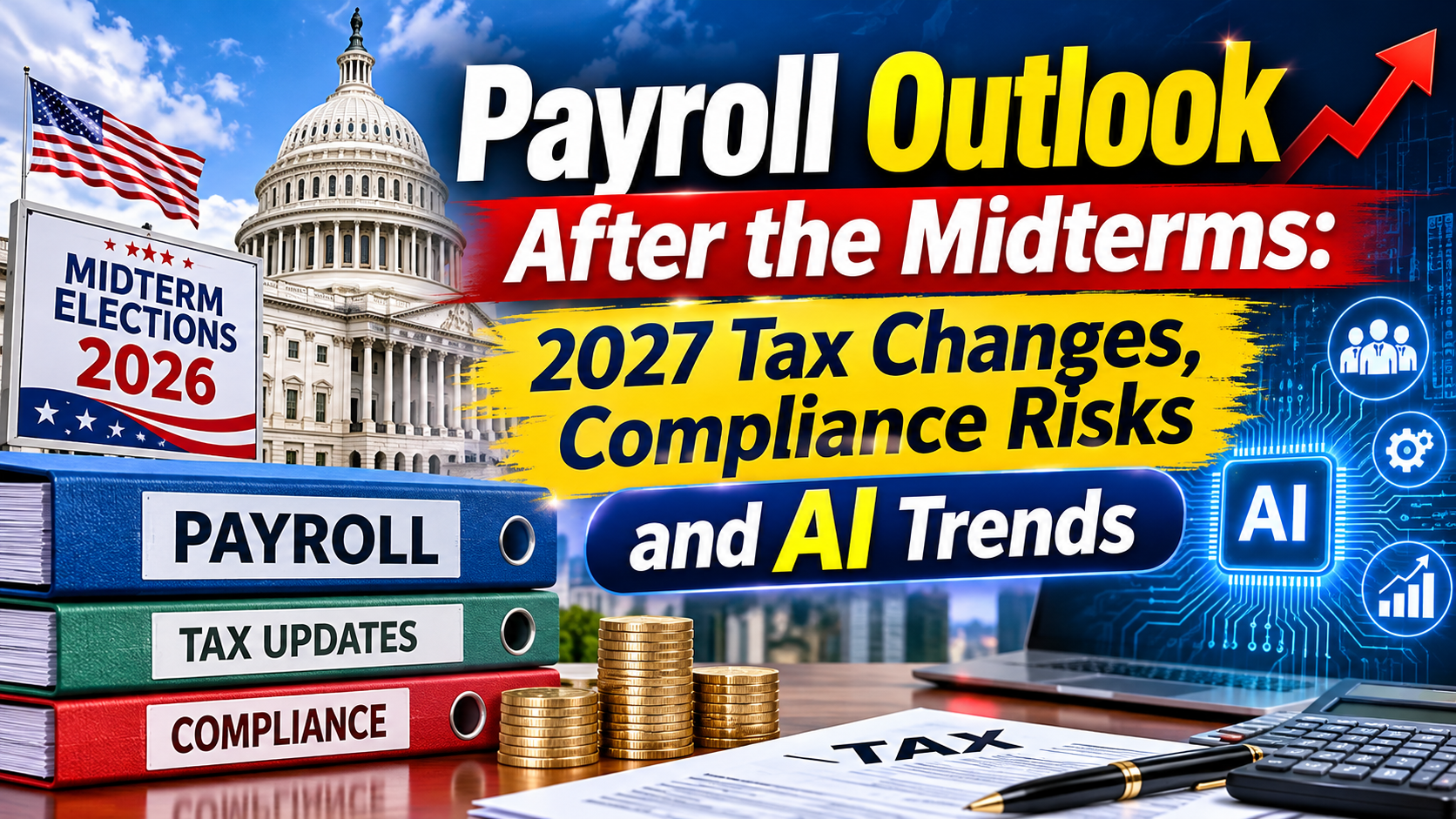
With the 2026 US midterm elections concluded, payroll departments are turning their attention to year-end processing and the possibility of late legislative changes that could alter 2027 withholding or reporting requirements. The IRS has already released inflation-adjusted figures for tax year 2027, but any lame-duck bill enacted with a 1 January effective date would compress the implementation window. Thomson Reuters Checkpoint
At the same time, industry surveys show continued acceleration in adopting AI and automation for payroll calculations, employee self-service, and compliance monitoring, along with growing interest in faster pay cycles such as weekly payroll.
Table of Contents
- What Are the Immediate Post-Election Priorities for Payroll Teams?
- Which 2027 Tax Adjustments Are Already Confirmed?
- Why Does Legislative Timing Create Implementation Risk?
- How Is Artificial Intelligence Changing Payroll Operations?
- What Is Happening with Faster Pay Cycles and Weekly Payroll?
- What Practical Steps Should Employers Take Now?
- How Should Organizations Prepare for Multi-State and Local Changes?
- Key Takeaways
- Frequently Asked Questions
What Are the Immediate Post-Election Priorities for Payroll Teams?
Monitor any tax legislation that emerges in the lame-duck session, finalise 2026 year-end reporting, load confirmed 2027 withholding tables, and prepare employee communications. Practitioners note that “timing is almost as important as the substance of the law” when changes arrive late in the calendar year. Thomson Reuters
Which 2027 Tax Adjustments Are Already Confirmed?
The IRS announced inflation adjustments for nearly 70 provisions. Illustrative standard-deduction amounts for 2027 include $33,200 for married couples filing jointly, $16,600 for single filers and $24,925 for heads of household. These figures flow directly into withholding calculations and Form W-4 processing and must be implemented for the first payroll of 2027. Thomson Reuters
Why Does Legislative Timing Create Implementation Risk?
Payroll systems, tax engines and year-beginning employee notices must be updated before the first 2027 pay date. A bill passed in December with a 1 January effective date leaves little room for testing and training, raising the probability of under- or over-withholding and subsequent corrections.
How Is Artificial Intelligence Changing Payroll Operations?
Industry research indicates that organisations are deploying AI for anomaly detection, predictive compliance, employee query handling and report generation. The technology is viewed both as a productivity tool and as a means of improving accuracy in multi-jurisdictional environments. Adoption continues to accelerate through 2026.
What Is Happening with Faster Pay Cycles and Weekly Payroll?
Search interest and employer adoption of weekly payroll and on-demand pay options continue to rise. Workers increasingly expect more frequent access to earned wages. Payroll teams must ensure that faster cycles remain compliant with tax-deposit schedules and reporting rules.
What Practical Steps Should Employers Take Now?
- Load the published 2027 IRS inflation adjustments into payroll systems.
- Establish a rapid-response protocol for any lame-duck legislation.
- Review state and local withholding changes effective 1 January.
- Audit AI and automation tools for accuracy and audit-trail capability.
- Communicate any material withholding changes to employees before the first 2027 payroll.
How Should Organizations Prepare for Multi-State and Local Changes?
Maintain updated tables for every jurisdiction in which employees work or reside, confirm reciprocity agreements, and test year-beginning payroll runs well before the first pay date of 2027.
2027 Standard Deduction Examples (IRS)
| Filing Status | 2027 Standard Deduction |
|---|---|
| Married filing jointly | $33,200 |
| Single | $16,600 |
| Head of household | $24,925 |
Key Takeaways
- Post-midterm focus shifts to 2027 implementation and year-end close.
- IRS inflation adjustments for 2027 are already published and must be loaded.
- Lame-duck legislation with short effective dates is the largest near-term risk.
- AI and automation adoption in payroll continues to accelerate.
- Weekly and faster-pay models are gaining traction.
- Proactive system updates and employee communication reduce compliance exposure.
Frequently Asked Questions
Do the midterm results immediately change federal payroll rules?
No. Existing law remains in force until new legislation is enacted and becomes effective.
When must the 2027 IRS adjustments be implemented?
In time for the first payroll of tax year 2027.
What is the biggest compliance danger right now?
Last-minute federal changes that alter withholding or reporting with a 1 January start date.
Is AI already handling core payroll calculations at most companies?
Adoption is growing rapidly but varies; many organisations still use AI mainly for ancillary tasks and exception handling.
Should employers delay updates until Congress adjourns?
No. Implement the known inflation adjustments now and retain flexibility for possible late changes.
Are weekly payroll cycles compliant with federal deposit rules?
Yes, provided deposit schedules and reporting are handled correctly by the payroll system.
Conclusion
Payroll professionals face a familiar but heightened post-election workload: absorb the already-published 2027 inflation adjustments while remaining ready for any surprise lame-duck provisions. For finance, HR and compliance audiences, the combination of legislative uncertainty and accelerating AI adoption makes disciplined change-management and testing essential. Organisations that prepare both their systems and their employee communications in advance will navigate the transition to 2027 with the least disruption.
Discover more from The Economy
Subscribe to get the latest posts sent to your email.

Open Banking Trends 2026: What Consumers Should Know

Nvidia After the Selloff: What to Watch Before Earnings

Black Friday 2026 Early Deals: A Data-Driven Shopping Guide

Fed Policy Path 2027: Rate Expectations After the Hold

Asia’s Economic Resilience in 2026: The Strategic Blueprint for Sustaining the Global Growth Engine

Credit Scoring Changes 2026: What Mortgage Buyers Need to Know

10-Year Treasury Yield Outlook for 2027 After the Democratic Sweep

Is the AI Infrastructure Boom Sustainable? A Reality Check

Disability Insurance Demand in 2026: Who’s Buying and Why

What the 2026 Midterms Mean for Treasury Yields and Bond Markets

Payroll Outlook After the Midterms: 2027 Tax Changes, Compliance Risks and AI Trends

Lisa Su: AMD Is Now a “Data Center First Company” – 2027 Outlook

Reasons for Falling US Gas Prices in November 2026: A Seasonal Shift

SoftBank’s $3.7 Billion Turbine Loss: What the AI Power Bet Reveals

Dow Jones Today: Dow Slips 237 Points After the Worst Day Since April 2025

US–Iran Conflict in October 2026: Hormuz, Oil Prices and Diplomacy

Pakistan IMF Programme 2026: Why Bailouts Keep Returning

SSI November 2026 Payment: Why Benefits Arrive October 30

Singapore Stock Market Outlook 2027: The STI’s Bank-and-Yield Test

2027 Federal Tax Brackets: New IRS Rates and Standard Deductions Explained

IMF Global Outlook 2027: The Recovery Is Real, but the Divide Is Growing

World Bank Debt Report 2026: The $9.4 Trillion Burden Behind the Recovery

Stock Market Crash 2026? What the November Rout Actually Tells Us

KSE-100 Index 2026: Is Pakistan’s Stock-Market Recovery Sustainable?

Germany–France ‘Made in Europe’ Deal Could Reshape China’s EV Ambitions

Zhuhai Airshow 2026: How China’s Stealth Jets, Drones and Missiles Are Redrawing Global Air Power

Global Markets Today: The AI Sell-Off Has Become a Test of Liquidity

Singapore’s Bank Sell-Off Is Really a Test of What Stability Is Worth
-

 Markets & Finance10 months ago
Top 15 Stocks for Investment in 2026 in PSX: Your Complete Guide to Pakistan’s Best Investment Opportunities
-

 Analysis9 months ago
Johor’s Investment Boom: The Hidden Costs Behind Malaysia’s Most Ambitious Economic Surge
-

 Analysis9 months ago
Top 10 Stocks for Investment in PSX for Quick Returns in 2026
-

 Banks10 months ago
Best Investments in Pakistan 2026: Top 10 Low-Price Shares and Long-Term Picks for the PSX
-

 Analysis9 months ago
Brazil’s Rare Earth Race: US, EU, and China Compete for Critical Minerals as Tensions Rise
-

 Investment10 months ago
Top 10 Mutual Fund Managers in Pakistan for Investment in 2026: A Comprehensive Guide for Optimal Returns
-

 Global Economy11 months ago
15 Most Lucrative Sectors for Investment in Pakistan: A 2025 Data-Driven Analysis
-

 Global Economy11 months ago
Pakistan’s Export Goldmine: 10 Game-Changing Markets Where Pakistani Businesses Are Winning Big in 2025