
IMF
Pakistan Moves From Stabilization to Recovery as IMF Review Puts Reform Momentum in Focus

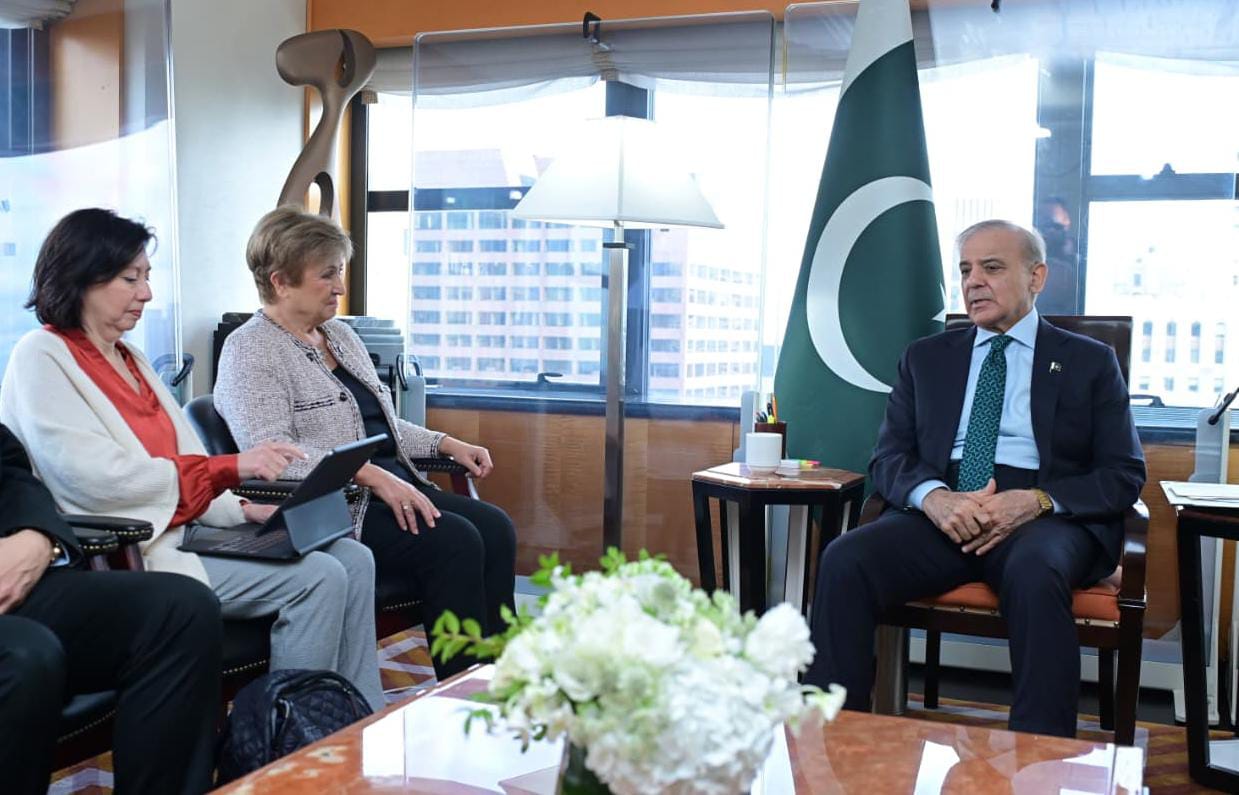
Pakistan is entering a new phase of its economic program, with Prime Minister Shehbaz Sharif saying the country is moving from macroeconomic stabilization toward recovery while reaffirming Islamabad’s commitment to IMF-backed reforms.
The statement came during Sharif’s meeting with International Monetary Fund Managing Director Kristalina Georgieva on the sidelines of the 81st United Nations General Assembly in New York.
The discussion comes at an important point for Pakistan’s economy. After a period dominated by efforts to restore fiscal and external stability, the government’s focus is increasingly shifting toward investment, productivity, exports and longer-term economic growth.

6
PM Shehbaz Sharif Reaffirms Pakistan’s Reform Commitment
According to the government and Radio Pakistan, Sharif told Georgieva that Pakistan was progressing from macroeconomic stabilization toward economic recovery despite regional conflict and external inflationary pressures.
The prime minister pointed to improvements in fiscal discipline, external buffers and investor confidence, while highlighting the National Tariff Regime, domestic revenue mobilization and privatization as important elements of the reform agenda.
Sharif also reiterated that Pakistan intends to remain committed to the IMF-supported reform program.
That commitment matters because the country’s recent economic stabilization has been closely connected to the IMF program and the government’s efforts to meet fiscal and structural targets.
IMF Says Stabilization Efforts Are Producing Results
The IMF’s own assessment provides important context to the government’s claims.
In its May 2026 review, the Fund said strong policy implementation had helped maintain economic stability and improve financing and external conditions. The IMF also approved approximately $1.1 billion under the Extended Fund Facility and about $220 million under the Resilience and Sustainability Facility, taking total disbursements under the two arrangements to about $4.8 billion.
The Fund identified several continuing priorities, including:
- strengthening public finances;
- broadening the tax base;
- improving competition and productivity;
- reforming state-owned enterprises;
- improving energy-sector viability;
- strengthening social protection;
- rebuilding foreign-exchange reserves; and
- improving public-service delivery.
This means Pakistan’s transition to recovery is not simply a question of higher GDP growth. The next phase depends heavily on whether stabilization measures can be converted into sustained productivity, investment and private-sector growth.
Pakistan’s Growth Has Improved, but the Recovery Remains Vulnerable
Pakistan recorded 3.7% GDP growth in FY2026, according to figures cited by the Finance Ministry and the Asian Development Bank. The ADB’s July 2026 outlook also puts Pakistan’s growth forecast at 3.7% for 2026 and 2027.
The ADB, however, has highlighted significant risks surrounding the outlook.
Its July forecast said Pakistan’s 2026 growth was being supported by the recovery in economic activity, but higher energy costs and pressure related to the Middle East conflict represented important downside risks. The ADB projects Pakistan’s inflation at 7.2% in 2026 and 8.3% in 2027.
That distinction is important.
Stabilization does not automatically mean a broad-based economic recovery. Pakistan still needs stronger investment, productivity and export performance to generate durable growth.
What Has Changed in Pakistan’s Economy?
Pakistan’s recent economic story has involved a combination of fiscal consolidation, monetary discipline, external financing and structural reforms.
The IMF reported that Pakistan’s reserves had increased, while fiscal performance remained strong. Its assessment also noted that the country’s economic recovery had gained momentum, although the Middle East conflict had complicated the near-term outlook.
The government’s current economic strategy is therefore moving beyond simply preventing another balance-of-payments crisis.
Finance Minister Muhammad Aurangzeb recently described the next stage as a move toward investment, capital formation, exports and private-sector-led growth. The government has identified macroeconomic stability, structural reforms, investment, exports and improved access to finance among its key priorities.
Why the IMF Review Matters
The upcoming IMF review is one of the most important tests for Pakistan’s reform program.
The IMF-supported Extended Fund Facility was approved in September 2024 and is designed to strengthen macroeconomic resilience while creating conditions for sustainable growth. The program includes fiscal reforms, reserve accumulation, tax-base expansion, SOE restructuring, energy-sector reforms and measures to improve competitiveness.
The forthcoming review will therefore provide an important assessment of whether Pakistan is continuing to meet the commitments associated with the program.
For financial markets and investors, successful implementation can influence perceptions of Pakistan’s external financing position and policy credibility. For households and businesses, however, the more important question is whether stabilization eventually translates into lower economic volatility, stronger investment and sustainable job creation.
Tariff and Revenue Reforms Could Reshape the Business Environment
The government’s National Tariff Regime is another significant component of the reform agenda.
The IMF’s latest Pakistan documentation says authorities are working to reduce tariffs and simplify non-tariff barriers while also pursuing broader regulatory reforms intended to reduce uncertainty and transaction costs for businesses.
The reform agenda also includes changes involving special economic zones and other fiscal incentives.
The objective is to gradually move away from policies that create distortions and toward a more competitive environment in which investment decisions depend more heavily on productivity and market conditions.
Privatization Remains Another Major Test
Privatization is also central to Pakistan’s structural-reform agenda.
The IMF has noted progress on the privatization agenda, including the agreement involving Pakistan International Airlines, while identifying additional SOE and electricity-distribution reforms as part of the broader program.
The government’s challenge will be to demonstrate that privatization and restructuring produce lasting improvements in efficiency rather than simply short-term fiscal relief.
External Financing Remains a Key Vulnerability
Pakistan’s recovery is also taking place against a complicated external backdrop.
Reuters reported in September that Pakistan was seeking an expansion of its 30 billion yuan currency swap arrangement with China when it comes up for renewal in 2027. Finance Minister Muhammad Aurangzeb also said Islamabad was awaiting a US decision concerning a proposed exchange-stabilization facility.
The report underscores an important reality: even as Pakistan’s macroeconomic indicators improve, the country continues to depend on external financing and bilateral and multilateral support to maintain reserves and meet debt obligations.
That makes continued reform implementation particularly important.
Energy Prices Could Complicate the Recovery
Higher energy costs represent another major challenge.
Reuters reported that Pakistan introduced austerity measures in September as rising fuel prices associated with the Gulf conflict increased pressure on the country’s economy. The measures included restrictions on official fuel use, government vehicle purchases and certain official expenditures.
The ADB has similarly warned that higher energy prices could increase inflationary pressure and weaken growth across the region, with Pakistan particularly exposed because of its external energy requirements.
This creates a difficult policy balance: authorities need to preserve fiscal and external stability while preventing higher energy costs from disproportionately affecting households and businesses.
What the Recovery Phase Means for Pakistan
The phrase “from stabilization to recovery” describes a shift in economic priorities.
The stabilization phase focused heavily on preventing external financing crises, controlling inflationary pressures, improving fiscal discipline and rebuilding reserves.
The recovery phase requires something broader:
more private investment + higher productivity + stronger exports + sustainable public finances + structural reform.
The ADB’s 2026–2030 country strategy for Pakistan similarly emphasizes private-sector development, inclusion, resilience and sustainability as key pathways toward longer-term growth.
That suggests the next stage of Pakistan’s economic story will be judged less by emergency stabilization and more by whether the country can turn improved macroeconomic conditions into sustained productive activity.
The Road Ahead
Pakistan has made measurable progress in restoring macroeconomic stability, and international institutions have acknowledged improvements in several areas.
But the economic recovery remains exposed to external shocks, particularly energy prices, geopolitical disruptions, financing conditions and inflation.
The government’s commitment to continued reforms therefore faces a critical test: whether stabilization can be maintained while investment, productivity, exports and private-sector activity expand.
For now, the latest meeting between Shehbaz Sharif and Kristalina Georgieva reinforces the government’s stated intention to remain on the reform path. The IMF review and the implementation of structural measures will provide more concrete evidence of how successfully Pakistan can turn stabilization into sustainable growth.
Key facts at a glance
| Indicator | Latest available information |
|---|---|
| FY2026 GDP growth | 3.7% |
| ADB 2026 Pakistan growth forecast | 3.7% |
| ADB 2027 Pakistan growth forecast | 3.7% |
| ADB 2026 inflation forecast | 7.2% |
| ADB 2027 inflation forecast | 8.3% |
| IMF EFF | 37-month program approved Sept. 2024 |
| IMF/RSF disbursements reported May 2026 | About $4.8 billion combined |
| Major reform areas | Taxation, SOEs, energy, tariffs, competition, reserves |
Sources:IMF
Discover more from The Economy
Subscribe to get the latest posts sent to your email.


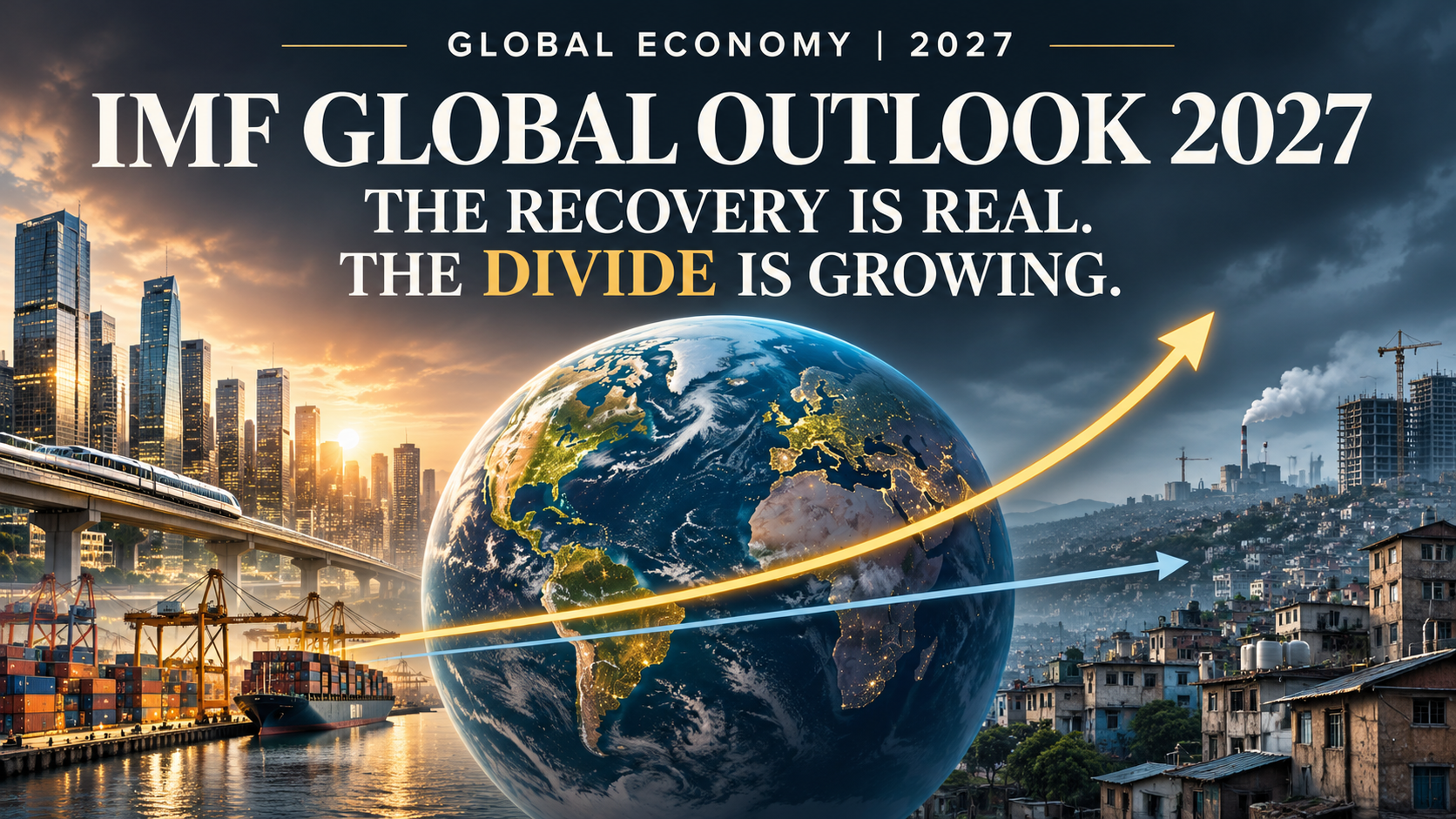
The IMF expects a modest rebound in 2027. Yet an energy shock and AI investment are distributing growth unevenly across countries and industries.
The IMF expects a modest rebound in 2027. Yet an energy shock and AI investment are distributing growth unevenly across countries and industries. This analysis draws on primary documents and contemporaneous reports available on November 6, 2026; subsequent market movements or policy announcements may change the outlook.
The IMF’s October 2026 World Economic Outlook forecasts global growth of 3.1% in 2026 and 3.4% in 2027, with headline inflation moderating from 4.7% to 4.1%. These figures are not a declaration that the world economy has fully recovered. The report, subtitled Resilience Under Strain, Urgent Choices, stresses geopolitical conflict, trade tension, stretched fiscal positions and the possibility of a change in investors’ expectations for AI.
One of its most important caveats is the underlying information cutoff: October 1, 2026. Subsequent market movements, including the November technology sell-off, should be assessed against—not silently folded into—that earlier baseline.
The two-speed world economy
AI-capital investment can sustain exports from economies integrated into advanced technology supply chains, while energy-importing countries outside those networks absorb higher bills. That distinction makes national growth forecasts more useful than one global average. Look at whether earnings are broadening across sectors, whether consumer demand is strengthening and whether investment is productive rather than merely speculative.
The IMF’s Asia-Pacific economic briefing forecasts regional growth of 4.8% in 2026 and 4.4% in 2027. A slowdown can still represent substantial economic expansion. But growth quality, distribution and fiscal headroom determine what households actually experience.
Inflation remains an economic constraint
Global inflation projected at 4.1% in 2027 would be lower than in 2026 yet still imply an increase in overall prices. Consumers care about cumulative food, rent and transport bills, not just whether an inflation percentage has fallen. Central banks must also distinguish one-off supply shocks from persistent wage-price dynamics.
The World Bank’s October commodity outlook projects an easing in broad commodity prices for 2027, but explicitly conditions that outlook on no major further conflict escalation. Policymakers should plan for both baseline normalization and a plausible renewed energy shock rather than assuming a smooth downward path.
The risk of an AI expectations reset
Massive AI investment contributes to GDP through construction, equipment orders and business spending. A correction in the expected profit from those investments can affect valuations immediately even if factories continue operating. If financing becomes harder, projects may be delayed and demand for chips, networking equipment and electricity infrastructure could soften.
The IMF explicitly includes a repricing of AI expectations among downside risks. That is not a prediction that AI will fail. It means that strong technology demand and vulnerable financial valuations can coexist. Investors should distinguish deployment and productivity metrics from the price paid for participating in the boom.
Policy choices are becoming harder
Governments want to support vulnerable households after energy and food shocks but cannot ignore rising interest costs. Broad subsidies can suppress immediate inflation while increasing fiscal pressure or discouraging adjustment. Narrowly targeted support may be cheaper but harder to administer.
A sensible 2027 policy agenda protects essential social spending, mobilizes investment with measurable returns and restores credible medium-term public finances. The key test is whether inflation declines without a severe employment shock, and whether productivity gains spread beyond the technology supply chain.
What a closer look at the source record shows
The available record supports a useful separation between confirmed developments and interpretation. The first column below identifies the type of evidence; the second explains the analytical use, not an independently measured market statistic.
| Research focus | How it informs this story |
|---|---|
| Confirmed evidence | IMF October 2026 World Economic Outlook |
| Interpretive opportunity | Translate forecast into household consequences |
| Secondary question | Date-source cutoffs |
| Next verification | Follow 2027 revisions, incoming inflation prints, oil inventories and credit markets. |
The research priority is relevance rather than sheer citation volume. Repeated references to the same press release do not represent independent confirmation, and authoritative data can support a narrower claim than an ambitious headline suggests. Wherever a numerical fact is used, the source date and stated coverage should travel with it.
How to interpret the evidence without overclaiming
Forecast vintages matter. A projection issued in October must not be quietly represented as knowledge of a market event in November. When comparing forecasts, preserve each report’s publication date and information cutoff. In this article’s subject—IMF global outlook 2027—that distinction prevents superficially precise figures from becoming misleading conclusions. A credible account should explain exactly which evidence supports each inference and what would change the analysis.
Growth is not the same as welfare. Higher output can coexist with falling affordability in some households or regions. Distribution, employment and access to public services matter when judging the quality of recovery. Follow 2027 revisions, incoming inflation prints, oil inventories and credit markets. These checks are important because individual data points can be correct while the story assembled from them is incomplete.
Three specific tests make the coverage stronger:
- Translate forecast into household consequences. Ask what the underlying observation actually measures, which population or companies it covers, and how recent it is. A relevant primary document outweighs a popular unsourced claim.
- Date-source cutoffs. Compare plausible explanations and resist attributing every market or policy movement to one event. When an observed change has several possible causes, explain which are supported and which remain hypotheses.
- Explain divergence between AI winners and importers. Describe what new fact would falsify the prevailing interpretation. Reporting that cannot be revised in the face of new evidence is advocacy, not analysis.
What could validate or derail the IMF baseline
Disinflation becomes broad-based. If oil and food pressures ease and central banks can reduce restrictive settings without destabilizing currencies, more countries may participate in the projected 2027 growth improvement. The strongest confirmation would be rising real household purchasing power and business investment outside the AI supply chain, not merely higher financial-asset prices.
AI and energy risks collide. A renewed disruption in shipping or oil production could sustain inflation just as markets reassess the profitability of massive technology investments. That combination would be harder than a conventional slowdown: authorities could face weak spending and elevated import costs simultaneously. The October IMF forecast explicitly warns about both classes of risk, but does not prescribe one inevitable sequence.
Recovery continues unevenly. The global average reaches something near the baseline while oil importers, indebted states and low-income households lag. That outcome matters for international institutions because a world growth figure can conceal worsening financing and development trade-offs. Country-level revisions, real wages and public debt-service burdens would be more useful tests than headline GDP alone.
A practical research checklist
A reader evaluating this issue should first open the primary sources linked in the article and check their publication dates. Next, identify the specific claim being tested, its units and its geographic or institutional scope. Then compare that evidence with at least one independent account, asking whether the sources are reporting the same underlying data or repeating one another. Finally, distinguish a dated observation from a prediction and note the developments that would demand an update.
For a working editorial desk, this sequence is equally important. A clearly dated article can remain valuable after prices or politics change if its explanations endure and its volatile numbers are identified as snapshots. An article that quietly presents yesterday’s quote as today’s fact, by contrast, loses credibility even when the broader argument is sensible.
A final distinction worth checking
For an editor, the IMF forecast should be paired with the date on which underlying information was available. October 1 is not November 6. If a November market disruption materially changes borrowing or investment assumptions, it is appropriate to discuss that development as a new risk, but not to claim it was already incorporated into the published forecast. Country-specific IMF tables provide a more precise starting point than a global average when evaluating household or corporate consequences.
Questions readers are asking
What is IMF world growth forecast for 2027?
The October 2026 IMF outlook projects 3.4% global growth in 2027.
What inflation does the IMF expect?
Global headline inflation is forecast at 4.1% for 2027, down from 4.7% in 2026.
What are key downside risks?
Conflict escalation, renewed trade tension, fiscal vulnerabilities and reassessment of AI investment expectations.
Is the IMF forecast updated daily?
No. The October outlook uses statistical information available through October 1, 2026; later developments require separate analysis.
The judgment
The IMF expects a modest rebound in 2027. Yet an energy shock and AI investment are distributing growth unevenly across countries and industries. The most responsible conclusion is conditional: Follow 2027 revisions, incoming inflation prints, oil inventories and credit markets. The argument should evolve when new source material is published, rather than being defended simply because it made a compelling headline on November 6. For readers, the value is a clearer distinction among what has already happened, what remains uncertain and what developments would actually change the decision.
Discover more from The Economy
Subscribe to get the latest posts sent to your email.
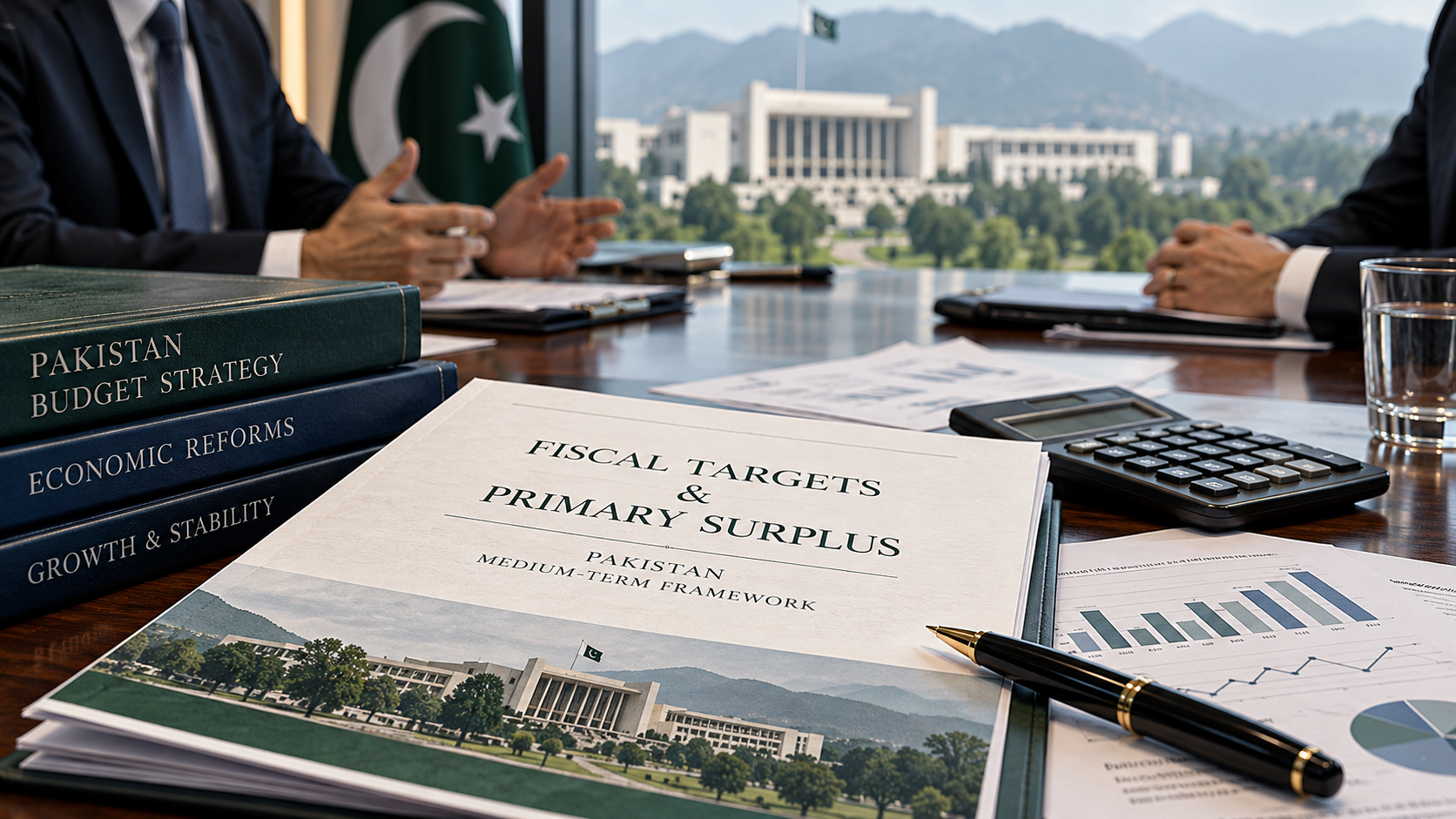
The IMF reached a staff-level agreement with Pakistan on 7 October 2026 that would release about US$1.2 billion once the Executive Board signs off. Staff-level deals are not final: the Board must still approve, and the amount is confirmed only in its press release.
According to Pakera’s summary of the IMF document, Pakistan committed to three things in return:
- A primary surplus of 2.0% of GDP in FY27.
- Health and education spending of 2.8% of GDP.
- Timely power tariff adjustments.
The same summary says the IMF wants the State Bank to maintain an appropriately tight stance so inflation returns durably to the SBP’s target range.
The Government’s Numbers Going In
Reporting by ProPakistani on the review talks (1 October) shows what Islamabad told the Fund. The economic team said the outlook remained stable and expressed confidence in reaching the government’s 4% growth target despite risks from the Middle East war. It projected inflation of around 7.5% for the fiscal year, expected to decline gradually after December, a current account deficit of $2.5 to $3 billion, exports near $34 billion and remittances of $45.5 billion. It named higher oil prices and supply chain disruption as key risks.
Those projections have since been tested. September inflation was 10.26%, and the SBP raised the policy rate to 12% on 26 October, citing the deteriorating inflation outlook from the US-Iran conflict. The 7.5% projection now looks ambitious unless oil eases.
The Exchange Rate Question
During the talks the two sides differed on the exchange rate: the government backed rupee stability while the IMF stressed a market-based rate. The IMF’s May country report had already described the exchange rate as the key shock absorber while the country faces its largest external shock since 2022-23. How much flexibility the agreement ultimately requires will matter for importers, remittance flows and inflation.
Why Social Spending Is in the Deal
Pairing a 2% primary surplus with a floor on health and education spending is a common feature of IMF programmes: it signals that fiscal consolidation should come through revenue and efficiency rather than cutting social lines. Delivering both depends on tax collection and on power-sector reforms, which is why timely tariff adjustments feature in the commitments.
Power Tariffs: The Politically Hard Part
Tariff adjustments on schedule mean consumers feel energy costs more quickly, at a time when inflation is already above 10%. The tension between the IMF’s fiscal conditions and household affordability is where implementation risk is highest.
What Happens Next
- IMF Executive Board approval and the official press release confirming the amount.
- SBP weekly reserves data after disbursement.
- Next SBP MPC meeting on 14 December, where the IMF has urged readiness to tighten further if inflation pressures intensify.
- Fuel and power price decisions over the winter as oil stays near $100.
Bottom Line
The agreement gives Pakistan breathing room, but it is a conditional lifeline in a harsher environment than the one assumed when the targets were set. Inflation, oil and exchange rate policy will decide whether the fiscal numbers hold.
Discover more from The Economy
Subscribe to get the latest posts sent to your email.
Understand Pakistan’s latest IMF review, Rs86.7 trillion public debt and the structural reforms required to avoid another bailout cycle. Read the analysis.
Key Takeaways
- IMF staff reached an agreement on Pakistan’s fourth EFF review and third RSF review on 7 October 2026, but said releases remained subject to Executive Board approval.
- The Finance Ministry reported Rs86.715 trillion in total public debt at end-June 2026, with a debt-to-GDP ratio of 68.3% on its broad measure; see the Annual Debt Review.
- A primary surplus can coexist with an overall budget deficit because interest payments remain large.
- Reducing repeated IMF dependence requires stronger exports, an affordable energy system, broad-based revenue and better debt management over multiple governments.
Pakistan’s latest IMF discussions are not simply about receiving another tranche. They concern why the country repeatedly needs external support when imports and debt payments strain available foreign currency. The Pakistan IMF programme 2026 reached a new milestone on 7 October, when Fund staff announced agreement on reviews under two facilities, subject to the Executive Board’s approval. The IMF’s statement provides the precise conditional status.
The scale of the long-term problem is visible in the debt numbers. At end-June 2026, total public debt stood at Rs86.715 trillion, the Finance Ministry’s Annual Debt Review reported. Debt-management progress can be real, yet a large stock and recurring external financing needs remain. This article explains how IMF programmes work, what they cannot fix alone, and what would have to change for Pakistan to depend on them less.
Has the IMF approved Pakistan’s October 2026 programme review?
As of the 7 October 2026 IMF announcement, staff had reached an agreement on the fourth EFF review and third RSF review, but approval by the IMF Executive Board was still required. Do not describe the associated potential financing as already disbursed without checking a subsequent Board decision.
What is the current Pakistan IMF programme 2026 status?
On 7 October 2026, IMF staff announced a staff-level agreement concerning the fourth review of Pakistan’s 37-month Extended Fund Facility (EFF) and the third review of a 28-month Resilience and Sustainability Facility (RSF). The IMF press release says approval could make approximately $1.0 billion under the EFF and around $210 million under the RSF available.
| IMF item | 7 October 2026 status | Practical meaning |
|---|---|---|
| EFF fourth review | Staff-level agreement | Not yet an approved disbursement |
| RSF third review | Staff-level agreement | Board decision still required |
| Potential EFF access | About $1.0bn | Conditional on approval |
| Potential RSF access | About $210m | Conditional on approval |
Some commentary casually calls this Pakistan’s ’25th IMF programme’. Counts of historical arrangements can vary with the start date and whether precautionary or emergency facilities are included. For current readers, the useful facts are the legal identity, duration, reviews and conditions of the existing EFF and RSF.
The IMF’s 8 May 2026 Board release confirmed completion of the preceding reviews, making a clear contrast with October’s still-conditional staff agreement. Conflating the two would falsely suggest that a future decision had already occurred.
How big is Pakistan’s public debt, and why does the definition matter?
The Ministry of Finance Annual Debt Review FY2026, published in September, places total public debt at Rs86,715 billion at end-June 2026, with Rs59,441 billion domestic and Rs27,274 billion external. The report gives a broad public-debt ratio of 68.3% of GDP. It separately cites a smaller amount under the fiscal-responsibility law’s definition.
| Stock at end-June 2026 | Amount | Broad classification |
|---|---|---|
| Domestic public debt | Rs59.441tn | Rupee liabilities |
| External public debt | Rs27.274tn | External obligations in rupee terms |
| Total public debt | Rs86.715tn | Finance Ministry headline series |
| Broad debt-to-GDP ratio | 68.3% | End-June 2026 |
Debt stock is not the same as annual debt-service payments. Nor can you divide the total by the population and claim each Pakistani personally owes that amount on demand. Government debt finances spending and refinancing obligations; its cost depends on interest rates, maturities and the exchange rate.
The report says interest expenditure fell in FY26, which is encouraging. Still, falling interest costs in one year do not remove refinancing risk or the burden of financing public services in later years.
Why does Pakistan turn to the IMF repeatedly?
A recurring pressure is the mismatch between the foreign currency earned through exports and other inflows and the currency needed for imports, debt servicing and private-sector payments. When external financing becomes scarce, exchange-rate pressure and reserve losses can become severe. IMF arrangements can provide financing and a framework for policy changes that encourage other creditors to keep supporting the country.
Domestic fiscal structure aggravates the problem. Weak and uneven tax collection leaves the state dependent on borrowing, while inefficient energy and state-owned enterprises can create costly commitments. Investment stays weak when firms cannot predict regulations, exchange-rate arrangements or electricity supply.
The World Bank’s 2026–35 Pakistan partnership framework argues that sustained reform and private investment are needed to overcome decades of volatile growth. That is a long-horizon diagnosis, not something a single IMF review can complete.
An IMF programme may help prevent a financing crisis. It does not automatically create export markets, make provincial tax systems consistent or change the incentives of every public institution.
What does the IMF mean by a primary surplus?
The primary fiscal balance excludes interest payments. A country can collect more revenue than it spends on programmes and administration but still borrow overall because debt servicing absorbs so much cash. The FY2026–27 budget book targets an underlying primary surplus of 2.0% of GDP and estimates a 3.6% overall fiscal deficit on the consolidated budget basis. These are different measures.
Imagine a public budget receiving Rs100, spending Rs95 on non-interest items and Rs20 in interest. The primary surplus is Rs5; the overall deficit is Rs15. That example is purely illustrative, but it captures the difference.
The IMF October 2026 statement supports a strong primary balance while also asking for better debt management and spending quality. Cutting useful maintenance or education merely to hit a near-term target can eventually damage growth and make future debt harder to repay. Good fiscal adjustment asks not only how much is spent but what taxpayers receive.
Are IMF conditions necessarily good or bad for households?
They involve trade-offs. A realistic electricity tariff can slow renewed arrears, but sharply higher bills impose immediate hardship. A flexible exchange rate protects reserves, but depreciation can increase import prices. Tighter monetary policy can protect the purchasing power of money, but raise borrowing costs for small businesses.
The 7 October IMF assessment calls for reducing energy-sector costs, preventing renewed circular debt, improving targeted social support and expanding human-capital spending. These objectives are not identical to indiscriminate austerity. How reforms are designed and who bears the cost determine their fairness.
Pakistan’s policy debate often presents a false choice between ‘accept every condition’ and ‘reject all reform’. Some reforms, like stopping electricity theft or improving procurement, would be worthwhile even without IMF involvement. Others require serious debate over distributional effects, implementation speed and constitutional responsibility.
What would a realistic exit strategy look like?
There is no credible one-year escape from a complex debt and competitiveness problem. A ten-year strategy would aim for sustained growth in higher-value exports, fewer unfunded electricity losses, transparent public debt issuance, a broader revenue base, stable regulation and better public education. The World Bank long-term country framework identifies productive private investment and human capital as central to Pakistan’s future.
Governments should publish measurable targets: export diversity, net energy-sector losses, tax collections sustained after appeal, debt maturities and learning outcomes. These indicators are harder to celebrate at rallies than a loan tranche, but they show whether the economy is becoming structurally more resilient.
The current IMF agreement supplies time and conditional financing. Success would mean using that time to reduce the need for exceptional financing, not merely to prepare for the next round of negotiations.
What This Means for You
Household: Track whether reforms change prices, wages and access to public services rather than interpreting a tranche as immediate economic prosperity. Use reliable inflation and budget data when assessing impact.
Business owner: Plan for exchange-rate, tariff and financing uncertainty. Build cash-flow buffers and review imported-input exposure before committing to long-term borrowing.
Exporter: Look for persistent reductions in administrative and energy costs. IMF approval can improve confidence, but export profitability depends on your business contracts and productivity.
Student: Understand debt stock, annual deficits, primary balances and foreign-exchange reserves as different concepts; mixing them produces misleading arguments.
What to Watch Next
- 26 October 2026: The State Bank monetary-policy decision and any revision to its inflation assessment; verify any schedule change with the SBP.
- Early November 2026, exact release date to be confirmed: Pakistan Bureau of Statistics October inflation and merchandise-trade releases.
- Late October–November 2026, date not yet confirmed: Any IMF Executive Board announcement on the October staff-level agreement; staff agreement is not Board approval.
- Throughout FY2026–27: Updated SBP monthly balance-of-payments and remittance statistics; compare cumulative results rather than one month alone.
Frequently Asked Questions
Has the IMF approved Pakistan’s October 2026 programme review?
As of the 7 October 2026 IMF announcement, staff had reached an agreement on the fourth EFF review and third RSF review, but approval by the IMF Executive Board was still required. Do not describe the associated potential financing as already disbursed without checking a subsequent Board decision.
How much was Pakistan’s public debt at June 2026?
The Finance Ministry’s Annual Debt Review reported total public debt of Rs86.715 trillion at end-June 2026, including Rs59.441 trillion of domestic debt and Rs27.274 trillion of external debt. Its broad debt-to-GDP measure was 68.3%, although legal definitions can produce different debt totals.
What is an IMF Extended Fund Facility?
An Extended Fund Facility is an IMF financing arrangement generally associated with longer-term policy adjustments to address structural balance-of-payments problems. Reviews assess agreed policy commitments. Financing remains subject to the applicable approval and programme terms.
What is a primary fiscal surplus?
A primary surplus exists when government revenue exceeds non-interest expenditure. It does not mean the overall budget is in surplus because interest on existing debt can still create a borrowing requirement. Both measures are needed to evaluate fiscal health.
Can Pakistan stop borrowing from the IMF?
It can reduce dependence over time by increasing foreign-exchange earnings, investment and reliable domestic revenues while managing energy costs and debt maturities. There is no guarantee or quick deadline. Reforms must last across business cycles and changes in government to make external financing shocks less dangerous.
The next IMF disbursement, if approved, will matter for financing and confidence. It will not answer the deeper question. Pakistan stops returning to crisis lending when its productive economy and public institutions can finance stability on their own.
Discover more from The Economy
Subscribe to get the latest posts sent to your email.

Personal Injury Lawyer Near Me in NYC: How to Find the Right Attorney After an Accident

Why Falling World Food Prices Do Not Always Lower Grocery Bills

Oil Shocks and Core Inflation: Why the Two Move Differently

Singapore Cannot Fight Financial Fraud by Making Victims Bear the Risk Alone

Singapore Banking’s Real Test: Beyond Profits, Who Will Safeguard Financial Trust?

Nvidia’s Share Price Is Not a Scorecard for Singapore’s AI Future

The Australian Dollar Is Not Asia’s Oracle. Singapore Should Listen Anyway

Singapore’s Bank Sell-Off Is Really a Test of What Stability Is Worth

Why a Weaker Currency Makes Imported Food More Expensive

How Oil Price Shocks Raise Food Prices in Importing Countries

Petrol and Diesel Prices in Pakistan Today: Complete Update for 9 November 2026

Wall Street’s Renminbi Paradox: Banks, Beijing and the Dollar

The Market Economy Is Winning

Bitcoin’s Dollar Trap: The Chart That Exposes the Future of Money

Stock Market Crash in 2026? Warning Signs, Scenarios and a Calm Investor Checklist

US–Iran Conflict in October 2026: Hormuz, Oil Prices and Diplomacy

Dow Jones Today: Dow Slips 237 Points After the Worst Day Since April 2025

China’s AI Microdrama Boom: How Beijing Is Reshaping Global Media

Pakistan IMF Programme 2026: Why Bailouts Keep Returning

SSI November 2026 Payment: Why Benefits Arrive October 30

US–China AI Export Controls in 2026: Chips, Testing Rules and Corporate Risk

2027 Federal Tax Brackets: New IRS Rates and Standard Deductions Explained

EU-China Trade Deal 2026: How Beijing and Brussels Avoided a Trade War—and Who Wins

Singapore Stock Market Outlook 2027: The STI’s Bank-and-Yield Test

Stock Market Crash 2026? What the November Rout Actually Tells Us

IMF Global Outlook 2027: The Recovery Is Real, but the Divide Is Growing

World Bank Debt Report 2026: The $9.4 Trillion Burden Behind the Recovery

KSE-100 Index 2026: Is Pakistan’s Stock-Market Recovery Sustainable?
-

 Markets & Finance10 months ago
Top 15 Stocks for Investment in 2026 in PSX: Your Complete Guide to Pakistan’s Best Investment Opportunities
-

 Analysis9 months ago
Johor’s Investment Boom: The Hidden Costs Behind Malaysia’s Most Ambitious Economic Surge
-

 Analysis9 months ago
Top 10 Stocks for Investment in PSX for Quick Returns in 2026
-

 Banks10 months ago
Best Investments in Pakistan 2026: Top 10 Low-Price Shares and Long-Term Picks for the PSX
-

 Analysis9 months ago
Brazil’s Rare Earth Race: US, EU, and China Compete for Critical Minerals as Tensions Rise
-

 Investment10 months ago
Top 10 Mutual Fund Managers in Pakistan for Investment in 2026: A Comprehensive Guide for Optimal Returns
-

 Global Economy11 months ago
15 Most Lucrative Sectors for Investment in Pakistan: A 2025 Data-Driven Analysis
-

 Global Economy11 months ago
Pakistan’s Export Goldmine: 10 Game-Changing Markets Where Pakistani Businesses Are Winning Big in 2025